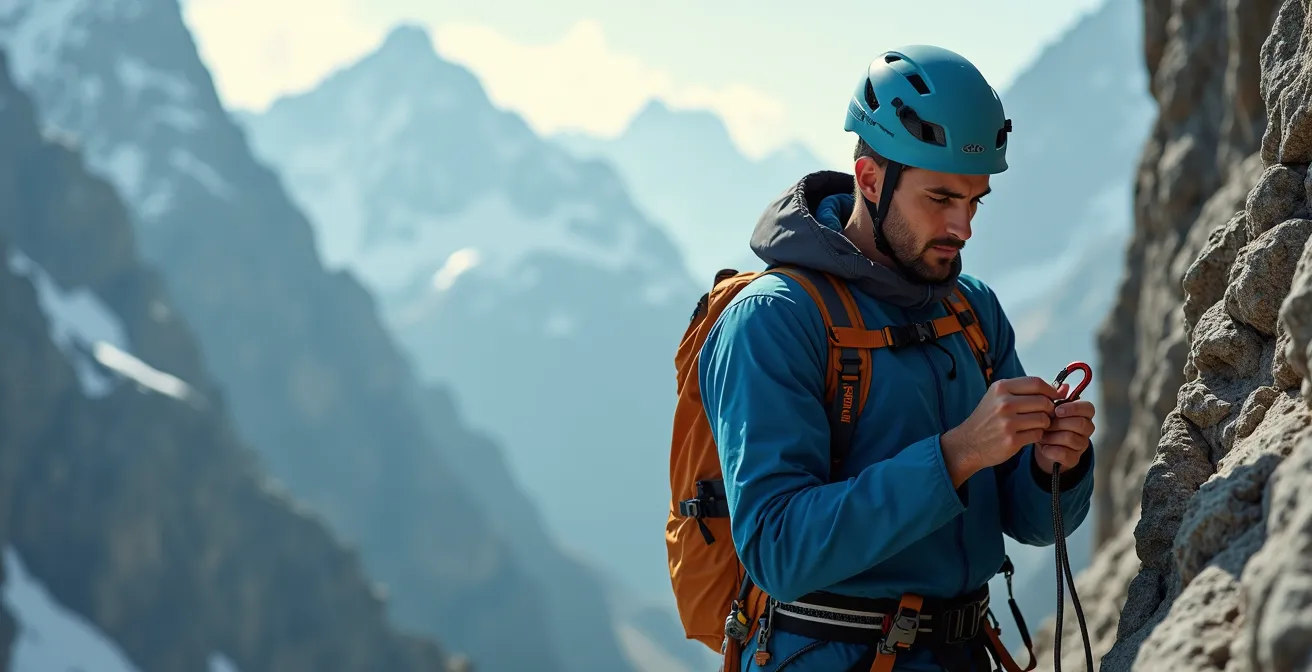
The greatest risk in adventure travel isn’t the activity itself, but choosing an operator with a flawed safety system.
- Effective safety assessment goes beyond surface checks; it requires inspecting an operator’s systemic approach to risk, training, and emergency protocols.
- Objective standards like UIAA gear ratings, guide certifications, and transparent acclimatization schedules are non-negotiable indicators of a professional operation.
Recommendation: Shift from being a passive tourist to an active inspector. Use the frameworks in this guide to deconstruct an operator’s safety culture before you commit your money and your well-being.
The allure of adventure tourism is the promise of pushing boundaries, of trading the predictable for the exhilarating. Whether it’s the vertical world of rock climbing or the raw power of a whitewater river, these experiences forge unforgettable memories. But the line between thrilling and tragic is often invisible. Many thrill-seekers simply trust the glossy brochures and positive online reviews, assuming that safety is a given. They might check if the equipment looks new or if the guide seems friendly, but this is a dangerously superficial approach.
The common advice to “check certifications” or “read reviews” barely scratches the surface. What do those certifications actually mean? How do you read between the lines of a five-star review to spot potential red flags? The truth is, a professional safety culture is a complex system, not a simple checklist. It encompasses everything from gear retirement policies to the psychological management of a group under pressure. Relying on gut feeling alone is an abdication of responsibility when your life is on the line.
This is where we must change our mindset. True adventure safety isn’t about avoiding risk, but about forensically deconstructing it. This guide treats safety assessment not as a passive exercise, but as an active investigation. It will equip you with the critical thinking of a safety inspector, enabling you to identify the systemic strengths or fatal flaws that an operator’s marketing will never reveal. We will move beyond the obvious and give you the tools to analyze everything from the subtle markings on a carabiner to the critical data hidden within a trek itinerary.
By learning to think like an inspector, you can transform fear into focus and uncertainty into confidence. This isn’t about eliminating risk—that would be to eliminate the adventure itself. It’s about making an informed choice to partner with an operator who manages that risk with the discipline and professionalism you deserve.
This guide provides a systematic framework for your assessment. We will explore the psychology of risk, the technical standards of equipment, the crucial decision between a guided and solo trip, and the hidden dangers in poorly planned itineraries, empowering you to book your next expedition with genuine, earned confidence.
Summary: Your Inspector’s Handbook for Adventure Safety
- Why Fear Freezes You but Adrenaline Sharpens Your Reflexes?
- How to Inspect Climbing Gear Ratings (UIAA) Before Trusting Your Life?
- Hiring a Guide or Going Solo: Which Is Safer for Your Skill Level?
- The Acclimatization Mistake That Ends 30% of Himalayan Treks
- How to Train for a Multi-Day Kayak Trip 3 Months in Advance?
- Why Your Brain Performs Better When Prefrontal Activity Decreases?
- The Volume Trap That Leads to Chronic Fatigue Syndrome
- Booking Apps: How to Use Algorithms to Find Hidden Travel Deals?
Why Fear Freezes You but Adrenaline Sharpens Your Reflexes?
In a high-stakes environment, the line between a paralyzing fear response and a sharp, focused state of “flow” is managed by your brain. Fear, when uncontrolled, can trigger a “freeze” response, hindering decision-making when you need it most. Adrenaline, however, is a performance-enhancing tool when channeled correctly. It heightens your senses, speeds up reaction times, and can unlock physical capabilities you didn’t know you had. The key difference lies in proactive mental preparation and having a framework to process stress.
A competent operator understands this dynamic. Their briefings and training are not just about technical skills; they are about building your mental toolkit. They teach you to convert the raw energy of fear into heightened awareness. This is what separates amateurs from professionals. A professional guide’s calm demeanor under pressure is a direct result of ingrained protocols that reduce cognitive load, allowing them to observe, orient, decide, and act (the OODA loop) effectively while a client might be panicking.
Case Study: The Avalanche at Massey’s Ice Climbing Site
The tragic avalanche incident on March 11, 2019, is a stark reminder that even the highest qualifications are not infallible. Despite being led by an IFMGA-certified guide with decades of experience, a fatality occurred. This incident highlights a critical lesson: technical expertise and proper equipment are necessary but insufficient. The management of group psychology and individual fear responses is an equally vital component of a systemic safety approach. It proves that safety isn’t just about what’s on your harness; it’s about what’s in your head and how the team manages pressure collectively.
Before any trip, ask an operator how they prepare clients for the mental challenges of the activity. Do they discuss breathing techniques? Do they have clear, simple emergency commands? An operator who dismisses these questions is showing you a critical flaw in their safety system. True safety integrates the human factor as seriously as the equipment.
Understanding this psychological dimension is the first step in your inspection. It provides the context for why the technical details that follow are so critically important.
How to Inspect Climbing Gear Ratings (UIAA) Before Trusting Your Life?
Your life literally hangs on the integrity of your equipment. But simply seeing a rack of shiny, new gear isn’t enough. A professional inspector looks for proof of standards, not just appearance. For climbing and mountaineering equipment, the gold standard is the UIAA Safety Label. The Union Internationale des Associations d’Alpinisme (International Climbing and Mountaineering Federation) sets the most rigorous safety standards in the world for everything from ropes to carabiners to helmets.
When you assess an operator’s gear, your first question should be, “Is your equipment UIAA certified?” Don’t be afraid to ask to see the markings. A legitimate operator will be proud to show you. The UIAA label is your assurance that the gear has undergone extreme testing for strength, durability, and performance under load. It’s a non-negotiable baseline for safety. Any operator using non-certified or, even worse, counterfeit gear is not cutting corners—they are creating a catastrophic liability.
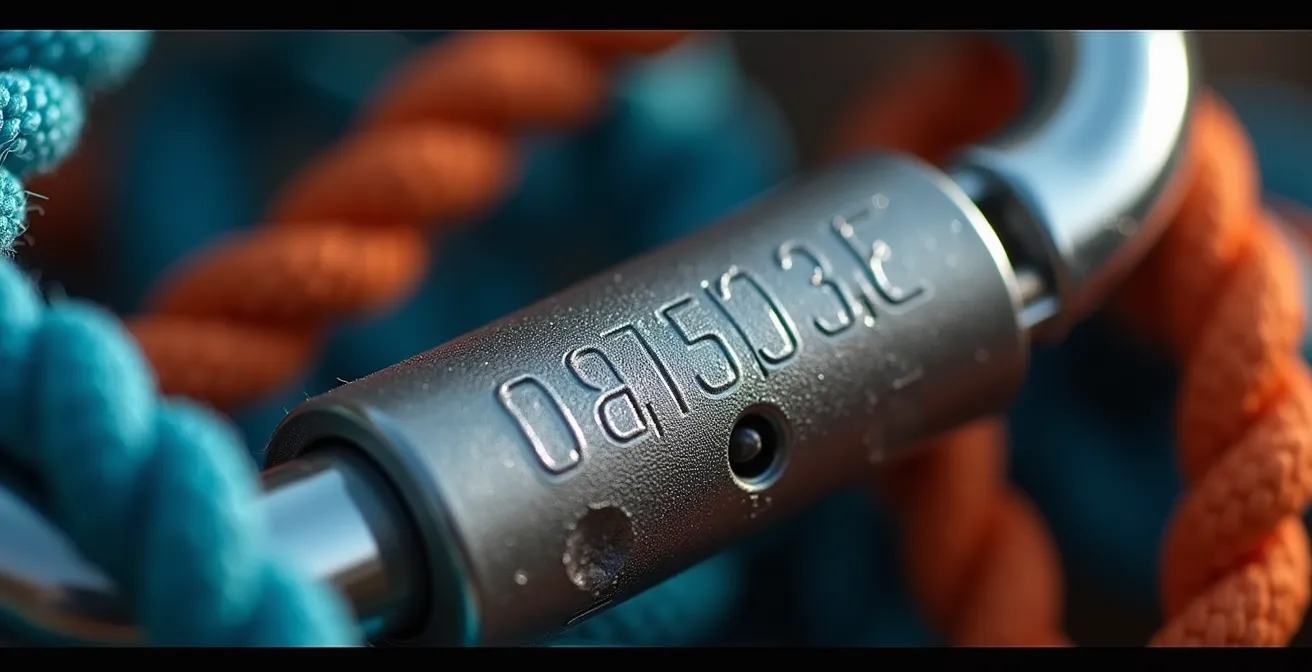
Beyond certification, an inspector’s eye looks for a systematic approach to gear management. Ask about their gear retirement policy. How often are “soft goods” like ropes and harnesses retired? (This should be based on a combination of age and usage, not just visible wear.) How do they track the history of each piece of “hard goods” like carabiners and belay devices? A logbook or digital tracking system is a sign of a highly professional operation. A vague answer like “we replace it when it looks old” is a major red flag.
Finally, perform your own visual inspection. Look for excessive wear on carabiners where the rope runs, any fraying or discoloration on harnesses and ropes, and ensure helmet shells are free of cracks or significant dents. This hands-on check, combined with verification of UIAA certification and a clear retirement policy, completes your equipment inspection.
This level of scrutiny moves you from a passive user to an informed participant, actively verifying the safety chain you are about to become a part of.
Hiring a Guide or Going Solo: Which Is Safer for Your Skill Level?
The decision to hire a professional guide or embark on a solo or unguided trip is one of the most critical safety choices you’ll make. It’s not a matter of ego, but of an honest and objective assessment of the competence-to-challenge ratio. A guide’s primary role is to bridge the gap between your current skills and the objective hazards of the environment. Their local knowledge, emergency response training, and experience are safety multipliers you cannot replicate with a GPS and a first-aid kit.
Statistically, the risks are demonstrably different. While all travel has risks, research shows a significant gap between guided and non-guided activities in high-risk environments. For example, some data suggests extreme adventure activities can have a mortality rate as high as 0.14 deaths per 100,000 participants, compared to 0.03 in traditional tourism. A professional guide is the single most effective tool for mitigating this elevated risk. Their presence drastically improves emergency response times and ensures decisions are made based on years of experience, not guesswork.
To make an informed choice, you must honestly evaluate your own capabilities against the demands of the planned trip. The following matrix, based on key safety factors, provides a framework for this critical decision.
This decision matrix helps quantify the safety benefits a guide provides, as highlighted in a recent comparative analysis of safety factors in adventure travel.
| Safety Factor | Guided Trip Score | Solo Trip Score | Key Questions to Ask |
|---|---|---|---|
| Emergency Response | High (9/10) | Low (3/10) | What’s the evacuation protocol? |
| Local Knowledge | High (10/10) | Variable (2-7/10) | How long has guide worked this area? |
| Equipment Backup | High (8/10) | Low (4/10) | What backup gear is carried? |
| Medical Training | Moderate-High (7/10) | Personal dependent | Does guide have WFR certification? |
| Cost Factor | Higher cost | Lower cost | Does price reflect safety investment? |
Choosing to go solo is not inherently wrong, but it means you are personally accepting 100% of the responsibility for every one of these factors. If you cannot confidently score yourself high in each category, hiring a certified guide isn’t a luxury; it’s a fundamental safety requirement.
The Acclimatization Mistake That Ends 30% of Himalayan Treks
At high altitudes, the most significant danger isn’t a fall or a wild animal; it’s the air itself. Or rather, the lack of it. Acute Mountain Sickness (AMS) is a debilitating and potentially fatal condition caused by ascending too quickly. The single biggest mistake an operator can make—and one you must inspect for—is an aggressive itinerary that ignores the non-negotiable rules of acclimatization. Your body needs time to adapt to lower oxygen levels, and this biological process cannot be rushed.
The data is clear and unforgiving. A 2023 study in Nepal’s Mustang district found a 58% AMS incidence with rapid ascent profiles, compared to just 33% with slower, more conservative schedules. This means an operator’s itinerary is a direct predictor of your health and success. An itinerary that prioritizes speed over safety is not “efficient”; it’s dangerous. Many treks, estimated as high as 30% in some regions, fail not because of a lack of fitness, but because of preventable, debilitating altitude sickness.
As a safety inspector, the itinerary is a key piece of evidence. You must scrutinize it for these red flags, based on guidelines from high-altitude medical experts:
- No Acclimatization Days: An itinerary without scheduled rest days (or “active rest” days with minimal ascent) above 9,000 ft (approx. 2,750m) is a serious warning sign.
- Excessive Daily Ascent: A common rule of thumb is to not increase your sleeping altitude by more than 1,650 ft (500m) per day, once above 9,000 ft.
- Rapid Initial Ascent: Flying from sea level directly to a starting point over 8,000 ft (2,400m) without at least one full day of rest is courting disaster.
- No Contingency Days: A professional itinerary includes buffer days to account for weather, illness, or slower-than-expected acclimatization. A rigid, packed schedule is a sign of an amateur operation.
- Operator Indifference: If the operator doesn’t ask about your previous high-altitude experience during the booking process, they are not tailoring their approach to individual risk factors.
Do not be tempted by a shorter, cheaper trip that cuts these corners. Paying for extra days at altitude isn’t a luxury; it’s an investment in your health and your ability to actually reach the summit and return safely.
How to Train for a Multi-Day Kayak Trip 3 Months in Advance?
Arriving unprepared for a physically demanding trip is a primary safety risk. For an activity like a multi-day sea or river kayak expedition, fitness is not just about comfort; it’s about having the endurance and strength to handle unexpected conditions like strong headwinds or currents, and to perform a self-rescue when you are fatigued. Your training is the first and most important piece of safety equipment you bring. An operator should provide training guidelines, but the responsibility to prepare falls squarely on you.
A comprehensive training plan, starting at least three months out, should be built on four distinct pillars. It’s not just about paddling. You must develop functional core strength, master critical safety drills, and achieve total competency with your gear. This holistic approach ensures you have the physical reserves and muscle memory to act effectively when things go wrong.

Your preparation is a direct reflection of your respect for the environment and the risks involved. Mastering a wet exit or a T-rescue in the calm water of a pool or lake is infinitely easier than attempting it for the first time in cold, choppy water when you are tired and panicked. An inspector’s mindset means treating your training with the same seriousness as a pilot practices in a flight simulator. You must build the instinctive reactions that will save your life.
A solid training program should include these key elements:
- Endurance: Gradually build your time on the water, aiming to paddle for 2-3 hours continuously without a break to simulate a long day.
- Functional Core Strength: Kayaking power comes from your core. Focus on rotational exercises (like Russian twists), planks, and back extensions to build a strong, stable torso.
- Safety Drills: Practice wet exits (getting out of a flipped kayak), T-rescues (rescuing another paddler), and self-rescues (like the paddle float) until they are second nature.
- Gear Competency: You should be able to attach your spray skirt, operate your bilge pump, and access your safety gear with your eyes closed.
- Communication: In a group setting, clear communication is vital. Learn and practice essential hand signals and emergency whistle protocols before you leave.
When you ask an operator about their trip’s physical demands, a professional will respond with a detailed description of daily distances and expected conditions, not a vague “you should be in good shape.”
Why Your Brain Performs Better When Prefrontal Activity Decreases?
The coveted “flow state,” where athletes and adventurers perform at their peak with seemingly effortless focus, has a fascinating neurological basis. This state of high performance is often associated with a phenomenon called transient hypofrontality—a temporary decrease in activity in the prefrontal cortex. This part of the brain is responsible for complex planning, self-consciousness, and analytical thought. By quietening it down, the brain can focus all its resources on the task at hand, leading to faster reactions, heightened creativity, and an almost automatic execution of complex skills.
From a safety perspective, this is a double-edged sword. While flow state enhances performance, the reduction in analytical oversight can be dangerous if not managed within a structured safety system. A professional adventure operator’s role is to create an environment where guides and clients can achieve this performance state safely. They do this by offloading the brain’s analytical burden onto systematic safety protocols. When a guide doesn’t have to consciously think about every safety check because it’s an ingrained, automatic process, more of their cognitive capacity is free to monitor the environment, the client, and their own performance.
Case Study: ISO 21101 Safety Management Implementation
The international standard ISO 21101:2014 provides a framework for adventure tourism operators to manage safety and performance simultaneously. It mandates a systematic approach to everything from planning to emergency response. Companies that implement this standard often report improved guide performance and client safety. By creating robust, repeatable procedures, they reduce the guide’s cognitive overload, allowing them to maintain the calm, focused demeanor essential for managing group dynamics and achieving a safe group flow state.
As the Tamara Camera Blog Research Team notes, this systematic approach is the bedrock of modern adventure safety. In their “Adventure Tourism Safety Mastery Report,” they state:
A systematic safety approach works best in adventure tourism. Risk assessment, work procedures, backup plans, incident documentation, and follow-up analysis are key components.
– Tamara Camera Blog Research Team, Adventure Tourism Safety Mastery Report
When vetting an operator, ask about their safety management system. The use of terms like “procedures,” “documentation,” and “analysis” indicates a mature operation that understands how to build the foundation for safe, peak performance.
The Volume Trap That Leads to Chronic Fatigue Syndrome
In adventure travel, there’s a pervasive “more is better” mentality. Longer days, higher peaks, and more miles are often seen as badges of honor. This is the “volume trap,” and it’s a direct path to overexertion, injury, and in extreme cases, a state of chronic fatigue. Cumulative fatigue is an insidious risk factor. It degrades your physical performance, impairs judgment, and weakens your immune system, making you more susceptible to everything from a simple cold to severe altitude sickness. An itinerary that doesn’t strategically manage energy expenditure is fundamentally unsafe.
Research confirms that the intensity and volume of activity are directly correlated with injury rates. For instance, New Zealand adventure tourism research reveals that the highest injury rates are found in activities like cycle tours and white-water rafting, where the risk of falls is compounded by long durations and high physical output. A responsible operator doesn’t just plan a route from A to B; they meticulously calculate the total physical load on a client over the entire duration of the trip.
This includes factoring in not just daily distance, but also elevation gain, technical difficulty, and the cumulative effect of consecutive hard days. A professional guide will be constantly assessing the group’s energy levels and be willing to modify the itinerary, even if it means not reaching a specific objective. Their priority is the group’s well-being, not ticking a box. An operator who is inflexible or pressures the group to “push through” is demonstrating a dangerous lack of professionalism.
Before booking any multi-day trip, especially a trek, you must conduct your own fatigue assessment of the proposed itinerary. This checklist provides a framework for deconstructing the “volume trap.”
Your Action Plan: Cumulative Fatigue Assessment
- Points of Contact: Calculate the total daily elevation gain and mileage for every single day of the trek.
- Collect Data: Inventory the number of consecutive days without a scheduled rest or acclimatization day.
- Assess Coherence: Confront the itinerary with reality. Does it include “penalty points” for technically difficult sections or known challenging conditions?
- Identify Gaps: Ask the operator about their guide rotation schedule. Fatigued guides make poor decisions. A good company manages their staff’s fatigue as carefully as their clients’.
- Develop an Action Plan: If your assessment reveals a dangerously packed schedule, request a modified, more conservative itinerary or find a different operator.
This analytical approach to the trip’s physical demands is a core tenet of thinking like a safety inspector, protecting you from an operator’s overly ambitious planning.
Key Takeaways
- True safety assessment requires an investigative mindset, focusing on an operator’s systemic protocols, not just surface appearances.
- Objective, verifiable standards like UIAA gear certification and medically sound acclimatization schedules are non-negotiable indicators of professionalism.
- Your own physical and mental preparation is a critical component of the safety system; you are an active participant, not a passive passenger.
How to Use Booking Apps to Find More Than Just a Good Deal?
In the digital age, booking apps and online travel agencies (OTAs) are the primary gateways to adventure. While their algorithms are designed to surface the best prices and most popular trips, they can also be powerful tools for a safety inspector—if you know how to use them. The key is to look beyond the star ratings and leverage the vast amount of user-generated data to find clues about an operator’s safety culture and transparency.
A high number of positive reviews is a good start, but it’s not enough. You must dig deeper. Use the search function within the reviews for specific keywords that relate to safety. Searching for terms like “safety,” “protocol,” “emergency,” “rescue,” and “guide” will filter the noise and bring you to the comments that matter. A review that says, “The guide conducted a thorough safety briefing every morning” is infinitely more valuable than one that just says, “Great trip!” Conversely, a review mentioning a disorganized response to a minor incident is a significant red flag.
Industry-wide initiatives are also making this easier. For example, a pioneering move in accountability was made with a new self-assessment tool. The South Africa’s Tourism Services Association launched a free online tool that helps operators evaluate their own procedures against established safety protocols. This initiative creates a benchmark for transparency, allowing travelers to verify an operator’s commitment to safety before booking. Look for operators who voluntarily participate in such programs or mention compliance with national safety directives, as it signals a culture of proactive accountability.
Your search strategy on these platforms should be methodical:
- Keyword Search: As mentioned, search reviews for “safety,” “emergency,” “protocol,” and “guide.”
- Filter for Solo Travelers: Trips rated highly by solo travelers often correlate with better safety standards, as guides must be more attentive.
- Compare Durations: For the same route (e.g., Kilimanjaro’s Lemosho Route), compare trip lengths across different operators. A significantly shorter trip often means a dangerously fast, unsafe acclimatization schedule.
- Look for Certifications: Check operator descriptions for mentions of certifications like ISO 21101, or compliance with government mandates, which indicates a higher level of professionalism.
Your next great adventure begins not on the trail, but with the diligence you apply today. Start applying these inspection principles to your research and book with the confidence that comes from genuine insight, ensuring your focus remains on the experience, not on questioning your safety.