Arts/Culture
The world of arts and culture has transformed dramatically in recent years, evolving from traditional gallery spaces and patron-artist relationships into a complex ecosystem where technology, economics, and creativity intersect. Whether you’re a collector considering your first acquisition, a museum professional rethinking visitor engagement, or an artist navigating new revenue streams, understanding this landscape has never been more crucial.
This comprehensive exploration examines the foundational elements shaping contemporary arts and culture: how artworks are valued and traded, how institutions create meaningful experiences, how creative professionals build sustainable careers, and how design trends emerge and evolve. By understanding these interconnected systems, you’ll gain the confidence to participate meaningfully in the cultural sphere that resonates with you.
The Art Market: Investment, Valuation, and Acquisition
The art market operates at the fascinating intersection of aesthetic appreciation and financial investment, where emotional response meets economic calculation. Understanding how this market functions empowers both collectors and creators to make informed decisions that balance cultural value with practical considerations.
How Artworks Acquire Their Value
Art valuation is far from arbitrary. Multiple psychological and economic factors converge to establish an artwork’s worth. Provenance—the documented history of ownership—can dramatically influence value, as works with prestigious previous owners or exhibition histories command premium prices. Similarly, an artist’s career trajectory, critical reception, and institutional recognition all contribute to perceived value.
The psychology behind valuation reveals fascinating patterns. Collectors often respond to scarcity, uniqueness, and the narrative surrounding a work. A painting’s value isn’t merely about technical skill; it’s about the story it tells, the moment it captures, and the cultural conversation it enters. Think of it like vintage wine: the liquid itself is only part of the equation—the year, the vineyard, the bottle’s history all contribute to its worth.
Blue-Chip Versus Emerging Artists
Collectors face a fundamental choice between established and emerging artists, each carrying distinct risk profiles. Blue-chip artists—those with proven market track records and institutional validation—offer relative stability but require substantial capital and offer limited appreciation potential. They’re the “safe bet” of the art world.
Emerging artists present the opposite proposition: lower entry costs with higher uncertainty. Supporting emerging talent can yield significant returns if an artist’s career ascends, but many never achieve market breakthrough. Savvy collectors often maintain a balanced portfolio, much like financial investing, spreading risk across different career stages and artistic movements.
Authentication and Acquisition Strategies
The secondary market—where artworks change hands after initial sale—requires careful navigation. Authentication processes become critical when purchasing previously owned works. Reputable dealers provide detailed provenance documentation, condition reports, and expert verification. For significant acquisitions, engaging independent appraisers adds another layer of security.
Online art purchasing has democratized access but introduced new risks. Without physical inspection, buyers cannot fully assess condition, scale, or the subtle qualities that make artworks compelling in person. If buying remotely, consider these protective measures:
- Request detailed condition reports with high-resolution images from multiple angles
- Verify the seller’s reputation through independent reviews and industry associations
- Ensure clear return policies and shipping insurance coverage
- For significant purchases, arrange professional inspection before finalizing
Tax Considerations and Strategic Donations
Art ownership carries tax implications that informed collectors leverage strategically. Donating artworks to qualified institutions can provide substantial tax benefits while supporting cultural preservation. The donated work’s fair market value typically becomes deductible, though specific regulations vary by jurisdiction and require professional appraisal documentation.
Strategic donors often time contributions to years with higher income, maximizing deduction impact. However, the primary motivation should remain cultural contribution—tax benefits represent a welcome secondary advantage rather than the driving force behind meaningful patronage.
Museum and Gallery Experiences in the Modern Age
Cultural institutions face unprecedented challenges in capturing and maintaining audience attention. Modern museums must balance educational missions with engaging presentation, preserving scholarly rigor while creating experiences that resonate with diverse, digitally-native audiences.
Creating Immersive and Engaging Exhibitions
The most successful contemporary exhibitions transcend passive viewing, creating immersive environments that actively involve visitors. This doesn’t necessarily mean elaborate technology—sometimes the most powerful immersion comes from thoughtful spatial design, strategic lighting, or carefully curated soundscapes that transport viewers into the artwork’s world.
However, technology offers remarkable opportunities. Augmented reality (AR) layers can provide contextual information without cluttering physical spaces, allowing visitors to access deeper content at their own pace. Imagine pointing a device at a historical painting and watching the scene animate, or seeing the artist’s preliminary sketches overlaid on the finished work. These tools enhance rather than replace the primary encounter with art itself.
The Psychology of Visitor Flow
How people move through galleries profoundly impacts their experience. Research reveals consistent patterns: visitors tend to turn right upon entering spaces, tire after approximately ninety minutes, and remember artworks encountered at beginnings and endings more vividly than those in the middle—a phenomenon psychologists call the serial position effect.
Thoughtful curators design exhibition flow acknowledging these patterns. They strategically position highlight works, create rest points for contemplation, and vary pacing between dense and sparse hanging to prevent visual fatigue. The physical experience becomes as carefully composed as the artistic content itself.
Thematic Versus Chronological Organization
Curators face a fundamental structural choice: organizing exhibitions chronologically by creation date or thematically by subject matter, technique, or concept. Chronological arrangements clearly demonstrate artistic evolution and historical context, making them particularly effective for monographic shows or period surveys.
Thematic curation, conversely, reveals unexpected connections across time periods and geographies. Grouping works by concept—such as representations of nature, explorations of identity, or investigations of light—allows dialogue between ancient and contemporary pieces, challenging visitors to see familiar works through fresh perspectives. The most engaging exhibitions often blend both approaches strategically.
Accessibility Without Oversimplification
Museums constantly navigate the tension between accessibility and scholarly depth. The valid concern about “dumbing down” content must be balanced against the reality that jargon-heavy presentations exclude potential audiences. The solution lies not in reducing intellectual rigor but in clearer communication.
Effective interpretation provides multiple entry points: concise labels for casual visitors, deeper content for enthusiasts, and specialized resources for scholars. Digital platforms particularly enable this layered approach, letting each visitor choose their engagement level. Accessibility means removing barriers to understanding, not lowering the ceiling of available knowledge.
Building a Sustainable Career as a Creative Professional
The romantic notion of the struggling artist has given way to recognition that creative professionals deserve sustainable livelihoods. Modern artists navigate a dramatically changed landscape where traditional gallery representation represents just one of many possible paths to viability.
Navigating Digital Platforms and the Gig Economy
The creator economy has democratized access to audiences while introducing new challenges. Digital platforms promise direct artist-to-audience relationships, eliminating intermediaries and their associated commissions. However, platform algorithms determine visibility in ways often opaque to creators themselves.
Success on these platforms requires understanding their unique dynamics. Consistent output, strategic use of trending formats, and authentic audience engagement all influence algorithmic promotion. Yet artists must resist allowing platform demands to completely dictate their creative direction—the most sustainable careers balance algorithmic awareness with artistic integrity.
Diversifying Revenue Streams
Financial sustainability increasingly requires multiple income sources. Smart creative professionals develop diversified revenue models that might include:
- Direct sales of original works through galleries or personal channels
- Licensing arrangements allowing commercial use of existing work
- Commission-based custom projects for individual or corporate clients
- Print-on-demand products generating passive income from popular designs
- Educational offerings such as workshops, courses, or mentorship programs
Each revenue stream carries different time investments, profit margins, and scalability potential. The key lies in finding combinations that leverage existing work efficiently while preserving energy for new creative exploration.
Pricing Strategy and Portfolio Optimization
Underpricing remains one of the most common errors among emerging creative professionals. While competitive pricing matters, systematically undervaluing work creates unsustainable precedents and signals lack of confidence. Pricing should reflect not just materials and time, but also expertise, conceptual development, and market positioning.
Your portfolio serves as your primary sales tool, and strategic curation makes enormous difference. Rather than showcasing every project ever completed, curate selectively to demonstrate range within a coherent aesthetic vision. Potential clients should immediately grasp both your distinctive style and your ability to address their specific needs. Think of your portfolio as a gallery exhibition of your own work—every piece should earn its place.
The NFT Revolution and Digital Ownership
Non-fungible tokens (NFTs) have introduced new possibilities for digital artists to monetize work that previously had limited market value. By establishing verifiable ownership and scarcity for digital files, NFTs create collector markets for purely digital art. However, the technology remains volatile, environmentally controversial, and subject to speculative bubbles.
Compared to traditional print-on-demand models, NFTs offer higher potential returns but significantly greater complexity and risk. Print-on-demand provides steady, modest income with minimal upfront investment, while NFT success requires understanding blockchain technology, crypto markets, and a collector base that remains relatively niche. Most artists find room for both approaches depending on their work and audience.
Understanding and Navigating Design Trends
Design trends shape visual culture across disciplines from architecture to digital interfaces, following cyclical patterns influenced by technological change, socioeconomic conditions, and collective cultural mood. Understanding these patterns helps creative professionals make strategic decisions about when to embrace, resist, or transcend trending aesthetics.
The Cyclical Nature of Visual Trends
Design trends rarely emerge from nowhere; they typically represent reactions against prevailing aesthetics or revivals of earlier movements viewed through contemporary lenses. The recent prominence of minimalism, for instance, partially reflects socioeconomic factors—economic uncertainty often drives preference for simplicity, while prosperity tends to favor ornamental excess.
These cycles typically follow predictable arcs: emergence among innovators, adoption by early enthusiasts, mainstream saturation, and eventual rejection as the next counter-trend emerges. Understanding where a particular trend sits within this lifecycle helps creative professionals make informed adoption decisions.
Timeless Design Versus Trendy Aesthetics
Creative professionals face a strategic choice: pursue trend-forward work that captures immediate attention but risks rapid obsolescence, or develop timeless approaches with enduring appeal but potentially slower initial traction. Neither path is inherently superior—the optimal choice depends on your goals and market.
Commercial work often benefits from trend awareness, as clients seek contemporary aesthetics that signal cultural currency. Personal artistic work, conversely, may prioritize timeless qualities that sustain relevance across changing fashions. Many successful professionals maintain distinct approaches for different contexts, adapting their aesthetic decisions to each project’s specific requirements.
The Risk of Global Homogenization
Digital connectivity has produced unprecedented aesthetic cross-pollination, but also concerning “sameness” in global design. Instagram-driven trends particularly create remarkable visual uniformity, as algorithms promote similar content and creators mimic successful formulas. The result can be a flattening of regional distinctiveness and individual voice.
Resisting this homogenization requires intentionality. Drawing from local cultural traditions, personal history, and non-digital inspiration sources helps develop distinctive visual languages. The most memorable work typically balances awareness of contemporary aesthetics with elements that reflect unique perspective and context.
Applying Trend Forecasting to Creative Work
Professional trend forecasting analyzes cultural signals—from runway fashion to political movements—to anticipate aesthetic shifts before they reach mainstream awareness. While elaborate forecasting services exist for corporate clients, individual creatives can develop their own forecasting practice through systematic cultural observation.
Pay attention to early adopters in adjacent creative fields, emerging technologies that might influence visual possibilities, and social movements that could shift collective values. The goal isn’t slavish trend following but strategic awareness that informs timing decisions—knowing when to lean into an emerging aesthetic and when to deliberately position against prevailing trends.
The contemporary arts and culture landscape offers unprecedented opportunities for engagement, whether as collector, institution, creator, or informed enthusiast. By understanding market dynamics, exhibition strategies, career-building approaches, and trend cycles, you can participate more meaningfully in the cultural conversations that shape our shared visual world. Each aspect we’ve explored connects to the others—market forces influence what institutions show, which affects what artists create, which responds to and generates design trends. Your journey into any of these areas enriches your understanding of them all.

Why Are Contemporary Aesthetics Returning to Maximalism After a Decade of Minimalism?
The return to maximalism is not a simple pendulum swing of taste, but a deliberate cultural and economic corrective to a decade of perceived digital sameness and aesthetic austerity. Minimalism, often triggered by economic uncertainty, created a “sea of sameness”…
Read more
Visual Artists and the Gig Economy: How to Stabilize Income Streams?
True income stability for artists comes from acting like the CEO of your own creative enterprise, not just a gig worker. Shift focus from chasing one-off projects to building a portfolio of strategic income assets. Implement a “value ladder” pricing…
Read more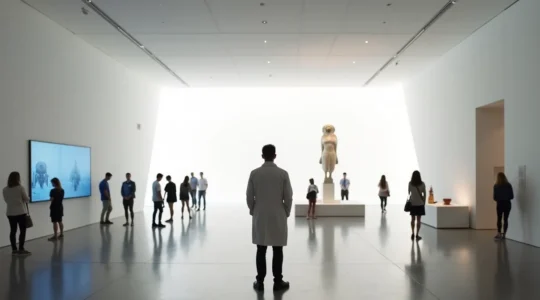
The New Curatorial Mandate: From Object-Focus to Experience-First
The transition to experience-first curation isn’t about adding digital gadgets; it’s about fundamentally redesigning visitor engagement around cognitive and narrative principles. Successful exhibits guide attention by strategically countering innate cognitive biases like the “right-turn” tendency. Layering digital stories over physical…
Read more
Fine Art Investing: A Strategist’s Guide to Spotting Undervalued Masterpieces
True art investment success hinges on rigorous financial analysis and forensic due diligence, not merely aesthetic preference. Structural value is quantifiable: elements like signature, condition, and provenance are critical data points that directly impact an artwork’s financial standing. Market inefficiencies,…
Read more