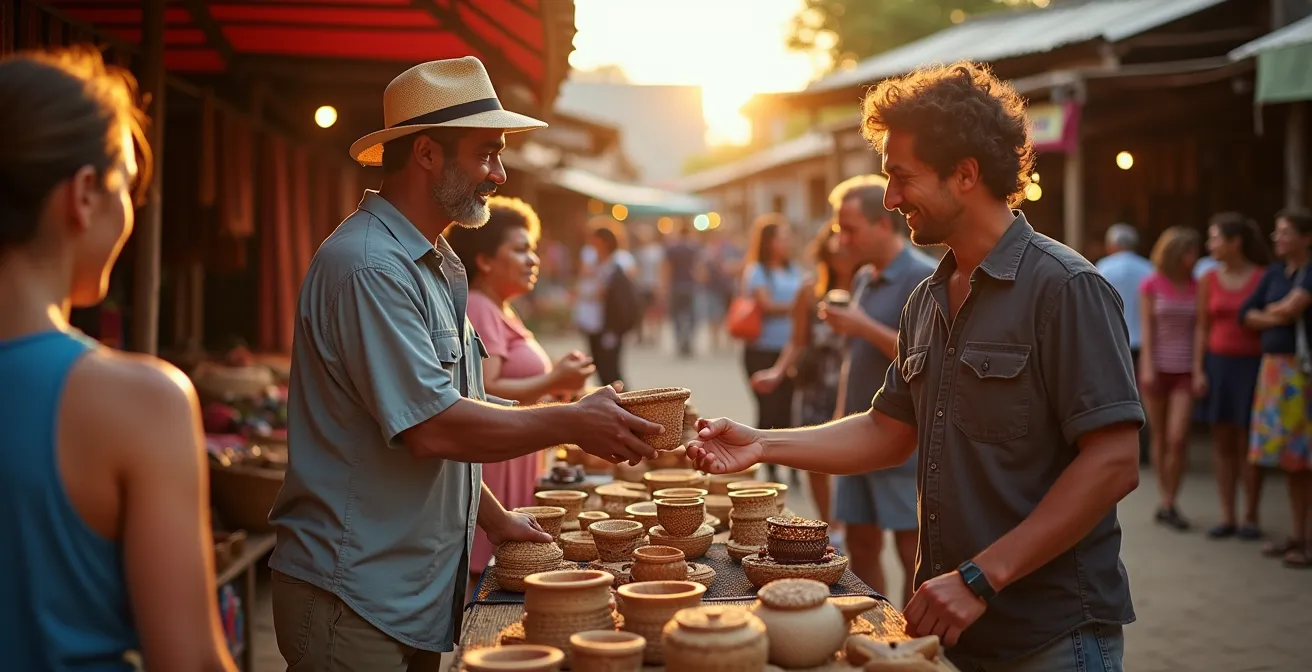
The biggest mistake responsible travelers make is focusing on *what* they buy, not *where* their money ultimately flows after the transaction.
- Most tourism revenue “leaks” out of local economies, especially through all-inclusive resorts and their global supply chains.
- True economic impact comes from supporting cooperative-owned businesses, prioritizing community skill-building over unskilled “voluntourism,” and traveling in the shoulder season to stabilize incomes.
Recommendation: Think like an economist on your next trip: trace the path of your dollar to diagnose financial leaks and ensure your spending directly empowers the communities you visit.
You stand in a vibrant market, the scent of spices and grilled food in the air, holding a handcrafted souvenir. You pay the vendor, feeling good about supporting a local artist. But have you ever stopped to ask where that money truly ends up? Does it pay for their child’s education, or is it siphoned away to pay for imported materials and a foreign-owned supply chain? For the responsible traveler, this question is no longer a fleeting thought but a central challenge. The common advice—”eat local,” “shop local”—is a starting point, but it barely scratches the surface of a complex system.
The hidden saboteur of well-intentioned tourism is a concept development economists call “economic leakage.” It’s the process by which revenue generated by tourism is lost to other countries’ economies. This happens when resorts import food, hire foreign managers, or use international construction companies. Your vacation spending, meant to enrich the destination, flows back out, leaving the local community with little more than low-wage jobs and strained infrastructure. To truly make a difference, we must move beyond superficial gestures.
This guide reframes the challenge. Instead of a simple checklist, we will adopt the mindset of a development economist. We will explore the concept of economic plumbing—understanding the intricate system of financial pipes, valves, and pumps that determine where your money flows. The goal is no longer just to spend, but to consciously direct that spending into the pipelines that lead directly to local households, cooperative businesses, and community-led initiatives. This article will equip you with the diagnostic tools to spot leaks and the strategic knowledge to ensure your tourist dollars become a powerful, sustainable force for local prosperity.
To navigate this complex economic landscape, this article breaks down the essential strategies. We will examine the core problems, from the structural flaws of mass-market tourism to the unintended consequences of our own actions, and provide concrete, actionable solutions to make your travels genuinely beneficial.
Summary: How to Ensure Your Tourist Dollars Benefit Locals?
- Why All-Inclusive Resorts Contribute Little to the Local Economy?
- How to Find Hotels Owned by Local Cooperatives?
- Painting Schools or Teaching Skills: Which Actually Helps?
- The Tipping Error That Disrupts Local Wage Structures
- When to Visit: Supporting Shoulder Seasons to Stabilize Local Incomes
- Why Last-Mile Delivery Fails in Developing Urban Centers?
- How to Trace Raw Materials Back to the Source to Ensure Fair Labor?
- Fair-Trade Tourism: How to Spot Hotels That Treat Staff Fairly?
Why All-Inclusive Resorts Contribute Little to the Local Economy?
The all-inclusive resort is the most visible symbol of tourism’s economic plumbing gone wrong. Marketed as a hassle-free paradise, its business model is engineered for maximum financial extraction, creating significant economic leakage that starves the surrounding community of revenue. These establishments often function as self-contained economic islands, where nearly every dollar a tourist spends is captured and retained by the parent corporation, which is frequently foreign-owned. The very design encourages guests to never leave the property, effectively cutting off local restaurants, taxi drivers, and independent tour operators from the tourism revenue stream.
The leakage is not accidental; it is structural. Most large resorts rely on global supply chains for everything from food and beverages to furniture and management staff. This means the breakfast buffet features imported cereal brands instead of local fruits, and key leadership positions are filled by expatriates rather than qualified locals. According to a UNWTO report, this model is so pervasive that in tourism-dependent regions like the Caribbean, it is estimated that as much as 80% of tourism revenue leaks out of the local economy. In Bali, a stark contrast is seen between hotel types: foreign-owned 4- and 5-star resorts experience a 51% leakage rate, while locally owned, non-star-rated hotels see a leakage of only 8.8%.
To identify these leaks as a traveler, you can observe a few key indicators:
- Imported Products: Notice if the food, drinks, and even the toiletries are international brands rather than locally sourced products.
- Lack of Local Leadership: Check if the hotel’s executive team includes local managers or if all senior roles are held by foreigners.
- Insular Transportation: Pre-arranged airport transfers that bypass local taxi services are a red flag, designed to keep the money “in-house.”
- Discouragement of Off-Site Exploration: The package’s all-inclusive nature is the clearest sign that the model’s goal is to prevent your money from reaching the wider community.
By choosing alternatives and spending money outside these self-contained bubbles, travelers can begin to redirect the flow of capital back into the hands of the people who make the destination unique.
How to Find Hotels Owned by Local Cooperatives?
Moving away from leaky economic models requires actively seeking out accommodations that are built on a foundation of community ownership. Hotels owned by local cooperatives represent one of the most powerful “pipelines” for directing tourist dollars straight into the heart of a community. Unlike a privately owned hotel where profits consolidate at the top, a cooperative structure ensures that financial benefits are distributed among its members—the staff, local suppliers, and the wider community. This model inherently fosters local leadership and decision-making, ensuring that the development driven by tourism aligns with the community’s own values and needs.
Finding these gems requires a bit of “digital sleuthing” before your trip, as they are often less visible on major booking platforms dominated by large chains. Your goal is to look past the glossy marketing and find evidence of genuine local roots and shared ownership. This proactive research is the first step in rerouting your financial impact.
Here are some practical steps to identify and verify locally or cooperatively owned hotels:
- Examine the ‘About Us’ Page: Genuine local ownership often comes with a story. Look for personal family histories, connections to the village, or explicit mentions of a cooperative structure. Vague claims like “community-focused” without specific examples are a red flag.
- Search Business Registries: A quick search of the hotel’s name in local or national business registries can reveal its ownership structure. Locally owned properties are typically registered in their home jurisdiction, not in an offshore tax haven.
- Look for Certifications: Many community-based tourism organizations and cooperatives display membership badges or certifications on their websites. These serve as a third-party endorsement of their model.
- Ask Direct Questions: Don’t hesitate to email the hotel directly. Ask pointed questions like, “Is your hotel part of a community-owned initiative?” and “How are profits and benefits shared with staff and the wider community?” A transparent and proud owner will be happy to answer.
Case Study: The Andros Ecotourism Collective
A prime example of this model’s success is the Andros Ecotourism Collective in The Bahamas. In partnership with the Ministry of Tourism and the Caribbean Tourism Organization, a cooperative was established to highlight the island’s unique culture and natural assets. Through targeted training in areas like digital marketing, over 100 local businesses were empowered to refine their offerings and connect directly with global travelers, ensuring the economic benefits of tourism were retained and distributed within the Andros community.
This conscious choice sends a powerful market signal that travelers value authentic, equitable, and sustainable tourism models over extractive ones.
Painting Schools or Teaching Skills: Which Actually Helps?
The desire to “give back” during travels has fueled the rise of voluntourism, but from a development economics perspective, not all help is helpful. A critical error many well-intentioned travelers make is engaging in activities that provide a feeling of accomplishment but offer little to no long-term value to the community—and can sometimes be harmful. The classic example is a group of unskilled foreign volunteers painting a school. While the short-term result is a colorful wall and a feel-good photo opportunity, this act inadvertently takes a paid job away from a local painter who could have supported their family with that income. It creates a cycle of dependency, teaching a community to wait for free foreign labor rather than developing its own local economy.
True contribution lies not in performing unskilled labor, but in capacity building. This means focusing on the transfer of valuable, marketable skills that empower individuals to generate their own sustainable income long after the tourists have gone home. Instead of painting a wall, consider supporting programs that teach digital marketing skills to local artisans, offer language training to aspiring tour guides, or provide financial literacy workshops for small business owners. These initiatives create a ripple effect, building a resilient local workforce and fostering self-sufficiency.
This illustration captures the essence of genuine capacity building: a local educator, empowered with knowledge, sharing valuable digital skills with members of their own community in a natural, collaborative learning environment.

As the image suggests, sustainable development is about fostering local talent and creating systems where knowledge is passed on within the community itself. The goal is to make foreign assistance obsolete by building a strong local foundation.
This table, based on principles of sustainable tourism, clarifies the stark difference in outcomes between various types of voluntourism activities, as analyzed by travel experts at Nomadasaurus.
| Activity Type | Short-term Impact | Long-term Benefits | Dependency Risk |
|---|---|---|---|
| Painting/Building (Unskilled Labor) | Visible infrastructure improvement | Minimal – takes jobs from local painters | High – creates expectation of foreign help |
| Teaching Marketable Skills | Less immediately visible | Sustainable income generation | Low – builds local capacity |
| Train-the-Trainer Programs | Slow initial progress | Exponential knowledge transfer | Very Low – empowers local leaders |
Choosing to support programs focused on education and empowerment is a far more impactful investment in a community’s future than any temporary, cosmetic fix.
The Tipping Error That Disrupts Local Wage Structures
Tipping is one of the most culturally nuanced and economically sensitive actions a traveler can take. While often intended as a gesture of gratitude and a way to directly supplement a worker’s income, improper tipping can have the unintended consequence of disrupting local wage structures and creating economic distortions. In many cultures, particularly outside of North America, service charges are already included in the bill, and wages are set with the expectation that tipping is not a primary source of income. When tourists from tipping-heavy cultures arrive and leave excessively large tips, it can create a host of problems.
From an economic standpoint, this influx of cash can create a “two-tier” economy within the tourism sector. Staff in front-facing roles that receive tips (like waiters and tour guides) may end up earning significantly more than equally vital but non-tipped staff (like cooks, cleaners, and maintenance workers). This disparity can breed resentment and devalue essential behind-the-scenes labor. Furthermore, it can lead to an over-reliance on tourist generosity, making workers vulnerable to the volatility of seasonal tourism and creating an unstable income model. In some extreme cases, employers might even lower base wages, assuming that foreign tips will make up the difference.
The key is not to stop tipping altogether, but to tip intelligently and in a way that respects local norms. Before you travel, research the tipping culture of your destination. Is it expected? Is a service charge already included? If tipping is appropriate, a modest amount (e.g., rounding up the bill or leaving 5-10%) is often sufficient to show appreciation without causing economic disruption. The goal is to reward good service, not to single-handedly alter a worker’s income bracket. This mindful approach to gratuity is a small but significant part of responsible economic engagement, preventing your generosity from becoming a source of imbalance. It’s another valve in the economic plumbing that requires careful adjustment. This problem is a microcosm of the larger issue where tourist money fails to distribute evenly, such as in cruise tourism where only $0.10 of every dollar spent by passengers in Alaska stays in the local economy.
Ultimately, advocating for and choosing establishments that pay a fair, living wage to all their employees is a more sustainable solution than relying on the randomness of tipping.
When to Visit: Supporting Shoulder Seasons to Stabilize Local Incomes
One of the most powerful yet overlooked tools a traveler has for positive economic impact is timing. The decision of *when* to visit a destination can be as important as *where* you spend your money. Most destinations experience a “peak season” of high demand and an “off-season” of low demand, which creates a boom-and-bust cycle for local economies. Businesses and workers face immense pressure during the peak, only to struggle with little to no income during the off-season, often leading to seasonal layoffs and financial instability. By choosing to travel during the “shoulder seasons”—the periods just before or after the peak—you can help smooth out this cycle and provide a more stable, year-round source of income for the community.
Traveling during the shoulder season is a win-win scenario. For the traveler, it offers a more authentic and enjoyable experience. You can explore landmarks without the usual throngs of tourists, interact more genuinely with locals who are not overwhelmed, and often benefit from better rates on accommodations and activities. This quieter time allows for a deeper connection with the place and its people, turning a simple vacation into a more meaningful cultural exchange.
For the local economy, the benefits are profound. Your spending provides a crucial revenue stream during a traditionally slow period, allowing businesses to retain staff and invest in their operations year-round. It also reduces the strain on local infrastructure, as water, waste management, and energy systems can operate within their intended capacity rather than being pushed to their breaking point. Supporting the shoulder season is a strategic choice to promote economic stability and sustainability.
The advantages of this approach extend beyond just economics:
- Support Year-Round Employment: Your visit helps hotels, restaurants, and tour operators keep staff on the payroll instead of implementing seasonal layoffs.
- Authentic Cultural Interactions: With fewer crowds, locals have more time and energy for genuine conversations and exchanges.
- Reduced Environmental Strain: Spreading out the tourist load lessens the environmental impact on sensitive ecosystems and local resources.
- Better Value and Availability: Accommodations and tours often offer competitive prices and unique experiences to attract visitors during these times.
This image of a quiet coastal town evokes the peaceful and authentic atmosphere of shoulder-season travel, where local life continues at its natural pace, welcoming visitors without the stress of the peak-season rush.

This simple shift in timing is a powerful lever for promoting a more balanced and sustainable tourism industry worldwide.
Why Last-Mile Delivery Fails in Developing Urban Centers?
The call to “buy local” is a cornerstone of sustainable tourism, but it often runs into a logistical wall: the “last-mile delivery” problem. In many developing urban centers, the infrastructure that tourists from developed nations take for granted—standardized addresses, reliable postal services, and ubiquitous courier companies—simply doesn’t exist. This creates a significant barrier between rural producers or artisans and the urban hotels where potential buyers are staying. A tourist might love to buy a hand-woven basket directly from a village cooperative, but getting that basket from the village to their hotel can be an insurmountable challenge.
This failure of last-mile logistics reinforces economic leakage. Large hotel chains, prioritizing efficiency and reliability, circumvent this problem by relying on their established global supply chains. As noted in an analysis of Costa Rican tourism, these resorts have global relationships with suppliers that can service all their needs in any location. It’s more cost-effective and streamlined for them to import goods in bulk than to navigate the complexities of sourcing from numerous small, local producers. This means that even if local companies wanted the business, the existing relationships and unfavorable unit economics make it nearly impossible for them to compete.
However, this challenge has also spurred incredible local innovation. In the absence of formal systems, informal networks and gig-economy solutions have emerged. Local motorcycle or bicycle courier services, often coordinated via mobile messaging apps, have become the lifeblood of commerce, using landmarks and real-time communication to navigate cities without formal addresses. Similarly, some cooperatives have established their own “click-and-collect” hubs in cities, creating a central point where tourists can pick up products ordered from a network of rural producers. Supporting these grassroots logistical solutions is a direct way to invest in the local economy’s resilience and ingenuity.
As a traveler, seeking out and using these local delivery solutions or cooperative hubs is a powerful way to help bridge the last-mile gap and ensure your purchases truly support the producers.
How to Trace Raw Materials Back to the Source to Ensure Fair Labor?
Purchasing a “locally made” product is a great first step, but the inquiry of a responsible traveler shouldn’t end there. The next, more crucial question is: were the *raw materials* also sourced locally and ethically? A souvenir can be assembled in a local workshop, but if the wood, fabric, or beads were imported, a significant portion of the product’s value has already “leaked” out of the economy. Furthermore, without a traceable supply chain, it’s impossible to know if the people who harvested or created those raw materials were paid fairly. Ensuring fair labor practices requires looking beyond the final point of sale and tracing the product back to its roots.
This level of transparency is a hallmark of true community-based tourism and fair-trade enterprises. These businesses are not just selling a product; they are sharing a story of provenance. They are often proud to introduce you to their suppliers, show you where their materials come from, and explain their payment principles. For example, the Tinkuy Community Tourism initiative in Peru preserves heritage clay crafts by welcoming travelers to learn about adobe agriculture and the creation of their clay figurines, making the entire process transparent. This openness is a strong indicator of ethical sourcing and a commitment to keeping value within the community.
Conversely, a lack of transparency should be a red flag. If a vendor is vague about where their materials come from or makes unverifiable claims, it’s wise to be skeptical. The distinction between “assembled locally” and “sourced locally” is a critical one for any traveler serious about making a positive financial impact.
Action Plan: Verifying Your Souvenir’s True Origin
- Points of Contact: Actively engage with vendors, hotel staff, and tour guides. Ask direct questions: “Where did the materials for this come from?” “Can you tell me about the artisan who made this?”
- Collecte: Inventory the evidence. Look for QR codes on tags that link to producer stories, official Fair Trade certification labels, or detailed founder histories on the business’s ‘About Us’ page.
- Cohérence: Confront marketing claims with observable facts. Does a “locally sourced wood” claim hold up if the region is not known for forestry? Differentiate between “assembled locally” and “truly sourced locally.”
- Mémorabilité/Émotion: Gauge the level of transparency. A business that proudly introduces you to its network of suppliers is a powerful signal of an ethical, community-integrated supply chain.
- Plan d’Intégration: Prioritize your spending at businesses with clear, traceable supply chains. When information is lacking, your direct questions can encourage vendors to become more transparent over time.
This investigative mindset ensures that your purchase supports an entire ecosystem of local and ethical labor, from the raw material to the final product.
Key Takeaways
- Economic leakage is the primary obstacle to sustainable tourism; all-inclusive resorts and global supply chains are major culprits.
- True support means seeking out community-owned cooperatives and verifying local ownership through proactive research.
- Prioritize capacity building (skill transfer) over unskilled voluntourism (like painting schools) to foster long-term self-sufficiency.
Fair-Trade Tourism: How to Spot Hotels That Treat Staff Fairly?
After tracing the flow of money and the origin of goods, the final and most important piece of the economic plumbing to inspect is the human element: are the people at the heart of the tourism industry being treated and compensated fairly? A destination can have 100% local ownership and sourcing, but if the workers are underpaid and overworked, the model is still fundamentally extractive. Fair-trade tourism is not just about a fair price for a product; it’s about a living wage, dignified working conditions, and opportunities for growth for every employee, from the general manager to the housekeeper.
Spotting fair treatment requires moving beyond marketing slogans and becoming a keen observer of workplace culture. You can learn a lot by simply paying attention to the interactions between staff members. Do they seem genuinely warm and collaborative, or is the atmosphere tense and hierarchical? High staff retention is another powerful indicator; seeing the same faces over multiple days or return visits suggests that the hotel offers job security and a positive work environment. Don’t be afraid to engage with staff beyond the front desk. A simple, friendly question to a gardener or maintenance worker like, “Are you from the local village?” or “How long have you worked here?” can often open the door to a more authentic understanding of their experience.
The concept of a real Living Wage is central to this. It’s a wage that is not just the legal minimum, but one that is sufficient to cover a family’s basic needs and allow for a decent standard of living. As organizations promoting fair hospitality employment practices note, implementing a real Living Wage is a crucial strategy for creating a more inclusive and equitable environment, ensuring all employees are paid fairly for their work. While harder for a tourist to verify directly, looking for hotels that are accredited “Living Wage Employers” or that are transparent about their pay scales is a great start. In some regions, progress is being made through policy, such as when the Los Angeles City Council approved yearly wage increases for hotel workers to ensure more equitable pay.
By making fair labor a non-negotiable criterion in your travel choices, you use your consumer power to champion human dignity and ensure that the benefits of tourism are shared by those who work the hardest to create a memorable experience.
Frequently Asked Questions on Sustainable Tourism
How can tourists support local artisans outside tourist zones?
Use local motorcycle or bicycle courier services that have emerged as gig economy solutions, connecting rural producers with urban hotels. These informal networks are often the most efficient way to bridge the “last-mile” gap.
What are click-and-collect alternatives?
Look for cooperative-run shops in cities that act as collection hubs for products from networks of rural producers. These hubs allow you to purchase directly from artisans without needing complex delivery logistics.
Why don’t major delivery companies work in developing areas?
The lack of standardized addresses in many developing cities makes traditional, algorithm-based delivery models ineffective. Local solutions are more agile, using landmarks and mobile communication to navigate.