
Traveling with a conscience isn’t about leaving no trace, but about leaving a positive, lasting impact.
- Your tourist dollars can be the most direct line of funding for wildlife protection and anti-poaching units.
- Genuine sustainability is verifiable through third-party certifications and transparent community-benefit models, not just marketing slogans.
Recommendation: Adopt an ‘investor’ mindset: scrutinize where your money goes to ensure it actively supports the ecosystems and communities you visit.
The desire to explore our planet’s most breathtaking corners often comes with a shadow of guilt. We hear about the carbon footprint of air travel, the strain on local resources, and the risk of turning pristine habitats into crowded tourist traps. The conventional advice is a familiar checklist: pack a reusable bottle, stay on the path, and choose “eco-friendly” options. While well-intentioned, this approach often misses the most powerful tool we have as travelers: our economic leverage.
What if we shifted our perspective? Instead of viewing our trips as an environmental cost to be minimized, what if we saw them as a direct investment in conservation? This guide is built on a transformative idea: true eco-tourism is not about a checklist of sacrifices, but a conscious strategy where your choices actively fund the protection of wildlife, empower local communities, and create a positive economic loop that makes nature more valuable alive than dead. It’s about demanding impact transparency and understanding the mechanisms that turn your holiday into a force for regeneration.
We will explore how your travel budget can become a vital tool for conservation, from directly funding anti-poaching units to ensuring your spending empowers local economies. We’ll provide the tools to distinguish authentic sustainability from clever marketing and offer practical steps to transform your next journey into a meaningful contribution to the planet.
This article provides a roadmap for the conscious traveler, moving beyond simple gestures to embrace a model of tourism that actively restores and empowers. Below is a summary of the key areas we will explore to help you master this approach.
Summary: Your roadmap to travel that restores and empowers
- Why Your Safari Fee Is Critical for Anti-Poaching Units?
- How to Calculate and Offset Your Flight Emissions Effectively?
- True Eco-Lodge or Just No Plastic Straws: Which Is Genuine?
- The Selfie Mistake That Stresses Wildlife and Ruins Habitats
- How to Pack a Zero-Waste Kit for Remote Travel?
- How to Distinguish Genuine CSR Sustainability From Corporate Greenwashing?
- Brain Drain or Gain: Which Countries Benefit Most From Migration?
- Sustainable Tourism Initiatives: How to Ensure Your Tourist Dollars Benefit Locals?
Why Your Safari Fee Is Critical for Anti-Poaching Units?
When you look at the price of a reputable safari, it’s easy to see it as a simple vacation expense. However, a significant portion of that fee is one of the most direct and effective forms of conservation funding available. In protected areas, tourism acts as a powerful economic engine for preservation. It’s not just about seeing animals; it’s about paying for the complex infrastructure that keeps them safe. This is the concept of conservation-as-a-service, where your visit directly finances the protection of the ecosystem you’re enjoying.
The economic impact is substantial. In South Africa, for instance, safari operations and related activities are a cornerstone of the conservation economy. Evidence shows that trophy hunting alone contributes more than $341 million to the South African economy and supports more than 17,000 jobs. This economic incentive is vital. When local communities benefit directly from living wildlife, they become its most ardent protectors. Your safari fee helps fund anti-poaching patrols, provides fair-wage employment for local guides and trackers, and supports the construction of infrastructure like roads and schools in rural areas.
This creates a virtuous cycle: tourism revenue justifies the high cost of protecting vast wilderness areas, which in turn preserves the biodiversity that attracts more conscientious travelers. A well-managed safari is not a passive activity; it is an active participation in a successful conservation model. It turns a wildlife habitat from a resource to be potentially exploited into a sustainable asset that provides for generations.
How to Calculate and Offset Your Flight Emissions Effectively?
There is no denying the environmental cost of air travel. It’s often the single largest component of a traveler’s carbon footprint. The scale of the issue is significant, as a report from Sustainable Travel International highlights:
Tourism is responsible for 8% of the world’s carbon emissions
– Sustainable Travel International, Carbon Footprint of Tourism Report 2024
This fact makes understanding and mitigating our flight emissions a non-negotiable part of responsible travel. The first step is calculation. Not all carbon calculators are created equal. Some only measure direct CO2, while others account for factors like radiative forcing—the amplified warming effect of emissions at high altitudes. Choosing a detailed, transparent calculator is key to understanding your true impact.

Once you have a number, the next step is offsetting. This is where scrutiny is essential. Effective offsetting means investing in projects that are certified, permanent, and “additional”—meaning they wouldn’t have happened without your investment. Look for projects certified by Gold Standard or Verra that focus on renewable energy (like wind or solar) or methane capture. While sustainable aviation fuels are a promising long-term solution, credible offsetting projects provide the most immediate way to take responsibility for your emissions today. The table below compares some of the leading tools to help you make an informed choice.
This comparative data, based on an in-depth analysis of carbon calculators, highlights the different methodologies used to assess flight impacts.
| Calculator | Methodology | Radiative Forcing | Best Feature |
|---|---|---|---|
| Atmosfair | Most detailed, route-specific | 3x multiplier above 9km | Ranks airlines by efficiency |
| ICAO | UN standard, conservative | Not included | Only internationally approved tool |
| MyClimate | Swiss standard | 2x multiplier | Simple interface |
| Google TIM | Real-time data | Variable | Integrated in search |
True Eco-Lodge or Just No Plastic Straws: Which Is Genuine?
The term “eco-lodge” has become a marketing buzzword, often used by establishments whose commitment to sustainability is paper-thin. A hotel that eliminates plastic straws but still imports its food from across the globe and pays its local staff poorly is not a genuine eco-lodge; it’s an exercise in greenwashing. True sustainability is a 360-degree commitment that permeates every aspect of an operation, from energy and water use to community integration and supply chain management.
Distinguishing the real deal requires a bit of detective work. Look for evidence of a deep, systemic approach. Does the lodge run on renewable energy sources like solar or geothermal? Does it have advanced water conservation systems, such as rainwater harvesting or greywater recycling? A powerful indicator is its relationship with the local community. A genuine eco-lodge sources its food locally, hires and trains staff from nearby villages, invests in local schools or clinics, and operates in a way that celebrates and preserves local culture, rather than displacing it.
Costa Rica provides a pioneering model. After decades of deforestation, the government implemented policies in the 1980s that reversed the trend, and today over half the country is forested. This revival was built on a model of small-scale, high-end eco-lodges that directly contributed to rainforest conservation. These lodges proved that a business model built on preserving biodiversity could be more profitable and sustainable than one based on its destruction. This demonstrates the power of choosing accommodations that have impact transparency at their core.
Your 360° Sustainability Audit Plan: How to Vet Your Lodge
- Energy Sources: Look for tangible proof of renewable energy generation on-site, such as solar panels or wind turbines.
- Local Sourcing: Ask if the lodge sources its food and supplies from within a 50km radius, supporting local farmers and artisans.
- Employee Welfare: Inquire if staff are hired from local communities and receive fair wages and professional training.
- Water Conservation: Check for systems like greywater recycling for irrigation or comprehensive rainwater harvesting programs.
- Community Investment: Verify if the lodge transparently contributes a portion of its revenue to local health clinics, schools, or community-run conservation projects.
The Selfie Mistake That Stresses Wildlife and Ruins Habitats
In the age of social media, the desire for the perfect wildlife photo can have devastating, unseen consequences. The “selfie mistake” isn’t just about getting too close for a picture; it’s a mindset that prioritizes the digital trophy over the animal’s welfare. Approaching wildlife, using flash, making loud noises, or baiting animals with food can induce severe stress. This stress can disrupt feeding and breeding patterns, separate mothers from their young, and make animals more vulnerable to predation or disease.
The ethical way to observe wildlife is from a respectful distance, using binoculars or a telephoto lens. The goal should be to witness animals in their natural state, behaving naturally, without ever making them aware of your presence. This requires patience and a shift in perspective: the privilege is in the quiet observation, not the close-up interaction. Any tour operator that encourages or allows touching, holding, or baiting wild animals is not a conservation-focused entity and should be avoided at all costs. These practices often support an illegal wildlife trade or habituate animals to humans, leading to conflict.
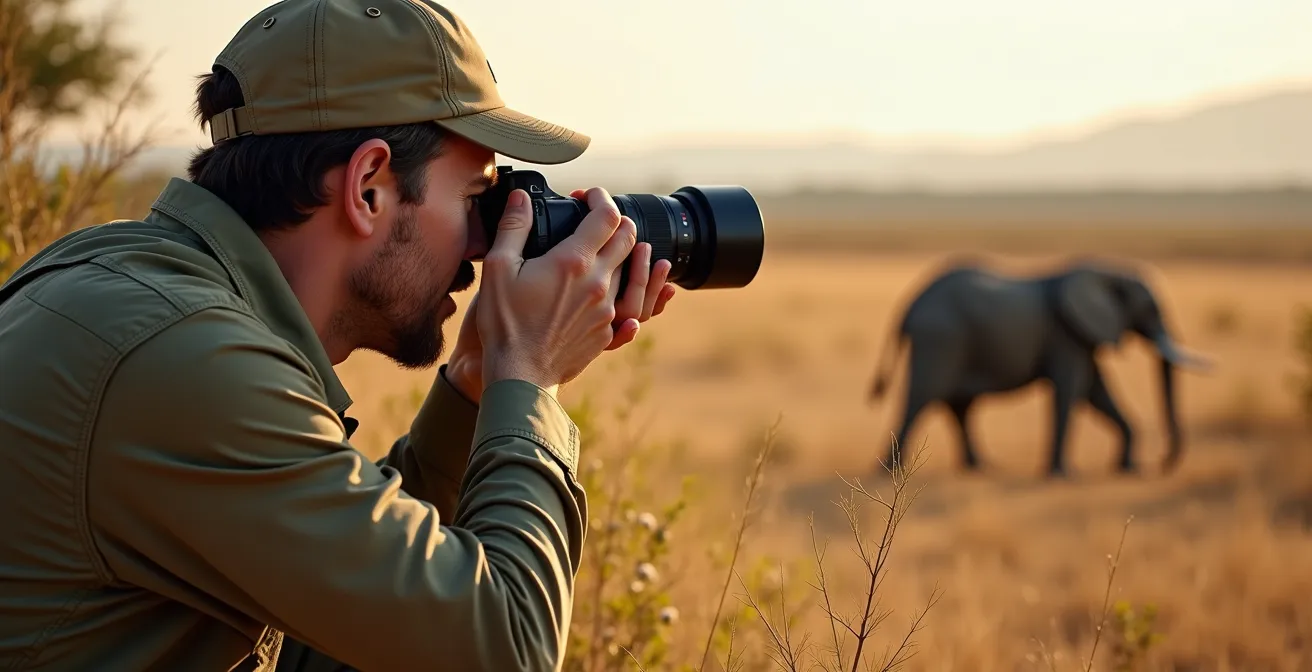
The stakes are incredibly high. For species already under threat from habitat loss and poaching, added stress from tourism can be the tipping point. Poachers tragically claim the life of an African elephant approximately every 26 minutes. While tourism provides the funds to fight this war, irresponsible tourist behavior adds another front of pressure on these vulnerable populations. By choosing to observe from a distance, you are not only ensuring the animal’s well-being but also setting a standard for ethical tourism that values the animal’s life above a photograph.
How to Pack a Zero-Waste Kit for Remote Travel?
Your commitment to sustainability extends to what’s in your suitcase. In remote areas, waste management infrastructure is often limited or non-existent. Every piece of single-use plastic you bring—from a shampoo bottle to a snack wrapper—can end up polluting a pristine environment for hundreds of years. Packing a zero-waste travel kit is not about asceticism; it’s a practical strategy to take responsibility for your own footprint and relieve pressure on fragile local systems.
The philosophy is built on two principles: multi-use and refusal. Choose solid toiletries that can serve multiple purposes. A solid shampoo bar can often double as soap and shaving cream, eliminating the need for multiple plastic bottles. Refuse single-use items by bringing your own reusable alternatives. A water bottle with a built-in filter is perhaps the most critical item, allowing you to drink safe water anywhere without buying plastic bottles. Similarly, a set of bamboo cutlery and a collapsible container means you can enjoy local street food without creating any waste.
This approach also extends to resource consumption. As the World Economic Forum notes, water usage in tourism is a significant issue. By being mindful of your consumption and using products that require less water, you contribute to a lighter overall footprint. Here are the essentials for a compact and effective zero-waste kit:
- Solid shampoo bar that doubles as soap and shaving cream.
- Stainless steel water bottle with a built-in filter for safe hydration.
- Bamboo cutlery set in a cloth wrap to avoid single-use plastics.
- Beeswax food wraps as a sustainable alternative to plastic bags for snacks.
- Collapsible silicone containers for packing leftovers or buying takeaway food.
- Digital downloads of maps and documents to travel paper-free.
How to Distinguish Genuine CSR Sustainability From Corporate Greenwashing?
As conscious consumerism grows, so does “greenwashing”—the corporate practice of making misleading claims about environmental benefits. A company’s Corporate Social Responsibility (CSR) report can be a powerful tool for transparency or a masterful work of fiction. The key to seeing through the facade is to look for specific, measurable, and verified data instead of vague, emotive language.
Buzzwords like “eco-friendly,” “green,” or “natural” are red flags. They are legally meaningless and designed to evoke a positive feeling without making a concrete promise. Genuine sustainability is communicated through metrics. A truly committed company won’t say it “cares about water”; it will state, “We have achieved a 30% reduction in water use since 2020 by investing in greywater recycling technology.” Look for commitments that are tied to timelines, report on failures as well as successes, and disclose their full supply chain emissions (Scope 3), not just their direct operations.
The gold standard for legitimacy is third-party certification. Instead of self-created “green” logos, look for established, rigorous standards like B Corp certification, which evaluates a company’s entire social and environmental performance, or travel-specific credentials from the Global Sustainable Tourism Council (GSTC). The GSTC Standards serve as the global benchmark for sustainability in tourism, used for everything from policy-making to certification. These independent audits provide the impact transparency that separates true commitment from a clever marketing campaign. The table below, inspired by data from authoritative sources like Sustainable Travel International, offers clear indicators to watch for.
| Greenwashing Signs | Genuine Sustainability |
|---|---|
| Vague terms: ‘eco-friendly’, ‘natural’ | Specific metrics: ‘30% reduction in water use since 2020’ |
| Marketing budget > sustainability investment | Capital expenditure on green technology documented |
| No Scope 3 emissions reporting | Full supply chain emissions transparently reported |
| Self-created ‘green’ labels | Third-party certifications (B Corp, Green Globe) |
| One-off initiatives | Systematic, long-term commitments with timelines |
Brain Drain or Gain: Which Countries Benefit Most From Migration?
A common concern in global development is the “brain drain,” where talented individuals leave their home countries for opportunities abroad. However, sustainable tourism offers a powerful counter-narrative by creating a localized “brain gain.” When managed correctly, the tourism industry creates high-value, skilled jobs that provide a compelling reason for talented locals to stay, invest, and build their careers at home. This transforms tourism from a simple service industry into an engine for community empowerment and talent retention.
The economic scale of wildlife tourism is immense. Globally, the industry is a significant economic driver, and a 2023 report indicated that wildlife tourism contributes $165.4 billion to the global GDP. The crucial question is how this wealth is distributed. When it is channeled into community-based models, it fosters a profound sense of ownership and opportunity. These models train and employ locals not just in entry-level positions, but as expert guides, lodge managers, conservation officers, and entrepreneurs. This is the Proximity Principle in action: value is created and retained locally.
Botswana’s community-based conservation model is a world-class example. In the Khumaga community, residents have partnered with Moela Lodge Safaris as co-owners of their local lodge. Community members built the lodge using local materials and now hold high-skill jobs that give them direct access to the economic benefits of one of Africa’s great migrations. This is not just a job; it is a stake in the future of their own natural heritage. By choosing operators with these deep community partnerships, travelers directly support a model that makes staying home a more attractive option than migrating.
Key Takeaways
- Your travel fee is a direct investment in conservation infrastructure like anti-poaching patrols.
- True sustainability is measured by transparency and third-party validation, not vague “eco-friendly” claims.
- Minimizing your impact involves conscious choices at every stage, from booking flights to daily interactions and packing.
Sustainable Tourism Initiatives: How to Ensure Your Tourist Dollars Benefit Locals?
One of the most significant challenges in tourism is “economic leakage.” This occurs when the money you spend on a trip flows out of the local economy and into the pockets of international corporations. Shocking research reveals that in some conventional tourism models, up to 70% of tourist money can ‘leak’ out of the host country. This means that despite the visible presence of tourism, the local community sees very little of the financial benefit. Ensuring your tourist dollars stay local is arguably one of the most impactful choices you can make.
The solution is to intentionally shorten the supply chain by supporting businesses that are 100% locally owned and operated. This includes everything from your choice of accommodation and tour operator to the restaurants you dine in and the shops where you buy souvenirs. Independent, locally-owned businesses are far more likely to hire local people, pay local taxes, and source their own supplies from other local vendors. This creates a powerful multiplier effect, where your money circulates within the community, fostering economic resilience and broad-based prosperity.

To maximize your local impact, actively seek out these opportunities. Book directly with a small, family-run guesthouse instead of a multinational hotel chain. Hire a local guide who can offer unparalleled insight into their culture and environment. Eat at restaurants that pride themselves on using ingredients from nearby farms. When you buy crafts, buy them directly from the artisan. By making these deliberate choices, you move from being a simple consumer to a genuine partner in the local economy, ensuring that the benefits of your visit are felt long after you’ve returned home.
Your journey as a conscious traveler begins with the understanding that every choice matters. By adopting an investor’s mindset, you can transform your travels from a passive experience into an active force for global good. Start today by scrutinizing your next trip’s supply chain and demanding the impact transparency that empowers real change.