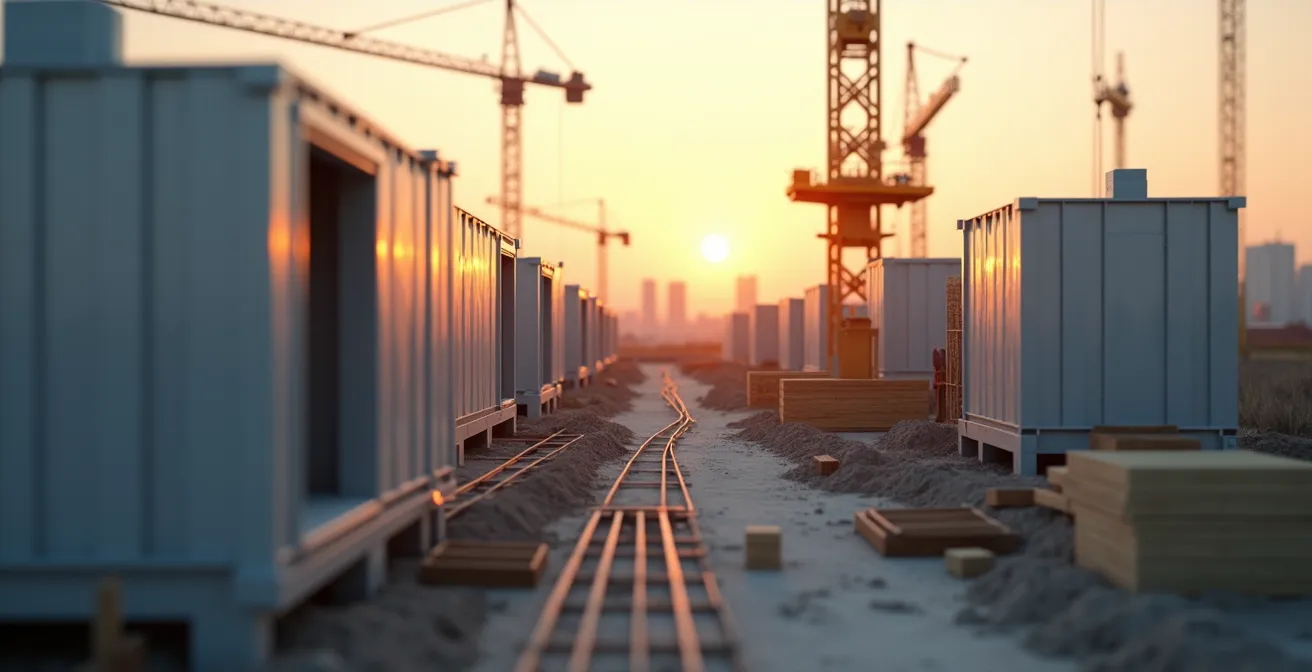
Slashing construction timelines by 30% is not achieved by buying new technology, but by re-engineering project delivery into a unified, manufacturing-style system.
- Prefabrication and modular methods are key, but only when logistics are flawlessly integrated to prevent bottlenecks.
- Digital tools like BIM and snagging software eliminate rework by creating a single source of truth from design to closeout.
Recommendation: Audit your current workflows for fragmentation and data silos—these are your biggest barriers to speed.
For property developers and construction managers, the pressure to deliver projects faster and on budget has never been more intense. The conventional wisdom points toward adopting new technologies—drones, robotics, and advanced software—as the silver bullet for efficiency. While these tools are powerful, this isolated approach often leads to disappointing results, adding complexity without delivering the promised transformation. The real challenge isn’t a lack of technology; it’s the persistence of a fragmented, sequential workflow that has defined construction for decades.
This fragmented model, where design, engineering, and construction operate in separate silos, is the primary source of the delays, rework, and cost overruns that plague the industry. The solution, therefore, is not to simply layer more technology on top of a broken system. Instead, achieving a radical reduction in project timelines requires a fundamental paradigm shift. It demands we stop thinking like traditional builders and start operating like advanced manufacturers, focusing on process integration, data flow, and systemic optimization.
This article moves beyond the platitudes. We will not just list technologies; we will deconstruct the new operational playbook. We will explore how to re-engineer your project lifecycle by integrating prefabricated components, mastering digital workflows, and adopting a manufacturing mindset. This is the blueprint for transforming your construction process from a series of disconnected steps into a single, cohesive, and highly efficient system capable of delivering projects 30% faster.
This guide provides a structural breakdown of the key pillars supporting this modern construction methodology. By understanding these components, you can begin to build a more resilient, efficient, and profitable development strategy.
Summary: The New Blueprint for Accelerated Construction
- Why Prefabricated Walls Reduce Waste and Labor Costs simultaneously?
- How to Permit a 3D Printed Structure With Local Authorities?
- Concrete or Wood: Which Material Speeds Up High-Rise Construction?
- The Logistics Error That Delays Modular Projects by Weeks
- How to Use Digital Snagging Tools to Close Out Projects Faster?
- How Rapid Prototyping With 3D Printing Cuts Development Costs by 50%?
- When to Switch From Batch Processing to One-Piece Flow?
- How BIM Modeling Prevents Costly Clashes Before Construction Begins?
Why Prefabricated Walls Reduce Waste and Labor Costs Simultaneously?
Prefabrication is more than just building components off-site; it’s a strategic shift toward a manufacturing-based approach that tackles two of construction’s biggest inefficiencies: waste and labor. In a factory-controlled environment, materials can be precision-cut and optimized, drastically reducing the scrap common on a traditional job site. This process also allows for the bulk purchasing and standardized assembly that generate significant material cost savings. The impact on timelines is profound; industry data shows that modular and prefabricated components can lead to a 30% reduction in construction timelines.
On the labor front, the benefits are twofold. First, factory settings provide a safer, more controlled environment, which increases worker productivity and reduces the risk of on-site accidents. Workers can operate in ergonomic stations with specialized equipment, allowing for a higher quality of finish and faster assembly. Second, it decouples a significant portion of the construction schedule from on-site conditions like weather, enabling parallel processing where foundation work happens on-site while the building’s superstructure is manufactured simultaneously.
This approach transforms the cost structure of a project. While the initial cost of prefabricated modules might seem higher, the systemic savings in labor hours, waste reduction, and accelerated project closeout deliver a superior return on investment. The key is to view prefabrication not as a product, but as an integrated system that optimizes the entire project lifecycle, from material procurement to final assembly.
How to Permit a 3D Printed Structure With Local Authorities?
Introducing a disruptive technology like 3D concrete printing into a field governed by long-standing building codes presents a significant regulatory challenge. Local authorities are often unfamiliar with the materials, structural performance, and testing protocols associated with these novel methods. Securing a permit for a first-of-its-kind 3D printed structure is therefore less a matter of form-filling and more a campaign of education and strategic validation.
The primary hurdle is the lack of pre-approved standards. Your team must proactively build the case for safety and compliance from the ground up. This involves compiling a comprehensive dossier of material science data, third-party structural engineering analyses, and evidence from smaller-scale tests. Rather than presenting this as an adversarial process, frame your project as a collaborative pilot program that positions the municipality as a leader in construction innovation. The image below represents the convergence of innovative design and the rigorous planning required for regulatory approval.

Engaging with permitting officials early and often is critical. Schedule pre-application meetings not to ask for permission, but to educate them on the technology and your quality assurance process. Partnering with a local university’s engineering department can provide an invaluable layer of independent validation that builds trust. By managing the permitting process as a strategic communication project, you can turn a potential roadblock into a powerful endorsement.
- Step 1: Schedule a Pre-Application Meeting with the local permitting office to educate officials on the technology and its benefits.
- Step 2: Create a comprehensive Certification Dossier, including all material data, testing results, and structural analysis from certified engineers.
- Step 3: Partner with a local university’s engineering department to conduct independent validation and lend academic credibility to your methods.
- Step 4: Propose a small-scale, non-residential pilot project, like a utility building or park structure, to establish a local proof-of-concept.
- Step 5: Frame the project as an economic and technological development opportunity that can attract talent and investment to the municipality.
Concrete or Wood: Which Material Speeds Up High-Rise Construction?
When speed is the primary driver for high-rise construction, the choice of structural material has cascading effects on logistics, foundation work, and on-site assembly. While precast concrete has long been a reliable option for rapid building, mass timber—specifically Cross-Laminated Timber (CLT) and Glulam—is emerging as a powerful accelerator. The fundamental difference lies in the material’s weight.
Mass timber components are significantly lighter than their concrete counterparts. This advantage translates directly into faster, less expensive foundation work, as the building’s dead load is substantially reduced. On-site, the lighter weight allows for the use of smaller, more economical cranes that can be set up and operated more quickly. Furthermore, timber components can be stockpiled on-site with greater ease, providing a buffer that is difficult to achieve with the just-in-time delivery required for heavy precast concrete panels.
Digital integration is another area where mass timber excels. Its compatibility with CNC (Computer Numerical Control) machining allows for components to be manufactured with extreme precision, ensuring perfect fits and minimizing the need for on-site adjustments. This synergy between digital design and physical manufacturing is a core tenet of modern, efficient construction. The following table breaks down the key differences, sourced from a recent comparative analysis of prefabricated systems.
| Factor | Mass Timber (CLT/Glulam) | Precast Concrete Panels |
|---|---|---|
| Weight Impact | Significantly lighter – faster foundation work | Heavier – requires robust foundations |
| Crane Requirements | Smaller, more economical cranes | Heavy-duty cranes needed |
| Site Logistics | Can stockpile components easily | Just-in-time delivery required |
| Digital Integration | Excellent CNC compatibility | Good BIM integration |
| Neighborhood Disruption | Minimal due to lighter equipment | Higher due to concrete trucks |
The Logistics Error That Delays Modular Projects by Weeks
In modular construction, the project’s critical path shifts from the construction site to the supply chain. The single most catastrophic and common error is the “interface gap”—a failure to perfectly synchronize factory production, transportation logistics, and on-site receiving capabilities. A single miscalculation here can leave a multimillion-dollar project in limbo, with modules arriving out of sequence, transport permits missing, or a crane that isn’t rated for the heaviest lift. The financial impact is severe; industry data reveals that around 30% of all construction costs are due to rework and inefficiencies, many of which stem from logistical failures.
This is not a traditional shipping issue; it’s a complex systems integration problem. The solution is to establish a dedicated Logistics Integration Manager role early in the planning phase. This individual or team is responsible for creating a master schedule that harmonizes the factory’s output with trucking availability, route restrictions, and the site’s assembly sequence. They must verify that the factory’s transport specifications align perfectly with the site’s offloading equipment and laydown areas.
Contingency planning is non-negotiable. What happens if a module is damaged in transit or a key transportation route is unexpectedly closed? Without a pre-planned response, the entire project can grind to a halt. A robust logistical plan anticipates these disruptions and builds in alternative sequences and solutions. Mastering modular logistics means treating the journey from factory to foundation with the same rigor as the building’s structural design.
Your Action Plan: Preventing the Modular Interface Gap
- Verify factory transport specifications match site receiving capabilities and laydown areas.
- Confirm crane capacity, reach, and placement for the heaviest and most distant module lift.
- Secure all necessary transportation permits for oversized loads months in advance, not weeks.
- Map and confirm all transportation routes, noting bridge clearances, weight restrictions, and time-of-day limitations.
- Establish a single point of responsibility by creating a dedicated Logistics Integration Manager role.
How to Use Digital Snagging Tools to Close Out Projects Faster?
The project closeout phase is notoriously slow, often bogged down by a paper-based snagging (or punch list) process. This traditional method, involving checklists, photos, and emails, creates a fragmented trail of information that leads to miscommunication, lost items, and significant delays in final handover. Digital snagging tools transform this process by creating a centralized, real-time database of all deficiencies. Using a tablet or smartphone, a site manager can log an issue, attach a photo, assign it to a subcontractor, and set a deadline—all within seconds, directly from the field.
This creates an immediate and transparent chain of accountability. Subcontractors are notified instantly and have all the information they need—location, description, and visual evidence—to address the issue correctly the first time. The project manager can view a live dashboard showing the status of all outstanding items, allowing them to focus resources where they are needed most. This eliminates the administrative bottleneck of compiling and distributing paper lists, accelerating the entire closeout cycle. The professional in the image below exemplifies the focus and control that digital tools bring to quality assurance.

The most advanced applications of this technology now involve robotics and automated data capture. By deploying robots equipped with high-resolution cameras and laser scanners, developers can automate the inspection process, capturing a comprehensive and objective record of the project’s state far more quickly and accurately than human teams. This not only speeds up snagging but also creates an invaluable as-built record for facility management.
Case Study: Robotic Inspection at Heathrow Airport
To refurbish its vital cargo tunnel, Heathrow Airport commissioned a robotic dog named “Dave.” Equipped with Trimble’s field capture technology, the robot provided highly accurate 3D laser scans of the confined space. This approach allowed Dave to navigate challenging areas more efficiently and safely than human inspectors, significantly reducing the risk of accidents while accelerating the data-gathering process for the renovation project.
How Rapid Prototyping With 3D Printing Cuts Development Costs by 50%?
We are well past using 3D printing just for prototyping. The technology is being used for creating actual structures.
– Indovance Construction Technology Report, Construction Technologies in 2024: Current and Emerging Trends
While the prospect of printing entire buildings captures the imagination, one of the most immediate and impactful uses of 3D printing in property development is for rapid prototyping. In the traditional design process, creating physical architectural models is a slow and expensive craft. Any significant design change requires a new model from scratch, discouraging experimentation and front-loading risk. 3D printing shatters this limitation by allowing architects and developers to create detailed, scale models in-house, overnight, and at a fraction of the cost.
This capability fundamentally changes the design-development cycle from a linear progression to an iterative, agile process. Multiple design variations can be printed and evaluated physically, allowing stakeholders to identify potential issues with massing, circulation, or constructability long before they become costly change orders. This “fail-fast” approach is a cornerstone of modern manufacturing and is directly responsible for dramatic cost reductions. A recent McKinsey report found off-site construction can reduce costs by up to 20% and accelerate timelines by 20-50%, a principle that begins with rapid prototyping.
By investing in a 3D printer, a development firm transforms design reviews from abstract 2D plan readings into tangible, collaborative workshops. This not only improves the final design but also accelerates decision-making and secures stakeholder buy-in far more effectively. The ability to quickly and cheaply test ideas physically is a strategic de-risking tool that pays for itself by eliminating just one major design flaw that would have otherwise been discovered during construction.
When to Switch From Batch Processing to One-Piece Flow?
The traditional construction site operates on a “batch processing” model. A crew completes all the framing for an entire floor (a batch), then another crew follows to complete all the electrical work (another batch), and so on. This approach seems logical but creates massive inefficiencies: long wait times between trades, large piles of work-in-progress inventory, and a high potential for discovering defects long after the responsible crew has left. The alternative, drawn from lean manufacturing, is one-piece flow.
One-piece flow focuses on completing one unit (e.g., a single apartment, a hotel room) from start to finish before moving to the next. A small, multi-skilled team moves from unit to unit, performing all the necessary tasks in a continuous sequence. This radically reduces the time a unit spends as “work-in-progress” and ensures that defects are caught and corrected almost immediately. This shift to a factory-style workflow is a key driver of efficiency, enabling worker productivity increases of 20-30% in prefabricated environments.
The switch from batching to one-piece flow is most effective in projects with a high number of repeatable units, such as multi-family housing, hotels, or hospitals. It requires a significant upfront investment in cross-training workers and meticulous pre-planning to ensure a steady supply of materials for each team. However, the payoff is a dramatic reduction in the overall project timeline and a significant improvement in first-time quality. It represents a core philosophical shift from managing trades to managing a continuous production process.
Key Takeaways
- System Over Tools: Lasting efficiency gains come from re-engineering the entire construction process, not just adopting standalone technologies.
- Data Is the Foundation: A unified data environment, championed by BIM, is the digital backbone that prevents clashes, reduces rework, and enables speed.
- Logistics Are Paramount: The transition to off-site construction shifts the primary project risk from on-site execution to supply chain and logistical coordination.
How BIM Modeling Prevents Costly Clashes Before Construction Begins?
Building Information Modeling (BIM) is the digital foundation of modern, efficient construction. It is far more than a 3D model; it is an intelligent, data-rich digital twin of the project where every component contains critical information. Its most powerful function is proactive clash detection. In a traditional 2D design process, conflicts between structural, mechanical, electrical, and plumbing (MEP) systems are often only discovered on-site, leading to expensive rework and delays. BIM prevents this by simulating the entire building in a virtual environment first.
The BIM software automatically flags every instance where two objects—like a steel beam and an HVAC duct—are trying to occupy the same space. These “clashes” can be identified and resolved by the design and engineering teams collaboratively within the model, long before any materials are ordered or workers are on-site. According to a Deloitte report, the use of AI and data analytics, which are core to advanced BIM platforms, can yield operational cost savings of 10-15%, largely by eliminating such rework.
By front-loading this coordination effort into the digital phase, BIM serves as the single source of truth for the entire project team. It ensures that all subcontractors are working from the same coordinated plan, eliminating the ambiguity that leads to on-site errors. This shift from reactive problem-solving during construction to proactive problem prevention during design is the essence of building faster and more profitably. BIM is not a piece of software; it is the central nervous system of an integrated, data-driven project.
The first step in this transformation is a candid assessment of your current processes. Begin by auditing your project workflow to identify the data silos, communication gaps, and sequential bottlenecks that are costing you time and money. Adopting this systemic approach is the most direct path to achieving radical efficiency in today’s competitive market.