
The term “clinically proven” is only meaningful when backed by a rigorous, transparent, and statistically sound methodology.
- True efficacy is demonstrated in double-blind, placebo-controlled studies with a statistically significant sample size (typically 80+ participants).
- Objective instrumental measurements (e.g., wrinkle depth analysis) are far more reliable than subjective “user perception” surveys.
Recommendation: To validate a product’s efficacy, focus on the study’s design and data integrity, not just its headline percentage claims.
The skincare aisle is a battlefield of claims. Banners proclaim “95% of users saw reduced wrinkles,” and labels boast of being “clinically proven.” For the discerning consumer or industry professional, this noise creates a fundamental problem: how do you separate marketing hyperbole from genuine scientific validation? The common advice to “look for proof” is often a gateway to more confusion, as not all “proof” is created equal. Many so-called studies are little more than glorified consumer surveys, lacking the scientific rigor needed to be meaningful.
The key to navigating this landscape is not to hunt for bigger percentages, but to understand the architecture of the studies that produce them. The difference between a robust clinical trial and a weak marketing claim lies in the methodology. This requires a shift in perspective—from that of a consumer to that of a clinical trial coordinator. Instead of asking “Does it work?”, we must ask “How was it proven?” This involves scrutinizing the study design, the nature of the control group, the statistical significance of the results, and the type of evidence collected.
But if the real answer isn’t a single hero ingredient like retinol, and if consumer wearables can’t replace clinical tools, what should you look for? This guide will deconstruct the components of a legitimate dermatological study. We will equip you with the knowledge to dissect clinical trial results, identify statistical red flags, and ultimately distinguish between products that are merely tested and those that are truly proven by science. By understanding the principles of gold-standard research, you can make informed decisions based on data, not just marketing.
To navigate the complexities of dermatological science, this article breaks down the essential components of a valid clinical trial. The following sections will guide you through the critical elements to look for when evaluating skincare product claims.
Summary: How to Read Clinical Trial Results for Skincare?
- Why Double-Blind Placebo Studies Are the Gold Standard in Dermatology?
- How to Conduct a RIPT Test to Certify “Hypoallergenic” Claims?
- Petri Dish or Human Skin: Which Test Predicts Irritation Better?
- The Sample Size Trick: Why “Tested on 10 Women” Is Statistically Irrelevant
- When to Start Stability Testing to Avoid Launch Delays?
- Can Consumer Wearables Replace Clinical Tools for Heart Monitoring?
- The Compliance Trap: Why Automated Tools Miss 70% of UX Issues
- Why Retinol Alone Isn’t Enough for Skin Regeneration After 40?
Why Double-Blind Placebo Studies Are the Gold Standard in Dermatology?
The most credible evidence in dermatological testing comes from a Randomized, Double-Blind, Placebo-Controlled Trial (RCT). This methodology is considered the gold standard because it systematically eliminates bias. In this setup, participants are randomly assigned to receive either the active product or an inert placebo. Crucially, neither the participants nor the researchers administering the tests know who is in which group (double-blind). This prevents the “placebo effect”—where participants’ belief in a treatment can cause perceived improvements—and eliminates any potential for researchers to subconsciously influence the results based on their expectations.
The power of this design is its ability to isolate the true effect of the active ingredients. The results are then analyzed for statistical significance, often expressed as a “p-value.” A low p-value (typically p < 0.05) indicates that the observed results are highly unlikely to be due to random chance. For instance, a 2023 study on a multi-herbal emulsion used a double-blind, placebo-controlled design to measure changes in skin hydration, elasticity, and wrinkles over 60 days, providing a clear comparison of the formula’s true performance against a baseline. The rigor is immense; a 2016 randomized controlled trial found that 82% of participants showed significant improvements with a p-value of less than 0.0001, confirming the results were not a fluke. When a brand cites this type of study, it demonstrates a high level of confidence in its product’s efficacy.
How to Conduct a RIPT Test to Certify “Hypoallergenic” Claims?
The term “hypoallergenic” is one of the most misused in the beauty industry. Legally, it has no standardized definition, meaning any brand can use it. However, for a brand to ethically and scientifically substantiate this claim, it must conduct a Repeat Insult Patch Test (RIPT). This is the clinical standard for assessing a product’s potential for sensitization and irritation. The test involves applying small patches of the product to a group of volunteers (typically 50-200 people) repeatedly over several weeks.
The process has two main phases. First is the “induction phase,” where the product is applied to the same skin site multiple times to see if the immune system can be “trained” to react to it. After a rest period, the “challenge phase” begins, where the product is applied to a new skin site. If no reaction occurs, the product can be considered a low-risk irritant and non-sensitizer. A dermatologist oversees the process, grading any reactions on a standardized scale. This rigorous, controlled method is starkly different from a simple consumer survey where skincare testing analysis reveals that 35 out of 80 women might report no irritation without the controlled, repeated exposure needed for a true assessment.
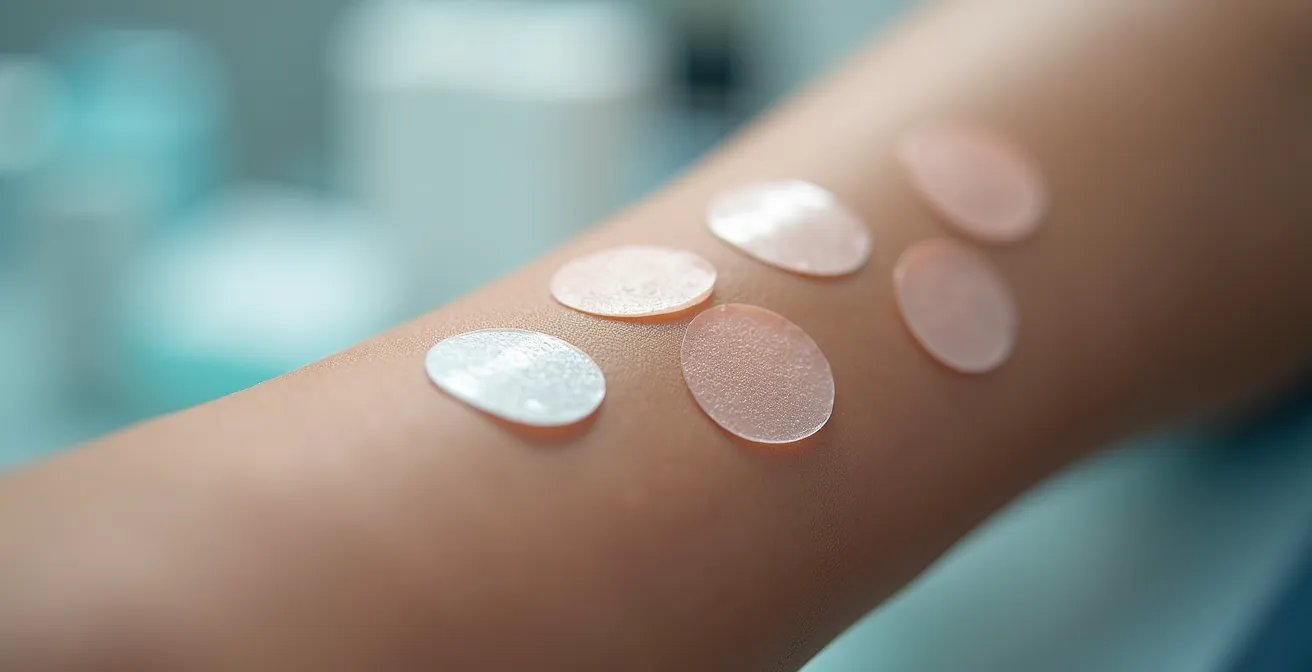
As the illustration of patch testing shows, this is a highly controlled and monitored process. Each site is carefully observed for signs of erythema (redness), edema (swelling), or other reactions. Only a product that passes a properly conducted RIPT on a sufficiently large and diverse panel of subjects can legitimately claim to be formulated to minimize allergy risks. A claim of “dermatologist tested” without the backing of a RIPT is largely meaningless for substantiating hypoallergenic safety.
Petri Dish or Human Skin: Which Test Predicts Irritation Better?
Before a product ever touches human skin, its safety profile often begins with *in-vitro* testing—evaluations conducted in a controlled lab environment, such as a petri dish or on engineered tissue models. These tests are invaluable for early-stage screening, allowing formulators to identify potentially cytotoxic or irritating raw materials without resorting to animal or human testing. They are fast, cost-effective, and essential for weeding out problematic ingredients. However, their predictive power has limitations. A petri dish cannot replicate the complex, dynamic environment of human skin, with its immune responses, metabolic processes, and unique barrier function.
This is where *in-vivo* testing—studies conducted on living organisms, specifically human volunteers—becomes indispensable. While *in-vitro* tests can signal a potential problem, only *in-vivo* tests like the RIPT can confirm how a complete formula will interact with real, living skin. This distinction is critical for both safety and efficacy claims. As one expert notes, the best approach is sequential. Hemali Gunt, Head of Clinical and Scientific Affairs at Burt’s Bees, explains the industry best practice:
It’s not an ‘either/or’ question, but the most reliable brands use a sequence of tests—in-vitro screening followed by in-vivo confirmation—for a complete safety profile.
– Hemali Gunt, Nature
This comprehensive approach provides a full picture, but it comes at a significant cost. The commitment to this level of rigor is a strong indicator of a brand’s dedication to safety and transparency, as industry experts estimate that clinical testing can cost upwards of $20,000+ per claim. Therefore, when evaluating a product, look for evidence that a brand has invested in both forms of testing to ensure its claims are built on a solid foundation of bio-relevant data.
The Sample Size Trick: Why “Tested on 10 Women” Is Statistically Irrelevant
One of the most common red flags in skincare marketing is a claim based on a tiny sample size. A “study” conducted on 10, 20, or even 30 participants lacks the statistical power to produce reliable or generalizable results. With such a small group, any observed effects could easily be due to random chance, individual anomalies, or confounding factors rather than the product itself. The results are statistically irrelevant and cannot be extrapolated to the broader population. A single participant with unusually reactive or resilient skin could dramatically skew the entire dataset.
To achieve statistical significance, a study must be “properly powered,” meaning it includes enough participants to detect a true effect if one exists. While the exact number varies based on the expected effect size and desired confidence level, a strong dermatological trial rarely involves fewer than 60 to 80 subjects. For instance, a properly powered skincare clinical trial requires a minimum of 80 participants, typically split into 40 receiving the active product and 40 receiving a placebo. This allows researchers to confidently state that the outcomes are due to the product, not coincidence. A recent 2024 acne treatment study further illustrates this, initially enrolling 102 women to ensure that even with potential dropouts, the final analysis with 92 participants (47 active, 45 placebo) remained robust.
When you see a claim based on a small sample, you should immediately question its validity. It often signals that the “study” was designed for marketing purposes rather than genuine scientific inquiry. Always look for the ‘n=’ number (the sample size) in the fine print. If it’s low, or if the brand is not transparent about it, consider it a significant warning sign about the credibility of the claim.
When to Start Stability Testing to Avoid Launch Delays?
Beyond immediate efficacy and safety, a crucial aspect of product development is ensuring the formula remains stable and effective over its entire shelf life. Stability testing is a non-negotiable process that should begin early in the formulation phase, long before a product is finalized for launch. This testing assesses how a product’s physical, chemical, and microbiological properties hold up under various conditions, such as exposure to different temperatures, light, and humidity. It verifies that the active ingredients won’t degrade, the color and texture won’t change, and the preservative system will remain effective at preventing microbial growth.
Starting this process late is a common cause of costly launch delays. If a formula fails stability testing, it may require a complete reformulation, setting the development timeline back by months. Rigorous testing involves placing product samples in controlled environmental chambers for an accelerated period (e.g., at 40°C for three months) to simulate a shelf life of one to two years. For example, during such tests, sophisticated instruments might be used to track changes over time. In one study, stability testing revealed a -1.4% reduction in ultrasound skin density for the placebo group at week 16, while the active ingredient group showed no change, proving the active’s protective effect and the formula’s stability. Neglecting this step not only risks a delayed launch but can also lead to product recalls and damage to a brand’s reputation if an unstable product reaches the market.
Action Plan: Key Factors for Skincare Stability Testing
- Washout Period: Ensure all test subjects cease using other skincare products for a designated period to establish a true, uninfluenced baseline measurement before the study begins.
- Whole Formula Testing: Test the complete, final formulation to validate ingredient interactions and overall stability, not just individual “hero” ingredients in isolation.
- Sufficient Duration: Monitor the formula for a minimum of 12 weeks for most studies. For specific conditions like melasma, extend the testing period to at least 16 weeks to observe meaningful changes.
- Account for Confounding Variables: Be aware that procedures like skin biopsies can trigger a natural healing response (wounding), which can affect collagen measurements and skew results if not properly accounted for.
- Use Quantitative Measurements: Rely on objective, measurable data such as gene expression analysis, RNA sequencing, or protein expression levels to provide unbiased evidence of a formula’s stability and efficacy.
Can Consumer Wearables Replace Clinical Tools for Heart Monitoring?
The rise of consumer technology, from skin-scanning apps to wearable health trackers, has raised the question of whether these tools can replace traditional clinical instruments in dermatological studies. While a smartwatch might monitor heart rate—a metric sometimes used in stress-related skin condition studies—it lacks the precision, validation, and specificity of clinical-grade equipment. Clinical tools, such as a Corneometer® for hydration or a Cutometer® for elasticity, are highly specialized, calibrated instruments designed to provide objective, reproducible, and quantifiable data.
Consumer devices, by contrast, are generally designed for wellness tracking, not medical-grade measurement. Their sensors and algorithms are not subject to the same rigorous validation standards. Therefore, data from a consumer wearable cannot be used as a primary endpoint in a credible clinical trial for skincare efficacy. However, technology is playing a new role in modernizing trial logistics. The emergence of decentralized clinical trials (DCTs) allows participants to remain at home while data is collected remotely. This can involve using validated questionnaires, self-photography with standardized lighting, or even shipping specialized (but user-friendly) measurement devices to participants. This approach improves participant recruitment and retention, and as modern virtual clinical studies show, they can be more cost-efficient.
The key distinction is that even in a decentralized model, the data collection methods are rigorously controlled and validated. An expert dermatologist might grade photos remotely, or data might be collected via a validated questionnaire. The technology serves to facilitate a rigorous protocol, not to replace it. The future likely involves a hybrid approach, but the core principles of using validated, precise instruments for primary claims remain unchanged. A consumer app’s “skin age” score is marketing; a 15% measured reduction in transepidermal water loss is data.
The Compliance Trap: Why Automated Tools Miss 70% of UX Issues
A major trap in interpreting skincare claims is confusing subjective perception with objective measurement. Many brands build their marketing around claims like “95% of women agreed their skin felt smoother.” This data is almost always collected through subjective self-assessment questionnaires. While not entirely useless, this type of feedback is highly susceptible to bias, the placebo effect, and individual interpretation. As a clinical trial coordinator, this is a critical distinction to make. What a participant “feels” or “sees” is not the same as what an instrument can quantitatively measure.
Erica Suppa, a formulation expert, provides clear guidance on how to spot these claims. This distinction is crucial for interpreting the validity of a study and understanding its limitations.
Subjective evaluations are surveys that ask for participant’s opinion. Look for words like ‘saw,’ ‘felt’ or ‘users agreed’ to signal that a claim is based on participants’ subjective opinions.
– Erica Suppa, Murad Skincare Clinical Series
A classic case study highlighting this discrepancy involves user experience. Skincare expert Caroline Hirons explains that if a hydrating moisturizer is given to a 70-year-old woman who has only ever used soap and water, she will likely perceive the results as miraculous. However, the same product given to an experienced skincare user might seem completely ineffective. Both opinions are real, but they are subjective. A truly scientific study would back up these perceptions with objective data, such as instrumental measurements showing a quantifiable increase in skin hydration levels across both groups. Reputable studies use both—instrumental data as the primary proof of efficacy, and subjective questionnaires as secondary, supporting evidence of the consumer experience.
Key Takeaways
- Small Sample Size: Claims based on studies with fewer than 60-80 participants lack statistical relevance and should be viewed with extreme skepticism.
- Subjective Language: Be wary of claims using words like “felt,” “saw,” or “agreed.” These signal user-perception data, which is less reliable than objective, instrumental measurements.
- Absence of a Placebo Control: Without a placebo group for comparison, it is impossible to determine if the observed results are from the product itself or simply due to the placebo effect or other external factors.
Why Retinol Alone Isn’t Enough for Skin Regeneration After 40?
A common marketing tactic is to spotlight a single “hero” ingredient, like retinol or vitamin C, and build all efficacy claims around it. However, this approach ignores a fundamental principle of cosmetic science: formulation synergy. The effectiveness of a skincare product rarely comes from one isolated ingredient but from the complex interaction of the entire formula. The base emulsion, preservatives, penetration enhancers, and supporting actives all work together to determine the final product’s stability, bioavailability, and ultimate performance on the skin.
Therefore, a clinical study that only tests the hero ingredient in isolation, rather than the complete, final formula, is providing an incomplete and potentially misleading picture. For instance, after the age of 40, skin regeneration involves multiple biological pathways. While retinol is excellent for promoting cell turnover, it doesn’t address all aspects of skin aging, such as hydration, antioxidant defense, or inflammation. A well-designed formula will incorporate a synergistic blend of ingredients to tackle these issues simultaneously. A clinical trial showing that layering antioxidants like green tea polyphenols, niacinamide, and vitamin E provides broader protection than a single ingredient confirms this principle. Such a combination can improve hydration while also targeting the free radicals responsible for aging.
Top-tier brands understand this and invest in testing their final, market-ready products. As clinical testing experts confirm that testing complete formulas improves credibility compared to trials on single ingredients. When reading a study, always check if the test was conducted on the finished good. This demonstrates that the brand is confident not just in its star ingredient, but in the scientific integrity and performance of its entire formulation.
By learning to deconstruct study methodologies, you are now equipped to look beyond marketing headlines and assess the true scientific merit of a skincare product. The next time you encounter a “clinically proven” claim, you can apply this critical framework to validate its legitimacy and make decisions based on evidence, not advertising.