True art investment success hinges on rigorous financial analysis and forensic due diligence, not merely aesthetic preference.
- Structural value is quantifiable: elements like signature, condition, and provenance are critical data points that directly impact an artwork’s financial standing.
- Market inefficiencies, from psychological biases in viewing habits to the “experience halo” of social media, create tangible alpha opportunities for the informed investor.
Recommendation: Apply a disciplined, asset-class framework to every potential acquisition to systematically mitigate risk and maximize capital appreciation.
For the uninitiated, the fine art market appears to be an opaque world governed by inscrutable tastes and dizzying auction prices. The common advice—”buy what you love”—is a romantic notion that serves the collector well but often fails the serious investor. While personal connection to a piece has its place, it is a poor substitute for rigorous financial discipline when building a portfolio of tangible assets. High-net-worth individuals are increasingly treating art not as decoration, but as a strategic component of a diversified portfolio, valued for its low correlation to traditional equities and its potential for significant appreciation.
The conventional approach involves visiting galleries, following major auctions, and tracking popular artists. However, this often means entering a crowded market where value has already been priced in. The real opportunity for outsized returns lies in shifting perspective. What if the key to unlocking value wasn’t just in identifying a beautiful object, but in deconstructing its financial and historical DNA? This requires moving beyond aesthetics and applying a framework of forensic analysis to uncover market inefficiencies and structural value drivers that most overlook.
This guide abandons the platitudes and instead provides a veteran dealer’s strategic playbook. We will dissect the quantifiable impact of a signature, the methodology for verifying provenance without a forensics team, and the financial calculus of choosing between Old Masters and contemporary stars. By treating art with the same analytical rigor as any other asset class, you can learn to spot undervalued masterpieces before they capture the market’s attention.
This article provides a structured approach to art investment, breaking down the critical factors that drive value and return. The following sections will guide you through the key areas of due diligence required to navigate this complex market with confidence.
Summary: Fine Art Investing: A Strategist’s Guide to Spotting Undervalued Masterpieces
- Why a Signature Adds 50% Value to an Otherwise Identical Print?
- How to Verify Provenance Without Hiring a Forensic Specialist?
- Old Masters or Young Contemporaries: Where is Your Capital Safer?
- The Condition Report Oversight That Ruins Resale Value
- How to Structure Art Donations to Maximize Fiscal Deductions?
- Why the “Right Turn” Bias Affects How People View Exhibitions?
- Why Real Assets Outperform Cash During Inflationary Periods?
- How Curating Exhibitions Has Shifted From Object-Focus to Experience-First?
Why a Signature Adds 50% Value to an Otherwise Identical Print?
In the world of multiples, such as prints, photographs, and sculptures, the artist’s signature is not a mere flourish; it is a primary driver of structural value. An unsigned print and its signed counterpart are physically identical, yet the market assigns a significant, quantifiable premium to the one bearing the artist’s hand. This is because a signature transforms a reproduction into a unique object, directly touched by the creator. It confirms intent and elevates the work from a simple image to a validated piece of the artist’s oeuvre. This distinction is critical in the secondary market, where authenticity and scarcity are paramount. For instance, the print market is substantial, and as it grows, signed works command increasingly higher premiums, a trend confirmed by market data showing 193,000 print transactions in 2024 where signed editions consistently outperform.
However, not all signatures are created equal. A savvy investor must learn to differentiate their hierarchy. A signature in pencil from the artist’s lifetime holds the most weight. An estate stamp, applied posthumously, carries less value but is still preferable to an unsigned work. A “plate signature,” which is part of the printed image itself, offers no added value. Authentication is therefore a crucial step in due diligence. It involves a forensic comparison of the signature against confirmed examples in the artist’s catalogue raisonné—the definitive, scholarly compilation of their work.
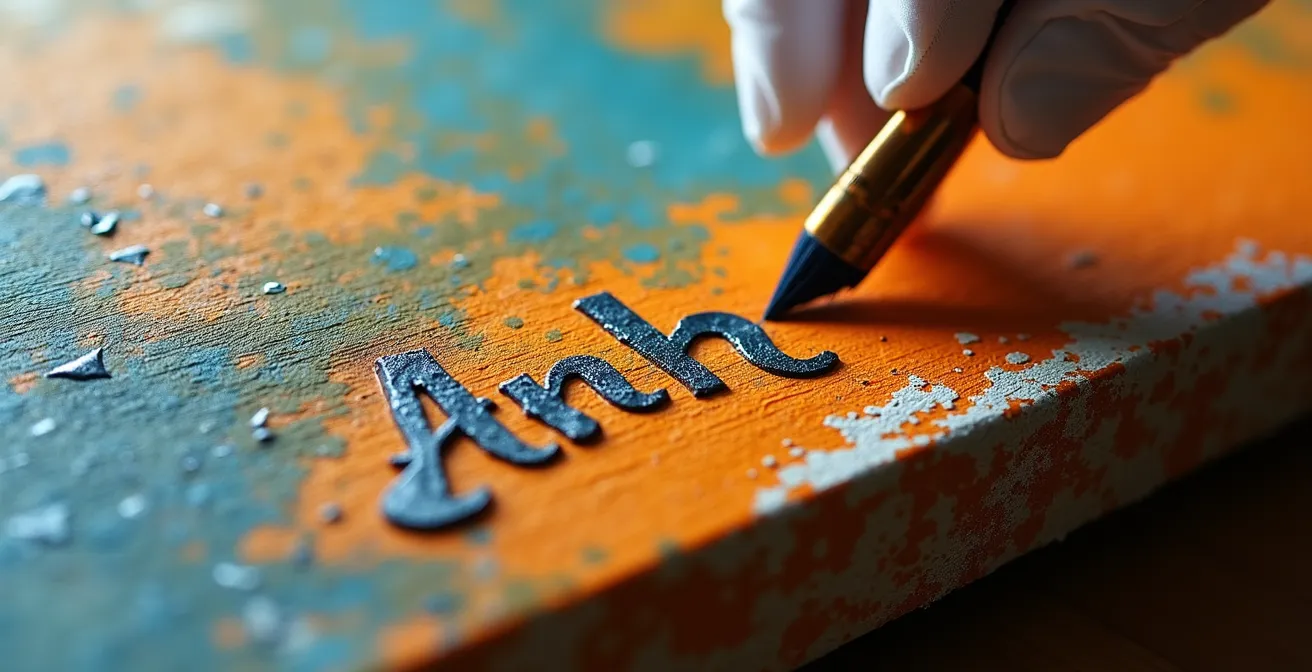
As this detailed view suggests, analyzing the pressure, style, and medium of the signature can reveal its authenticity. Advanced techniques, like UV light examination, can even uncover later additions or forgeries. Understanding this hierarchy and performing rigorous authentication is fundamental; it is a clear, data-driven method for evaluating a print’s investment potential far beyond its aesthetic appeal. It is a perfect example of how an investor can find an edge by focusing on quantifiable details that others might overlook.
How to Verify Provenance Without Hiring a Forensic Specialist?
Provenance—the documented history of an artwork’s ownership—is the bedrock of its value and authenticity. A piece with a complete, unbroken chain of custody is insulated from questions of forgery or theft, making it a secure asset. While a forensic specialist offers the ultimate assurance, investors can conduct a significant amount of financial forensics themselves using publicly available resources. The goal is to build a timeline that traces the work from the artist’s studio to the present day, corroborating each step. This process mitigates one of the greatest risks in art investment: acquiring a work with a compromised history, which can render it virtually unsaleable.
The first step is to analyze the back of the artwork. Gallery labels, exhibition stickers, and framer’s marks are the artwork’s passport, providing critical clues to its journey. Cross-referencing these details with digital archives is key. For example, a label from a specific gallery can be checked against that gallery’s exhibition history, often available online or through academic libraries. Digital tools have revolutionized this process; platforms like MyArtBroker utilize algorithms that scan vast archives of auction records and museum exhibition catalogues, allowing investors to independently verify if a piece has been publicly shown and when.
For investors looking to structure their due diligence, comparing various methods reveals a clear path to verifying provenance at different levels of cost and effort.
| Method | Cost | Reliability | Time Required |
|---|---|---|---|
| Getty Provenance Index | Free | High for historical works | 1-2 hours |
| Gallery Labels Analysis | Free | Medium | 30 minutes |
| Catalogue Raisonné Check | $50-500 | Very High | 2-5 days |
| Exhibition History Cross-Reference | Free-$100 | High | 2-4 hours |
By layering these methods, an investor can build a robust provenance report. Starting with free resources like analyzing gallery labels and searching the Getty Provenance Index can resolve many initial questions. If the work’s value justifies it, investing in access to the artist’s catalogue raisonné provides the highest degree of certainty. This systematic approach transforms provenance verification from an intimidating art into a manageable, data-driven process.
Old Masters or Young Contemporaries: Where is Your Capital Safer?
The decision between investing in Old Masters and contemporary artists is a fundamental question of portfolio strategy, boiling down to a classic risk-reward calculation. Old Masters (artists working before c. 1800) represent the ‘blue-chip stocks’ of the art world. Their markets are stable, their authenticity is well-documented in centuries of scholarship, and their value tends to be resilient during economic downturns. An investment in a Rembrandt or a Canaletto is an investment in art historical certainty. The risks are minimal, but so is the potential for explosive, short-term growth. This is a strategy for capital preservation.
Contemporary art, conversely, is the ‘venture capital’ of the art market. It offers the potential for staggering returns, with recent market analysis revealing that contemporary art has appreciated 11.4% annually since 1995, significantly outpacing the S&P 500. Investing in an emerging or mid-career artist is a bet on their future historical significance. This path is fraught with higher risk—the artist may fall out of favor, or the work may not stand the test of time. However, for investors with a higher risk tolerance and a keen eye for cultural trends, the upside is unparalleled. This is a strategy for capital appreciation.
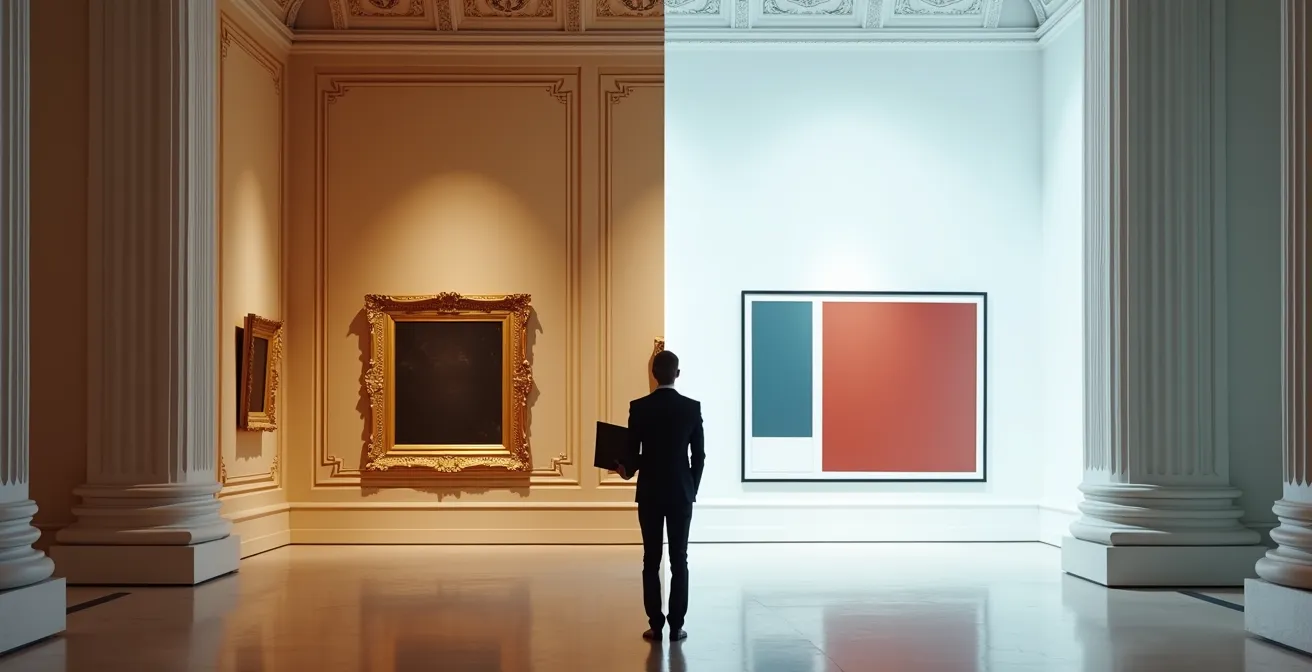
Ultimately, the choice is not mutually exclusive; a diversified art portfolio can and should include both. As a tangible asset, art provides a powerful hedge against market volatility that traditional securities cannot. As noted by industry experts, this diversification is one of its core strengths. Blair Haden of Restoration Division states it clearly:
Not only does art appreciate over time, but it’s a strong way to diversify. If the stock market crashes, fine art can remain unaffected and even continue to rise in value.
– Blair Haden, Restoration Division
For the savvy investor, the question isn’t “which is better?” but “what is the right allocation for my financial goals?” A balanced approach, perhaps weighted toward the stability of established artists with a smaller allocation to high-growth contemporaries, often provides the optimal blend of security and performance.
The Condition Report Oversight That Ruins Resale Value
Beyond authenticity and provenance, the physical condition of an artwork is the third pillar of its value. A pristine piece will always command a premium, while one with hidden damage or clumsy restoration can see its resale value plummet. Auction houses provide official condition reports, but these are often drafted to protect the seller and can be maddeningly vague. An investor who relies solely on these reports without conducting their own examination is exposed to significant financial risk. The most common and costly oversight is failing to detect undisclosed restoration, which can conceal everything from minor cracks to significant tears.
A hands-on inspection is non-negotiable. Certain techniques can reveal what a cursory glance will miss. For example, using “raking light”—shining a bright light at a sharp angle across the surface—can expose subtle changes in texture that indicate a repaired area or inpainting. Similarly, the tension of a canvas is a key health indicator; a sagging canvas often points to a history of exposure to humidity, which can lead to paint flaking over time. Documenting every small flaw, crack, or area of concern with high-resolution photographs creates a personal condition record that is invaluable for both negotiation and future resale.
Even for those unable to inspect a piece in person, understanding what to look for is crucial for asking the right questions. The following checklist outlines a professional approach to a preliminary condition assessment.
Your Action Plan: Pre-Acquisition Condition Audit
- Raking Light Technique: Hold a flashlight at a sharp angle to the artwork’s surface. Look for inconsistencies in sheen or texture that signal restoration patches or overpainting.
- Canvas Tension Test: Gently press on the center of the canvas from the back. If it feels loose or sags, it may indicate structural weakness or past moisture damage.
- Frame and Stretcher Examination: Inspect the frame joints and where the canvas meets the stretcher bars. Separation, new nails, or unusual stress lines can indicate environmental damage or re-stretching.
- Document All Findings: Photograph any and all issues, no matter how minor. Use a ruler in the frame to provide a clear sense of scale for any cracks, chips, or abrasions.
- Compare with Historical Photos: Cross-reference your findings with images from the catalogue raisonné or previous auction listings to identify any changes or damage that has occurred over time.
By adopting this forensic mindset, an investor transforms the condition check from a passive acceptance of a report into an active search for financial risk. This diligence protects capital and provides powerful leverage during price negotiations.
How to Structure Art Donations to Maximize Fiscal Deductions?
For high-net-worth collectors, an art portfolio is not just a source of appreciation but also a powerful tool for strategic wealth management and philanthropy. Structuring the donation of an artwork to a qualified institution, such as a museum or university, can result in significant fiscal deductions. However, the tax implications are complex and navigating them requires sophisticated planning. The most common mistake is a simple donation that only allows for a deduction based on the original purchase price (cost basis) rather than the work’s current, and often much higher, Fair Market Value (FMV).
To secure a deduction based on FMV, the donation must meet several criteria. First, the artwork must be a long-term capital asset, typically held for more than one year. Second, the receiving institution’s use of the artwork must be related to its tax-exempt purpose. For example, donating a painting to a museum for its collection qualifies; donating it to a hospital to be sold at a fundraiser does not. The artwork must also be formally appraised by a qualified appraiser to establish its FMV at the time of the gift.
For highly appreciated works, more advanced strategies can yield even greater benefits. Financial institutions like J.P. Morgan Private Bank specialize in these structures. Their experts help collectors utilize instruments like a Charitable Remainder Trust (CRT). In this scenario, the collector transfers the artwork to the trust, which then sells it. Because the trust is tax-exempt, no capital gains tax is due on the sale. The proceeds are then invested to provide an income stream to the collector for a set period. Upon the trust’s termination, the remaining assets pass to the designated charity. This strategy allows the collector to receive an immediate partial tax deduction, convert a non-income-producing asset into a cash flow, and fulfill their philanthropic goals, as detailed in their art financing and strategic planning services.
This level of planning transforms an art collection from a passive store of value into an active component of a sophisticated financial and estate plan, maximizing both personal benefit and public good.
Why the “Right Turn” Bias Affects How People View Exhibitions?
Beyond the tangible metrics of condition and provenance, the art market is influenced by subtle psychological factors that create market inefficiencies. One of the most fascinating is the “right-turn bias.” Museum studies and retail analytics have consistently shown that when people enter a space, they overwhelmingly tend to turn and walk to the right. Curators and gallery directors are acutely aware of this behavioral pattern and use it to their advantage. The first wall a visitor sees—the “power wall”—is the most valuable real estate in the gallery. Artworks placed here receive the most attention and are perceived as the most important pieces in the exhibition.
For an investor, this isn’t just a curatorial quirk; it’s actionable market intelligence. The placement of an artist’s work within a gallery or at an art fair is a strong signal of the dealer’s confidence and investment in that artist. As research from Grove Gallery highlights, “pieces given primacy in art fairs, such as those on the outside wall of a booth, serve as strong leading indicators of market momentum and dealer confidence.” An artwork moved from a back room to a prime position signals rising market interest before it is reflected in auction prices. The same psychology applies to digital viewing rooms, where the first image anchors the viewer’s perception of the entire exhibition.
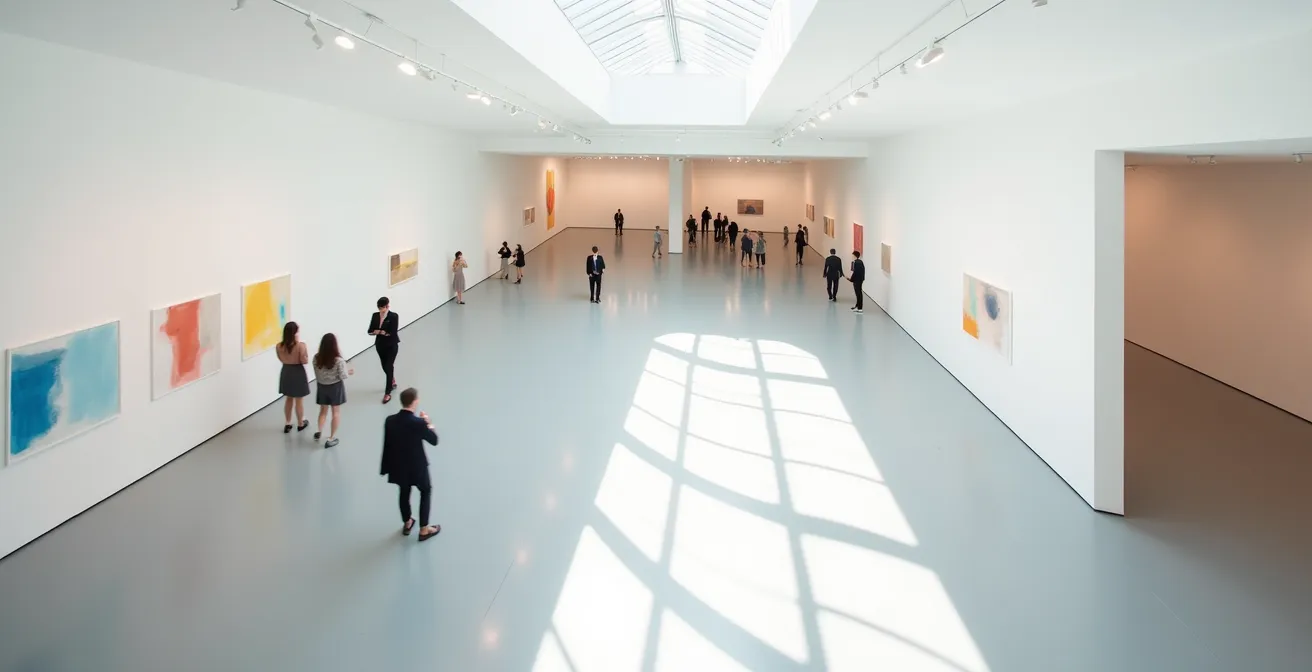
By observing these patterns, an investor can effectively front-run the market. It involves mapping gallery layouts, tracking which artists are consistently given “power positions,” and noting changes over time. Is an artist’s work being placed more prominently at major art fairs year over year? Is a gallery featuring them on the lead wall of their booth? These are qualitative data points that can precede a jump in an artist’s auction results. This strategy allows an investor to exploit a well-documented behavioral bias, turning a psychological phenomenon into a financial advantage.
Why Real Assets Outperform Cash During Inflationary Periods?
In an inflationary environment, holding cash is a guaranteed loss of purchasing power. As central banks increase the money supply and consumer prices rise, the value of each dollar, euro, or pound erodes. Investors therefore seek out “real assets”—tangible items whose value tends to rise with or exceed the rate of inflation. Fine art has long been recognized as a premier real asset, acting as a powerful store of value when currencies falter. Unlike cash, a masterpiece is a finite, unique object. Its supply is fixed, and its desirability often increases during periods of economic uncertainty as investors flee to the security of tangible goods.
The data robustly supports this thesis. The art market has demonstrated remarkable resilience and a low correlation to traditional financial markets. This means that when stocks and bonds are volatile or declining, art often holds its value or even appreciates. Recent Art Basel & UBS market data confirms that despite economic headwinds and market adjustments, global art sales remained at historically high levels, demonstrating the asset class’s robust inflation-hedging characteristics. This performance is not an anomaly; it is a structural feature of an asset class driven by scarcity, cultural significance, and the wealth of global high-net-worth individuals.
When compared to other alternative assets, contemporary art has shown superior long-term performance, reinforcing its position as a top-tier choice for portfolio diversification.
| Asset Class | 30-Year Return | Correlation to Stocks | Storage Costs |
|---|---|---|---|
| Contemporary Art | 11.4% annually | Nearly uncorrelated | 1-3% value/year |
| Gold | 7.8% annually | Low correlation | 0.5-1% value/year |
| Wine | 8.3% annually | Low correlation | 2-3% value/year |
| Classic Cars | 7.2% annually | Moderate correlation | 3-5% value/year |
While storage and insurance costs must be factored in, art’s historical returns and its ability to act as a hedge against inflation make it a compelling component of a sophisticated investment strategy. It is not merely a passion asset; it is a vital tool for wealth preservation in a volatile economic landscape.
Key Takeaways
- Value is structural and quantifiable: An artwork’s financial worth is deeply tied to measurable data points like signature authenticity, condition clarity, and provenance integrity.
- Art is a powerful diversifier: With a low correlation to traditional stock markets, fine art serves as a critical hedge against inflation and economic volatility.
- Market psychology is exploitable: Understanding curatorial strategies and behavioral biases, like the “right-turn bias,” can reveal market momentum and create investment opportunities.
How Curating Exhibitions Has Shifted From Object-Focus to Experience-First?
The 21st-century art world has witnessed a profound shift in curatorial philosophy. Historically, an exhibition was a quiet, contemplative space focused on the object itself. Today, driven by the demands of the experience economy and the power of social media, curation has increasingly become about creating immersive, memorable, and—most importantly—shareable moments. This “experience-first” approach has significant financial implications for investors, creating what can be termed the “experience halo” effect. When an artist creates a blockbuster, Instagram-worthy installation, the viral exposure dramatically boosts their public profile and, consequently, the market value of their other, more traditional works.
Yayoi Kusama’s “Infinity Mirror Rooms” are the quintessential example. These immersive installations generate massive queues and millions of social media posts, making Kusama a global household name. This widespread fame has a direct financial spillover: collectors who are priced out of her major works or cannot access the installations still want a piece of the phenomenon. This drives up demand and prices for her more accessible prints, paintings, and smaller sculptures. As analysis from institutions like Maddox Gallery shows, the value of an artist’s entire body of work can be lifted by the cultural gravity of a single, photogenic experience.
This trend is amplified by the art market’s accelerating digital transformation. The online space is inherently visual and experience-driven, and it is becoming a dominant sales channel. Artprice’s 30th Annual Report shows that online art market transactions are steadily rising, with hundreds of thousands of lots sold globally via digital platforms. In this context, artists who create visually compelling and digitally-friendly work are at a distinct advantage. For an investor, this means looking beyond the four corners of a canvas. It requires assessing an artist’s ability to engage audiences across platforms and create cultural moments. Investing in an artist who masterfully blends object and experience is a forward-looking strategy that aligns with the fundamental direction of the contemporary art market.
To build a resilient, high-performance collection, it is imperative to move beyond subjective taste and apply this rigorous, data-driven framework. By analyzing structural value, performing forensic due diligence, and identifying market inefficiencies, you position yourself to make informed decisions that protect capital and deliver superior returns.