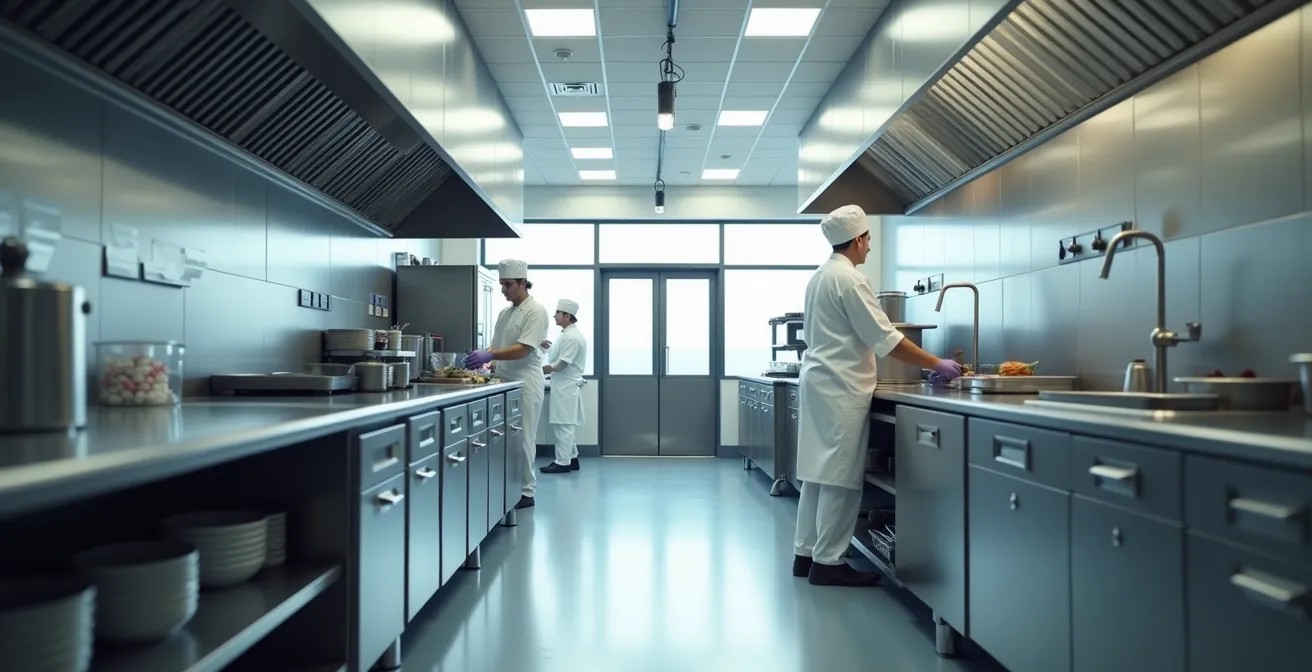
Passing a health inspection is not about memorizing rules; it is about systematically eliminating the critical failure points an inspector is trained to identify.
- Compliance requires immutable, verifiable data, making digitized logs superior to fallible manual records.
- Controlling pathogen growth demands strict adherence to temperature and time protocols, especially during the cooling phase.
Recommendation: Adopt a procedural mindset focused on risk analysis and workflow integrity, treating every operational step as a potential Critical Control Point (CCP).
For kitchen managers and head chefs, a health inspection is the ultimate test of operational discipline. The anxiety leading up to it is often rooted in uncertainty. You may believe you are following the rules, but are you addressing the underlying risks that lead to violations? Standard advice often revolves around generic checklists: wash hands, separate foods, cook thoroughly. While correct, this is rudimentary. These are the expected minimums, not the framework for guaranteed compliance.
The Hazard Analysis and Critical Control Point (HACCP) system provides a more robust structure, but its effective implementation is what separates a passing grade from a perfect score. An inspector’s objective is not merely to find fault, but to assess whether your entire system is designed to proactively prevent hazards. They are trained to spot systemic weaknesses, not just isolated mistakes. According to the World Health Organization, an estimated 600 million people worldwide become ill from contaminated food each year, a statistic that underscores the non-negotiable importance of rigorous safety protocols.
The true key to a zero-violation inspection lies in shifting your perspective from one of task completion to one of risk elimination. It requires understanding the *why* behind each protocol—the microbial kinetics, the physics of heat transfer, and the logic of workflow segregation. This is the mindset of an inspector. This guide is structured to instill that mindset, dissecting the most common and critical failure points and providing the procedural countermeasures to ensure your operation is not just compliant, but fundamentally safe.
This article provides a procedural breakdown of the key areas of scrutiny during a health inspection. The following sections will detail the critical control points that determine your success.
Summary: A Procedural Guide to Zero-Violation HACCP Compliance
- Why the “Danger Zone” (5°C-60°C) Is Critical for Protein Safety?
- How to Digitize Temperature Logs to Prevent Falsification?
- Mechanical Cooling or Manual: Which Preserves Food Texture Better?
- The Cutting Board Mistake That Spreads Salmonella Instantly
- When to Schedule Deep Cleaning: Nightly vs Weekly Protocols
- How Urban Planning Influences Public Health Outcomes in Mega-Cities?
- How to Audit a Factory for Quality Control remotely?
- How Farm-to-Table Sourcing Fixes the Broken Restaurant Supply Chain?
Why the “Danger Zone” (5°C-60°C) Is Critical for Protein Safety?
The temperature “Danger Zone” is not an arbitrary range; it represents the optimal conditions for the exponential growth of pathogenic bacteria like Salmonella, E. coli, and Listeria. For high-protein foods such as meat, poultry, and fish, this zone is particularly critical due to their high moisture and nutrient content, which act as a perfect breeding ground. Within this range, bacteria can double in number in as little as 20 minutes. An inspector’s assessment of temperature control is therefore an evaluation of your understanding of microbial kinetics.
Holding potentially hazardous foods within this temperature band for an extended period is a direct path to a critical violation. The cumulative time food spends in the danger zone is what matters. This includes time during prep, holding, and cooling. Your protocol must demonstrate control at every stage. A piece of chicken left on a counter for 30 minutes during a busy service is a significant breach, even if it is eventually cooked to a safe internal temperature. The focus is on minimizing exposure at all times.

As this visualization of a protein surface suggests, the difference between a properly chilled and a room-temperature environment is stark. On a microscopic level, the surface of food left in the danger zone becomes a thriving colony of pathogens. An inspector evaluates your procedures for evidence that you are actively combatting this growth. This includes calibrated thermometers, documented temperature logs, and a clear understanding among staff of the time-temperature abuse principle. It is a non-negotiable pillar of food safety.
How to Digitize Temperature Logs to Prevent Falsification?
Manual temperature logs are a well-known point of failure in many HACCP systems. “Pencil-whipping”—the act of filling in logs with plausible but fake data long after the fact—is a common and easily identifiable practice for a trained inspector. Inconsistent handwriting, perfectly round numbers, or logs filled out at the end of a shift are all red flags. The integrity of your temperature data is paramount, as it serves as the primary evidence that your Critical Control Points (CCPs) are being managed effectively. Falsified records render your entire HACCP plan invalid.
Digital logging systems eliminate this vulnerability by creating immutable, time-stamped records. When a staff member takes a temperature with a digital probe linked to a system, the time, date, temperature, and user ID are automatically recorded. This data cannot be altered, providing a verifiable and trustworthy audit trail. For an inspector, the ability to instantly review months of accurate data is a clear indicator of a robust and transparent safety culture. Furthermore, these systems can provide real-time alerts. As noted in the case of the Traqfood application, restaurateurs can receive an SMS or call if a refrigerator deviates from its set temperature, preventing catastrophic product loss and ensuring immediate corrective action.
The transition from manual to digital represents a shift from a reactive, fallible process to a proactive, automated one. The table below outlines the key procedural advantages that an inspector will recognize as superior practice.
| Aspect | Digital Logging | Manual Logging |
|---|---|---|
| Data Integrity | Immutable time-stamped entries | Vulnerable to pencil-whipping |
| Real-time Alerts | Automatic SMS/email notifications | No immediate alerts |
| Compliance Verification | Instant audit trail access | Time-consuming paper review |
| User Accountability | Mandatory user ID tracking | Signatures can be falsified |
| Cost Structure | Higher initial investment, lower long-term costs | Low initial cost, higher labor costs |
While there is an initial investment, the long-term benefits in labor savings, product loss prevention, and—most importantly—compliance certainty far outweigh the costs. Adopting a digital system is a definitive statement that your operation prioritizes data integrity over convenience.
Mechanical Cooling or Manual: Which Preserves Food Texture Better?
The cooling of cooked foods is one of the most hazardous processes in a professional kitchen. Improper cooling allows foods to linger in the temperature danger zone, promoting rapid bacterial growth. The choice between mechanical methods (like blast chilling) and manual methods (like ice baths) is not just about speed; it is about safety, consistency, and quality. From a compliance standpoint, the primary concern is meeting the mandated cooling curve. The FDA’s guidelines are explicit: foods must be cooled from 60°C to 21°C within 2 hours, and then from 21°C to 5°C or below in the next 4 hours.
Mechanical blast chillers are designed specifically to meet these timelines with precision. By circulating high-velocity, low-temperature air, they rapidly extract heat from food. This speed is critical not only for safety but also for preserving food texture. Slow cooling, often a result of improper manual methods, allows large ice crystals to form within the food’s cellular structure. These crystals rupture cell walls, leading to a mushy texture and moisture loss upon reheating. A blast chiller creates micro-crystals, which cause minimal damage, thus preserving the integrity and texture of products like delicate fish, sauces, and dense proteins.
Manual methods, such as placing a large stockpot in a walk-in cooler or using an ice bath, can be effective but are highly prone to procedural error. Success depends on factors like portion size, container material, and agitation. A large, dense batch of chili in a deep plastic container will not cool safely in a walk-in. An inspector will scrutinize your manual cooling procedures for evidence of active management: using shallow pans to increase surface area, dividing large batches, and using ice wands to cool from the inside out. For large-volume operations, reliance on manual methods for dense products is a significant red flag. Blast chilling is the superior procedural choice for consistency and safety, while manual methods require rigorous, documented validation to be deemed acceptable.
The Cutting Board Mistake That Spreads Salmonella Instantly
Cross-contamination is the silent and instantaneous saboteur of food safety. The single most common and dangerous mistake is using the same cutting board for raw proteins and ready-to-eat (RTE) foods without proper sanitization. A cutting board used to prepare raw chicken is immediately colonized with pathogens like Salmonella and Campylobacter. If that same board is then used to chop lettuce for a salad, those pathogens are directly transferred to a food that will not undergo a further kill step (i.e., cooking). This single act can be the source of a major foodborne illness outbreak, for which foodborne illnesses cause 420,000 deaths per year globally.
An inspector will not just look for clean cutting boards; they will assess your entire prep workflow integrity. The solution is not just cleaning, but complete physical and procedural segregation. A color-coded cutting board system is the industry standard and a clear, visual indicator of a compliant system. The standard colors include: red for raw meat, yellow for raw poultry, blue for raw fish, green for fruits and vegetables, brown for cooked meats, and white for dairy and bakery. This system must be enforced with zero tolerance for deviation.

Beyond color-coding, a truly robust system involves designated prep zones. As the image suggests, the ideal setup involves physically separate stations for raw protein preparation and RTE food preparation. This includes separate knives, utensils, and hand-washing sinks for each zone. An inspector will observe staff movement between these zones. Does a chef handle raw chicken and then move to the salad station without changing gloves and washing their hands? This is a critical violation. The goal is to create a unidirectional workflow where raw ingredients enter one area and move towards the “cooked” or “RTE” side of the kitchen without ever crossing paths again.
When to Schedule Deep Cleaning: Nightly vs Weekly Protocols
Surface cleaning is a daily routine, but it is the deep cleaning protocol that distinguishes a truly hygienic kitchen from one that merely appears clean. An inspector is trained to look beyond the polished stainless steel and assess the hidden areas where grease, food debris, and biofilms accumulate. These are the reservoirs for pathogens. A “clean” kitchen with a thick layer of grease behind the fryer is a significant fire and pest hazard and a clear sign of a deficient cleaning program. The debate between nightly and weekly deep cleaning is best resolved with a risk-based scheduling framework.
High-risk areas, such as the spaces under and behind deep fryers, raw protein prep stations, and floor-wall junctions, require more frequent and intensive attention. These areas should be subject to deep cleaning protocols at least every few days, if not nightly. Medium-risk areas like dry storage shelving or dining room fixtures might be adequately maintained with a thorough weekly deep clean. Your cleaning plan must be documented, specific, and assign responsibility. An inspector will review your cleaning logs for detail and consistency. As noted by food safety expert Robin Gérard:
Inspectors are particularly sensitive to daily temperature readings of refrigeration equipment, the traceability of labels and compliance with the expiry dates
– Robin Gérard, Merieux NutriSciences
This sensitivity extends to all documented procedures, including cleaning. Vague entries like “Cleaned kitchen” are unacceptable. A proper log specifies the task (e.g., “Degreased and sanitized area behind fryer line”), the time, and the signature of the responsible staff member. Critical, often-overlooked spots like can opener blades, ice machine interiors, and the undersides of shelves must be explicitly included in the daily or weekly schedule. This demonstrates a proactive and thorough approach to sanitation.
Action Plan: Auditing Your Cleaning Protocol
- Points of Contact: Systematically list all high-risk zones (e.g., under fryers, raw prep areas) and critical hidden spots (e.g., undersides of shelves, can opener blades, ice machine interiors).
- Data Collection: Inventory your current cleaning logs and schedules. Note the documented frequency and specific tasks assigned to each identified zone.
- Consistency Check: Confront the documented frequency with the actual risk level of each area. Does the nightly cleaning schedule adequately address the highest-risk points?
- Record Integrity Assessment: Analyze log entries for specificity. Are they detailed tasks with verifiable signatures and timestamps, or generic, easily falsified checkmarks?
- Integration Plan: Revise the master cleaning schedule to mandate higher frequency for high-risk areas. Implement a protocol requiring specific, descriptive log entries for all deep cleaning tasks.
Ultimately, your cleaning schedule should be a living document, tailored to the specific risks of your operation, not a generic template. It is a critical component of your defense against long-term contamination.
How Urban Planning Influences Public Health Outcomes in Mega-Cities?
While seemingly a macro-level issue, the principles of urban planning—managing flow, zoning for specific activities, and controlling environmental inputs—have a direct parallel in the micro-environment of a professional kitchen. Just as a city’s design can influence public health by promoting or preventing the spread of disease, the layout of a food production facility is a fundamental determinant of food safety. An inspector evaluates your kitchen’s physical layout as a primary Critical Control Point. A poorly designed workflow creates inherent risks that no amount of training can fully mitigate.
The core principle is creating a linear, unidirectional workflow. This means designing a layout where raw materials enter at a receiving area, move to raw storage, then to a segregated raw prep area, on to a cooking/kill step, and finally to a finishing/plating/service area. At no point should the path of raw ingredients cross the path of cooked, ready-to-eat food. This “zoning” prevents cross-contamination at a systemic level. A kitchen where the raw chicken prep station is located next to the salad prep station, or where staff must cross the “dirty” dishwashing area to get to dry storage, is fundamentally flawed from a food safety perspective.
Case Study: HACCP Implementation in a Contaminated Environment
In a region of Kazakhstan with environmental contamination, a food production facility implemented a rigorous HACCP plan focused on controlling inputs and process flow. The results demonstrated the power of systemic control even in a high-risk setting. As documented in a study published in Frontiers in Sustainable Food Systems, the plan led to a measurable reduction in contaminants, including a decrease in lead, arsenic, and Cs-137 in the final product. This case highlights how internal process control and layout (the “micro-planning”) can successfully mitigate external environmental risks, ensuring compliance and consumer safety.
Effective kitchen design incorporates physical barriers, dedicated equipment for different zones, and strategically placed hand-washing and sanitization stations. The goal is to make the safe procedure the easiest procedure. When a facility’s layout is optimized for food safety, compliance becomes the path of least resistance for staff, a condition any inspector will recognize as a sign of a deeply embedded safety culture.
How to Audit a Factory for Quality Control remotely?
The ability to audit a facility or a supply chain partner remotely has become an essential component of modern quality control, particularly for multi-unit operations or those with complex supply chains. Remote auditing leverages technology to provide oversight and verify compliance without the need for a physical presence. From an inspector’s viewpoint, a business that can demonstrate robust remote auditing capabilities is one that has extended its HACCP principles beyond its own four walls. It shows a commitment to controlling hazards at every point in the supply chain, from the source to the service.
The foundation of a successful remote audit is verifiable, real-time data. This is achieved through the deployment of Internet of Things (IoT) devices and other digital tools. For instance, installing live-feed cameras—potentially with AI overlays that can automatically flag non-compliance like failure to wash hands—provides direct visual evidence of procedural adherence. IoT temperature sensors in a supplier’s warehouse or delivery trucks can stream data directly to your dashboard, ensuring the cold chain is never broken. This is a significant trend, as 2025 food safety forecasts show a marked increase in the adoption of IoT devices for real-time CCP monitoring.
A comprehensive remote audit protocol should be structured and multifaceted, incorporating several layers of verification. This moves beyond simple trust to a system of digital proof. Key components of an effective remote audit checklist include:
- Installation of live-feed cameras with AI overlays for monitoring compliance with procedures like hand-washing.
- Deployment of IoT temperature sensors that provide access to a real-time dashboard.
- Mandatory quarterly virtual walk-throughs of supplier facilities.
- Implementation of time-stamped photo documentation for all critical control points.
- Configuration of automated alerts for any deviation from critical limits at a CCP.
- Weekly remote review sessions dedicated to analyzing digital HACCP records.
- Utilization of third-party traceability platforms for comprehensive supply chain verification.
This technology-driven approach provides an immutable record of compliance, allowing a manager or quality control officer to “be there” virtually, at all times. It transforms auditing from a periodic event into a continuous monitoring process.
Key Takeaways
- Data Integrity is Non-Negotiable: Shift from manual, fallible logs to immutable, time-stamped digital records to ensure a verifiable audit trail.
- Workflow Dictates Safety: Design kitchen layouts with a strict, unidirectional flow from raw to ready-to-eat to systemically eliminate cross-contamination risks.
- Proactive Risk Management: Implement risk-based schedules for deep cleaning, focusing on hidden areas and high-contact points, rather than relying on generic weekly plans.
How Farm-to-Table Sourcing Fixes the Broken Restaurant Supply Chain?
The farm-to-table model can significantly shorten and simplify the supply chain, offering enhanced traceability and freshness. However, this direct sourcing model also introduces a new set of variables and potential hazards that must be managed within a flexible HACCP framework. While a traditional supplier may have its own robust, certified food safety programs, a small, local farm may not. Therefore, the responsibility for hazard analysis shifts more directly onto the kitchen manager or chef. An inspector will assess how you have adapted your HACCP plan to account for these unique risks.
The primary advantage of farm-to-table sourcing is unparalleled traceability. In the event of a contamination issue, the source can be identified almost instantly, allowing for rapid corrective action. This is a powerful tool. However, the risks can be greater. Potential hazards include soil-borne pathogens like E. coli from manure if produce is not washed professionally, or chemical contamination from adjacent fields. Your HACCP plan must include CCPs specifically for receiving goods from these suppliers. This could involve testing water sources used for irrigation, requiring farmers to provide harvest data, and implementing a rigorous washing and sanitizing step for all incoming produce upon receipt.
Flexibility in applying HACCP is key. As the Food and Agriculture Organization (FAO) and WHO state, the principles are designed to be adaptable. This is crucial for operations with non-traditional supply chains.
HACCP principles can be applied with flexibility in individual operations, and businesses may use external resources or adapt a generic HACCP plan
– FAO & WHO, FAO GHP and HACCP Toolbox
This means your responsibility is to identify the unique hazards of your local suppliers and design specific, documented control measures. A successful farm-to-table restaurant in Brighton, for example, built a loyal clientele by not only sourcing high-quality local ingredients but also by rigorously implementing HACCP protocols from day one, demonstrating to discerning customers that safety and quality are intertwined. This transparency can become a powerful marketing tool, transforming your safety practices from a back-of-house requirement into a front-of-house statement of quality and trust.
Ultimately, achieving a zero-violation inspection is the result of a systemic, disciplined, and proactive culture of food safety. It is about understanding the risks, implementing verifiable controls, and documenting every step. The final step is to formalize this process into a comprehensive, written HACCP plan that serves as the operational blueprint for your entire team.
Frequently Asked Questions About HACCP Hygiene Protocols
What additional hazards exist with farm-to-table sourcing?
Shorter supply chains may mean less oversight, with potential hazards like soil-borne pathogens (E. coli from manure) or lack of professional washing facilities.
How can traceability become a strength in farm-to-table HACCP?
Farm-to-table sourcing offers unparalleled traceability, enabling almost instant identification of a contamination source for rapid corrective actions.
Should marketing incorporate HACCP compliance?
Yes, restaurants can market their safety practices as part of the farm-to-table narrative, demonstrating transparency about auditing water sources and integrating harvest data into HACCP plans.