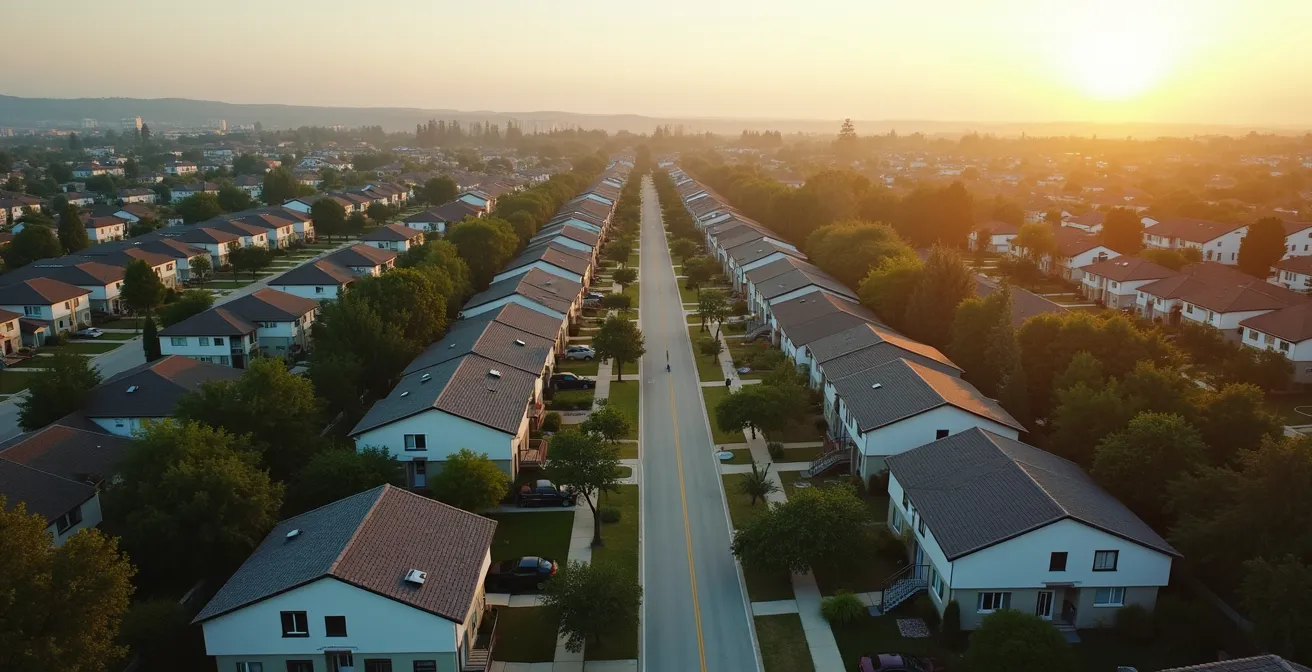
Post-pandemic suburban value isn’t about cheaper land; it’s driven by a property’s ability to support a “full-stack” remote lifestyle.
- Second-tier cities and suburbs are showing superior appreciation as they become self-sufficient economic hubs.
- True ROI now depends on “productivity” features like fiber internet and dedicated office space, which command significant rental premiums.
Recommendation: Investors must shift from broad geographic analysis to a granular, feature-based evaluation of properties to identify genuine growth opportunities in this new market paradigm.
For real estate investors and developers, the post-pandemic landscape has been a complex puzzle. The narrative of a mass urban exodus has dominated headlines, suggesting a simple gold rush into suburban markets. Conventional wisdom points to the rise of remote work and the search for more affordable space as the primary drivers. While these factors are undeniably part of the story, relying on them alone is a strategy for mediocrity, not market-beating returns. The most common advice—to simply buy in suburbs with good schools and larger yards—misses the profound structural shifts occurring beneath the surface.
The reality is far more nuanced. We are witnessing not just a migration, but a fundamental realignment of what constitutes “value” in residential real estate. The true opportunity lies not in chasing the trend, but in understanding the new micro-economic indicators that now dictate appreciation and yield. But if the old rules no longer fully apply, what is the new playbook? The key isn’t just analyzing where people are moving, but *how* they intend to live and work in those new locations. This requires a shift from a location-centric model to a property-centric one, where a home’s capacity to deliver a ‘full-stack’ lifestyle—blending work, productivity, and leisure—becomes the primary asset.
This analysis will dissect the key trends reshaping suburban property values for the discerning investor. We will move beyond the headlines to explore the outperformance of second-tier cities, the new realities of cap rate calculation in a volatile environment, and the strategic choice between short-term and long-term rental models. Furthermore, we will delve into the critical, often-overlooked impacts of zoning changes and identify the precise signals that mark the opportune “capitulation” phase of a market cycle. Finally, we’ll examine how global demographic pressures and development innovations are creating the high-yield opportunities of tomorrow.
For those who prefer a visual summary, the following video encapsulates the key trends and opportunities defining the post-pandemic real estate market, providing a perfect complement to the detailed analysis in this guide.
To navigate this new terrain effectively, a structured approach is essential. The following sections provide a detailed roadmap for investors and developers, breaking down each critical component of the modern suburban real estate equation.
Summary: A Strategic Guide to Post-Pandemic Suburban Investing
- Why Second-Tier Cities Are Outperforming Capitals in Appreciation?
- How to Calculate True Cap Rate When Interest Rates Are Volatile?
- Airbnb or Annual Tenant: Which Yields Better ROI in 202X?
- The Zoning Change Oversight That Can Crash Your Property Value
- When to Buy: Identifying the “Capitulation” Phase of a Market Cycle
- Why Global Demographics Shift Economic Power Toward Emerging Nations?
- Identifying High-Yield ROI Opportunities in a High-Inflation Economy?
- Innovations in Property Development: Reducing Construction Timelines by 30%?
Why Second-Tier Cities Are Outperforming Capitals in Appreciation?
The post-pandemic narrative is not simply about “suburbs,” but about the rise of “second-tier satellites”—smaller, self-sufficient cities that are capturing economic momentum once reserved for major capitals. The decoupling of work from a central office location means talent is now prioritizing quality of life, affordability, and community amenities. This creates a powerful investment thesis: capital appreciation is now flowing to markets that offer the best lifestyle-to-cost ratio, not just proximity to a traditional downtown core. These cities are no longer just bedroom communities; they are becoming vibrant economic centers in their own right, attracting businesses and a skilled workforce.
The data supports this structural shift. While major metropolitan areas see price growth stagnate, many smaller markets are experiencing significant value increases. For example, an analysis by Ownerly shows that Rochester, NY, saw per-square-foot prices rise by double digits year-over-year in April 2024. This isn’t an isolated event. A closer look at Lake County, Illinois, demonstrates this dynamic perfectly. The area is seeing substantial home price growth driven by remote workers who are attracted to its affordability and amenities, choosing the location for its lifestyle rather than its commute. This demonstrates a repeatable pattern: when a location combines affordability with high-quality infrastructure and lifestyle perks, it becomes a magnet for the modern workforce, driving property values upward.
For investors, this means the old maps are obsolete. The focus must shift to identifying these emerging second-tier hubs before they reach peak valuation. This requires a granular analysis of specific market indicators that signal sustainable growth.
Action Plan: Evaluating Second-Tier City Investments
- Points of Contact: Analyze inbound migration data from moving companies, mortgage application origins, and LinkedIn location changes to spot emerging talent flows.
- Collecte: Inventory key market-rate metrics, including cap rates for multifamily units (targeting the 5.8%-9.0% range), year-over-year asking rent growth (seeking 3%+), and multifamily vacancy rates (aiming for a healthy 5%-11%).
- Cohérence: Compare these metrics against the city’s investment in quality-of-life infrastructure (e.g., fiber internet rollout, park development, new retail) to ensure the growth is sustainable and not purely speculative.
- Mémorabilité/Émotion: Assess the city’s unique “brand” or appeal. Is it known for outdoor recreation, a vibrant arts scene, or a burgeoning tech community? A strong local identity attracts and retains talent.
- Plan d’Intégration: Prioritize acquisitions in neighborhoods with a high concentration of these amenities and a clear path for future development, looking for properties that can be easily upgraded to meet the “full-stack” lifestyle demand.
Ultimately, investing in second-tier cities is about capitalizing on a fundamental shift in how and where economic value is created. Those who can identify these patterns early will secure the most significant returns.
How to Calculate True Cap Rate When Interest Rates Are Volatile?
In a fluctuating interest rate environment, the traditional capitalization rate (cap rate) formula can be dangerously misleading. Calculating it as simply Net Operating Income (NOI) divided by property value ignores the dynamic and often aggressive impact of borrowing costs. For today’s investor, calculating a “true cap rate” requires stress-testing the formula against future interest rate scenarios and factoring in a risk premium for market volatility. A static cap rate is a snapshot in time; a true cap rate is a predictive tool that accounts for financial turbulence.
The relationship is not always linear. Rising interest rates typically put upward pressure on cap rates as buyers demand higher yields to compensate for more expensive debt. This was evident in the latter half of 2024, when office cap rates increased by roughly 20 basis points, with Class A offices exceeding 8%, according to CBRE’s H2 2024 survey. This expansion reflects a market re-pricing risk. Conversely, falling rates can compress cap rates as more buyers enter the market, bidding up prices and accepting lower initial yields.

As the visual suggests, meticulous calculation is paramount. The key is to move from a single number to a range of potential outcomes based on different rate environments. This “sensitivity analysis” is what separates speculative gambling from strategic investing.
The following table, adapted from J.P. Morgan analysis, outlines how to adjust your calculations based on the prevailing interest rate climate. It highlights the key factors to consider beyond the simple NOI/value equation.
| Interest Rate Environment | Typical Cap Rate Impact | Key Adjustments Needed |
|---|---|---|
| Rising Rates (2024) | +0.4% or more increase | Factor in higher borrowing costs, limited transaction volume |
| Stable Rates | Minimal change | Focus on rent growth potential, tenant quality |
| Declining Rates | Potential decrease | Account for increased buyer competition, compressed yields |
Therefore, a sophisticated investor’s spreadsheet should include columns for “best-case,” “worst-case,” and “most-likely” scenarios for interest rates over their holding period, yielding a dynamic cap rate range that provides a far more realistic picture of potential returns.
Airbnb or Annual Tenant: Which Yields Better ROI in 202X?
The short-term rental (STR) versus long-term rental debate has intensified in the post-pandemic era. While platforms like Airbnb historically offered the potential for higher gross revenue, the market is maturing, and the calculus is changing. A simple comparison of annual rent versus potential nightly rates is no longer sufficient. A true ROI analysis must now account for increased operational complexity, regulatory risks, and a significant shift in guest behavior toward longer stays.
On the surface, the numbers for STRs can be compelling. According to Airbnb data from 2021, the average host earned $13,800. Applied to a $200,000 property, this suggests a 6.9% ROI, which could outperform traditional rentals in many markets. However, this figure predates the current market dynamics. A more telling trend is the rise of the “digital nomad” and extended stays. Crucially, data from Baselane shows that Airbnb’s extended stays (30+ days) now account for 21% of total bookings, a notable increase from previous years. This blurs the line between a hotel alternative and a flexible long-term lease, demanding a hybrid management approach.
The biggest wild card remains regulatory risk. Municipalities across the country are cracking down on non-owner-occupied STRs, imposing hefty taxes, licensing fees, and in some cases, outright bans. An investment that looks profitable today could be rendered unviable by a single city council vote. This political volatility represents a significant, unquantifiable risk that is not present with traditional annual leases. Investors must therefore become political analysts, monitoring local government agendas as closely as they watch market data.
Regulatory Risk Scorecard for STR Investments
- Check local STR licensing requirements and associated costs: Are they one-time fees or recurring annual charges that impact NOI?
- Monitor city council meetings for proposed STR restrictions: Set up alerts for keywords like “short-term rental,” “Airbnb,” or “zoning.”
- Analyze percentage of non-owner-occupied homes in the area: A high percentage can trigger a community backlash and regulatory action.
- Evaluate hotel lobby influence in local politics: A strong hotel presence often correlates with stricter STR regulations.
- Track resident complaint frequency about STRs in neighborhood forums: This is a leading indicator of future political pressure.
Ultimately, the choice is not simply about maximizing gross revenue. For many investors, the stability, lower operational overhead, and regulatory certainty of an annual tenant now present a more attractive risk-adjusted return than the volatile, high-maintenance world of short-term rentals.
The Zoning Change Oversight That Can Crash Your Property Value
For most property investors, zoning is a static, background detail—a box to check during due diligence. This is a critical and potentially costly oversight. In the post-pandemic market, zoning is a dynamic and powerful force that can create or destroy value with astonishing speed. Proactive investors no longer just react to zoning laws; they practice “zoning arbitrage” by anticipating and capitalizing on future changes. Ignoring the political and social pressures driving these changes is akin to ignoring interest rate trends.
The most significant trend is “upzoning,” where land previously designated for single-family homes is rezoned to allow for denser developments like duplexes or small apartment buildings. This is often a municipal response to housing shortages and affordability crises. When a property is upzoned, its value can increase dramatically overnight because its highest and best use has fundamentally changed. Urban Institute research confirms that reducing development constraints invariably increases property values, especially for parcels ripe for new construction.
The 2019 decision in Minneapolis serves as a landmark case study. The city voted to eliminate single-family zoning, allowing for the development of small multifamily units in neighborhoods previously off-limits to developers. This single policy change unlocked immense potential value for property owners who could now sell their land to developers for a premium or undertake development projects themselves. The city ordinance specifically targeted areas with good access to transit and employment, creating a clear roadmap for savvy investors looking for the next growth zones.
Conversely, “downzoning” or the implementation of new restrictions (e.g., historical preservation overlays, stricter environmental codes) can have the opposite effect, capping a property’s development potential and effectively crashing its speculative value. An investor who buys a property with the intent to redevelop, without monitoring the local political climate, could find their plans completely derailed. Understanding the direction of local housing policy is therefore a crucial component of modern risk management.
The takeaway is clear: due diligence in 202X and beyond must include an analysis of the local planning commission’s agenda, attendance at community meetings, and an understanding of the political pressures shaping your target market’s future landscape.
When to Buy: Identifying the “Capitulation” Phase of a Market Cycle
Timing the market is a notoriously difficult endeavor, but savvy investors don’t guess—they look for clear, data-driven signals. In the context of the real estate cycle, the most opportune moment to buy is often during the “capitulation” phase. This is the point of maximum pessimism, where sellers who were holding out for peak prices finally give up and accept the new market reality. It’s characterized by a surge in inventory, increased days on market, and frequent price reductions. This is not a crash, but a correction that washes out speculation and creates opportunities for cash-rich, strategic buyers.
The early days of the COVID-19 pandemic provided a micro-example of this phenomenon. Historical data from the pandemic shows that in May 2020, home sales dropped a staggering 34.2% year-over-year as uncertainty paralyzed the market. This brief but intense period of fear was a capitulation phase. Those who had the foresight and capital to buy during that window were rewarded handsomely as the market rebounded with unprecedented speed within just a couple of months. While the next cycle may not be as dramatic, the principle remains the same: buying when others are fearful is a proven path to value.

Identifying this phase in the current, nuanced suburban market requires looking beyond national headlines and focusing on hyper-local, post-pandemic indicators. The signals of capitulation are different now than they were a decade ago.
Suburban-Specific Capitulation Signals to Monitor
- Surge in listings from “reluctant landlords”: Track rental listings that were previously Airbnbs. A spike indicates that STR operators are failing to generate expected income and are exiting the market.
- Drop-off in out-of-state mortgage applications: This suggests that the wave of remote work relocations is slowing, reducing external demand pressure.
- Analyze Days-on-Market specifically for homes without dedicated home offices: If properties lacking remote-work amenities are sitting on the market longer, it’s a sign that buyer priorities have fundamentally shifted.
- Watch for increased inventory from institutional and small-time investors exiting the market: This often signals a belief that short-term appreciation has peaked.
- Observe the frequency of pricing adjustments: An increase in the number of price cuts on comparable properties is the most direct signal of seller capitulation.
By systematically monitoring these new leading indicators, investors can move beyond emotional market timing and develop a data-backed strategy for entering the market at points of maximum opportunity.
Why Global Demographics Shift Economic Power Toward Emerging Nations?
While the term “emerging nations” often brings to mind countries in Asia or Africa, a parallel phenomenon is occurring *within* developed nations. The “emerging nations” of the post-pandemic real estate market are the second-tier cities and revitalized suburbs. The global demographic shift at play is not one of nationality, but of profession: the rise of a location-independent, skilled professional class. This demographic is migrating away from expensive, legacy economic hubs toward areas that offer a better quality of life, effectively shifting economic power and real estate demand with them.
This internal migration is a direct challenge to the long-held assumption that economic opportunity is inexorably tied to a few major metropolitan centers. As researchers from the Penn Institute for Urban Research noted, “Cities differ in productivity and amenities and, consequently, in real estate prices.” In the past, the productivity premium of being in a capital city outweighed the high cost of living. Today, technology allows for high productivity from anywhere, causing workers and the companies that want to hire them to re-evaluate the equation. They are choosing amenities and affordability, and real estate values are following suit.
The economic impact of this demographic shift is profound. The influx of high-earning remote workers into these “emerging” domestic markets injects significant capital into the local economy. This creates a virtuous cycle: new residents demand more services, which creates local jobs, which in turn attracts more residents and businesses, driving sustained property appreciation. This trend is not speculative; it is a fundamental re-routing of economic power. An analysis of this trend shows that these markets are not just getting more residents, they are getting wealthier ones, with income growth in popular remote work destinations far outpacing the national average.
For the real estate investor, this means the most valuable demographic to track is no longer a specific age group, but the growing cohort of skilled professionals whose location is a matter of choice, not necessity. Investing where they choose to live is the most direct way to invest in the future of the economy.
Identifying High-Yield ROI Opportunities in a High-Inflation Economy?
In a high-inflation environment, cash flow is king, and real estate is traditionally seen as a strong hedge. However, not all properties are created equal. To generate high-yield ROI, investors must focus on assets that not only retain value but also offer the ability to command premium rents that outpace inflation. In the post-pandemic market, this means investing in properties with specific, in-demand features that cater to the “full-stack” remote lifestyle. This is the essence of “Productivity-Adjusted ROI”: valuing property features based on their direct contribution to a tenant’s ability to live and work efficiently.
General inflation pushes all costs up, including rent, but properties with superior amenities can justify much larger increases. While a standard apartment might see a 3% rent bump, a unit with a dedicated home office, gigabit fiber internet, and energy-efficient systems can command a 10-15% premium. These are no longer “nice-to-haves”; they are essential infrastructure for a growing segment of the rental market. This focus on features provides a durable competitive advantage that is resistant to market fluctuations.
This strategy also directly impacts the cap rate. While broad market trends, as recent analysis reveals that cap rates for major sectors including multifamily expanded 23%, properties with these high-demand features often exhibit more stable, compressed cap rates because they are seen as lower-risk assets with more reliable income streams. They attract higher-quality, longer-term tenants, reducing turnover costs and vacancy risk—two major drags on NOI in an inflationary climate.
The following table breaks down specific inflation-adaptive features and their quantifiable impact on both rental income and long-term asset value, providing a clear guide for value-add investment strategies.
| Feature | Rental Premium Potential | Long-term Value Impact |
|---|---|---|
| Gigabit Fiber Internet | 5-10% higher rent | Essential for remote work tenants |
| Dedicated Home Office | 8-15% premium | Critical differentiator post-pandemic |
| Level 2 EV Charger | 3-8% increase | Growing importance with gas prices |
| Energy-Efficient Systems | 4-7% premium | Reduces tenant operational costs |
By investing in a property’s productivity, you are future-proofing your asset and building a portfolio that can deliver superior returns regardless of the macroeconomic climate.
Key Takeaways
- The most significant appreciation is occurring in second-tier cities that offer a superior lifestyle-to-cost ratio, attracting a skilled remote workforce.
- In a volatile market, a “true cap rate” calculation must be stress-tested against various interest rate scenarios to accurately reflect risk.
- High-yield ROI in an inflationary economy is achieved by investing in properties with “productivity” features that command premium rents, such as home offices and high-speed internet.
Innovations in Property Development: Reducing Construction Timelines by 30%?
In the fast-moving post-pandemic market, speed is a critical component of ROI. For property developers, the ability to bring a project to market faster means capitalizing on peak demand and beginning to generate revenue months or even years ahead of the competition. As one real estate development expert noted in an industry analysis, “Speed-to-market in a booming suburb can generate significant ‘first-mover’ income that dramatically alters the project’s ROI.” This is where innovations in construction, such as modular and prefabricated building techniques, become a strategic financial tool, not just an operational efficiency.
These methods, which involve manufacturing building components off-site in a controlled factory environment, can reduce construction timelines by as much as 30-50%. This acceleration has a cascading positive effect on a project’s financials. It reduces carrying costs for land, minimizes exposure to fluctuating material prices, and lowers on-site labor expenses. In a market where demand can shift rapidly, delivering a finished product while competitors are still breaking ground is a massive competitive advantage.
The ultimate strategy for maximizing returns combines these development innovations with proactive “zoning arbitrage.” The case of the NoMa area in Washington, D.C., provides a powerful illustration. After the 358-acre mixed-use area was upzoned, developers who could move quickly were able to capitalize on the new, higher-density allowances. This strategic combination of policy and speed generated an additional $49 million in annual revenue by 2012. This shows that the greatest value is unlocked at the intersection of regulatory opportunity and operational excellence. The developer who is prepared to build quickly is the one who benefits most from favorable zoning changes.
To capitalize on the trends shaping the new suburban landscape, the next step is to analyze your target markets not just for their location, but for their potential for zoning arbitrage and innovative development. The investors who master this synthesis of policy, speed, and product will lead the market for the next decade.