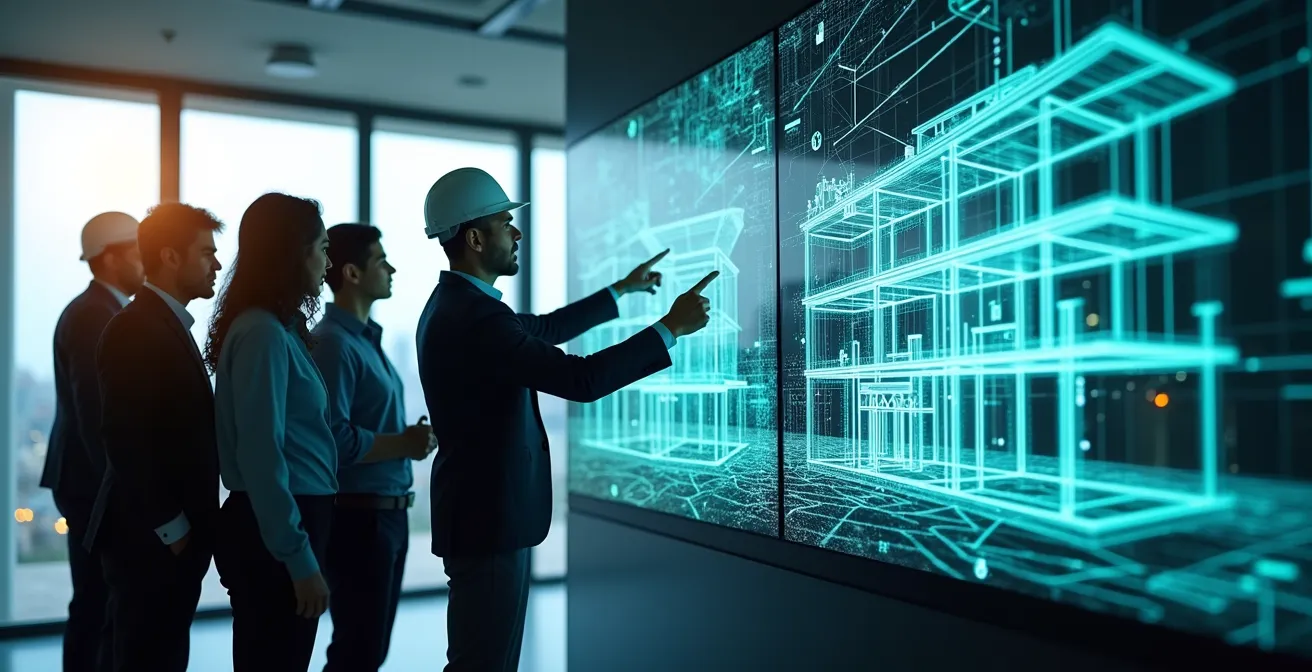
Effective clash prevention is not a software feature; it’s an operational discipline rooted in rigorous protocols and a collaborative culture.
- Technology alone is insufficient. Success depends on standardizing workflows and fostering shared accountability across all teams.
- Strategic data management, including the correct Level of Detail (LOD) and true software interoperability, delivers exponential ROI by eliminating rework.
Recommendation: Shift focus from simply finding clashes to building the systemic framework that prevents them from occurring in the first place.
For any architect, engineer, or construction manager, the specter of on-site clashes is a constant source of budget overruns and project delays. Building Information Modeling (BIM) is universally touted as the solution, a digital crystal ball to foresee and resolve conflicts before a single shovel hits the ground. The common wisdom suggests that running clash detection software is the silver bullet. Teams are told to collaborate, share models, and let the algorithm find the problems.
But this view is dangerously incomplete. Many projects that diligently use BIM software still suffer from costly errors. The real challenge isn’t a lack of technology; it’s a lack of process. Clashes are merely symptoms of a deeper issue: a breakdown in communication, misaligned data, and a failure of operational discipline. The belief that software can fix human and systemic problems is the most expensive assumption in modern construction.
What if the key to preventing clashes wasn’t just about the tool, but about the rules of engagement? This guide moves beyond the platitudes of “collaboration” to provide a framework for the rigorous discipline required for true clash avoidance. We will explore how to standardize protocols, define the right level of detail, foster a culture of shared accountability, and leverage innovations like digital twins not just as models, but as long-term management assets. This is the blueprint for turning BIM from a detection tool into a prevention strategy.
To fully grasp how these elements interconnect, this article breaks down the core disciplines required to transform your BIM process. The following sections will provide a detailed roadmap, from long-term asset management to the cultural foundations essential for success.
Summary: A Disciplined Framework for BIM Clash Prevention
- Why Managing a Digital Twin Reduces Maintenance Costs for 20 Years?
- How to Standardize BIM Protocols Across Three Different Firms?
- Design Detail or Fabrication Ready: Which Level of Detail Do You Need?
- The Interoperability Trap: When Architect and Engineer Software Don’t Talk
- When to Run Clash Detection: Weekly vs Milestone-Based Schedules
- Why Digital Transformation Fails Without a Parallel Cultural Shift?
- How to Use Digital Snagging Tools to Close Out Projects Faster?
- Innovations in Property Development: Reducing Construction Timelines by 30%?
Why Managing a Digital Twin Reduces Maintenance Costs for 20 Years?
The conversation around BIM often ends at project handover, but its true value extends far beyond construction. This is where the concept of a Digital Twin emerges. While a BIM model is a detailed but static design representation, a Digital Twin is a living, dynamic mirror of the physical asset, updated with real-time data from sensors and operational inputs. It’s the difference between a blueprint and a live monitoring system. This transition from a static model to a dynamic twin is the key to unlocking decades of operational savings. By simulating performance, predicting failures, and optimizing energy use, the Digital Twin transforms facility management from a reactive to a proactive discipline.
The financial implications are substantial. Predictive maintenance powered by a digital twin allows managers to address issues before they become catastrophic failures, dramatically cutting lifecycle costs. Research confirms a significant impact, with some studies showing up to a 40% reduction in maintenance costs. Furthermore, a comprehensive report on digital twin adoption found that companies not only achieve an average of 19% in cost savings and a 22% annual ROI, but also a 15% reduction in carbon emissions, linking operational efficiency directly to sustainability goals.
This visualization shows how a physical asset and its digital counterpart are intrinsically linked. The real-time data flow enables a level of foresight impossible with traditional methods, turning the building itself into an intelligent, self-diagnosing system.

Ultimately, investing in a Digital Twin is an investment in the building’s future. It ensures that the rich data coordinated during the design and construction phase becomes a perpetual asset, driving down costs and improving performance for the entire 20-year operational lifecycle and beyond. This long-term perspective is a cornerstone of a mature BIM strategy.
How to Standardize BIM Protocols Across Three Different Firms?
A federated model with input from multiple architectural, engineering, and contracting firms is a recipe for chaos without a unifying set of rules. The most advanced software is useless if one firm models to a different standard than another. This is where a robust BIM Execution Plan (BEP) becomes the single source of truth. The BEP is a formal document that defines the project’s BIM goals, standards, and responsibilities. It dictates everything from file naming conventions and model origins to the level of detail required at each project stage. Establishing this protocol-driven workflow is the most critical step in ensuring seamless collaboration.
Standardization is not about restricting creativity; it’s about creating a common language. It ensures that when models are combined for clash detection, they align perfectly, preventing a flood of false positives and allowing the team to focus on genuine constructability issues. This requires clear communication and upfront agreement from all stakeholders, turning the process from a technical exercise into a collaborative pact.
Your Action Plan: Establishing a Multi-Firm BIM Protocol
- Plan the Sequence: Conduct Pull Planning workshops to map the installation sequence of building systems. This helps all firms understand what elements go where and when, creating a logical construction timeline.
- Establish Priority: Define a System Priority Structure (e.g., structural elements take precedence over MEP). This creates a clear hierarchy for resolving clashes, ensuring the most critical issues are addressed first.
- Centralize Collaboration: Implement cloud-based software that allows each team’s model to synchronize in near real-time. This enables designers and engineers to track their own elements and manage updates transparently.
- Integrate and Detect: Use dedicated BIM integration and clash detection software (like those listed below) to create a clash-coordinated federated model that combines all disciplines.
- Capture and Reuse: Document the agreed-upon plan and coordination rules in a digital platform. Track progress to completion and, most importantly, reuse this successful framework on future projects to build institutional knowledge.
Choosing the right technology stack is essential to support these protocols. While many platforms exist, their ability to handle different file formats and facilitate cloud collaboration varies. The following comparison highlights some of the leading tools for multi-firm coordination.
| Software Platform | IFC Support | Cloud Collaboration | Best For |
|---|---|---|---|
| Navisworks | Full IFC import/export | Via BIM 360 | Large federated models |
| Solibri | OpenBIM certified | Limited | Rule-based checking |
| Revizto | IFC compatible | Native cloud | Real-time collaboration |
| Autodesk Construction Cloud | Native Revit + IFC | Fully cloud-based | Automatic clash detection |
Design Detail or Fabrication Ready: Which Level of Detail Do You Need?
The term “Level of Detail” (or Level of Development, LOD) is often misunderstood. It doesn’t mean modeling everything with maximum detail from the start. Doing so is inefficient and generates overwhelming amounts of data. The key is strategic granularity: applying the right level of detail at the right time for the right purpose. A model at LOD 200 might show a generic representation of a pump, while an LOD 400 model would include the exact manufacturer, connection points, and clearance requirements needed for pre-fabrication. Choosing the appropriate LOD is a strategic decision that directly impacts project cost and efficiency.
Demanding fabrication-ready detail (LOD 400) for every element in the early design stages is a waste of resources. Conversely, heading into construction with only schematic-level detail (LOD 200) for critical systems guarantees on-site clashes. The optimal strategy is to progressively increase the LOD based on project milestones. For instance, structural and primary MEP systems might be developed to a higher LOD earlier than interior finishes. This targeted approach focuses the modeling effort where it provides the greatest return on investment by resolving the most expensive potential conflicts first.
Case Study: The ROI of Strategic LOD
The value of investing in detailed modeling for critical areas is not theoretical. A case study by Haskell on a $230 million design-build food project demonstrated this powerfully. A targeted investment of $200,000 in BIM coordination, which includes developing key systems to a high LOD, resulted in over $2 million in savings from avoided clashes and rework. This 10x return illustrates that spending money on detailed digital modeling is not a cost, but a high-yield investment when applied strategically.
This disciplined approach to data development is proven to prevent the kind of errors that inflate budgets. In fact, a comprehensive study found that projects using a mature clash detection methodology, which relies on appropriate LOD, achieved estimated savings of 20% of the total contract value on a multi-million-dollar infrastructure project. This underscores that the “how much detail” question is central to financial success.
The Interoperability Trap: When Architect and Engineer Software Don’t Talk
The promise of BIM is a seamless flow of information. The reality is often a digital Tower of Babel, where the architect’s software doesn’t speak the same language as the structural engineer’s or the MEP contractor’s. This is the interoperability trap. While standards like Industry Foundation Classes (IFC) aim to create a common data format, the translation is rarely perfect. Data can be lost, corrupted, or misinterpreted, leading to model discrepancies that create false clashes or, worse, hide real ones. This technical friction undermines the entire coordination process.
However, the biggest challenge isn’t technical; it’s cultural interoperability. Even with perfect software, teams that operate in silos, protect their data, and fail to communicate their modeling assumptions will create disjointed federated models. The solution is not just a better file converter; it’s a designated human orchestrator who bridges these gaps. This role is a combination of technical expert, diplomat, and project manager.
The bridge between different software platforms is not built of code alone; it’s built on clear communication and unified protocols managed by a central coordinator.

This human element is so critical that it’s often the single point of failure or success in a multi-firm project. As the technical documentation from one of the leading BIM platforms notes, the role of this individual is paramount to success.
The BIM coordinator or BIM manager serves as the central orchestrator of the clash detection process.
– Revizto Technical Documentation, BIM Clash Detection Best Practices Guide
This orchestrator is responsible for setting up the federated model, defining clash tests, and—most importantly—facilitating the resolution meetings where architects, engineers, and contractors collaboratively find solutions. Without this central hub of accountability, technology alone will always fall short.
When to Run Clash Detection: Weekly vs Milestone-Based Schedules
One of the most common questions is how often to run clash detection. There is no single right answer, as the optimal cadence depends on the project’s phase and complexity. However, a hybrid approach combining frequent “pulse checks” with formal milestone reviews offers the best balance of proactivity and efficiency. Running a full clash analysis on the entire federated model every day can generate overwhelming noise. The key is to be strategic about what you test and when.
During active design phases, weekly automated checks within individual teams (e.g., the MEP team coordinating its own ductwork, piping, and electrical trays) are essential for maintaining internal model hygiene. These checks help resolve “hard clashes” (two objects occupying the same space) early. Then, leading up to major project milestones (like 30%, 60%, and 90% design submissions), formal, milestone-based clash reviews should be conducted on the fully federated model. These sessions are crucial for identifying “soft clashes” (objects without proper clearance) and “workflow clashes” (issues with scheduling or constructability) that require interdisciplinary negotiation.
A smart clash detection strategy involves more than just a schedule; it requires a system for prioritization and focus. The following framework helps teams manage the process effectively:
- Weekly Pulse Checks: Run automated internal coordination checks to resolve discipline-specific conflicts. This requires clear protocols with defined roles for who is responsible for moving which system.
- Milestone Phase Reviews: Use a Clash Matrix to prioritize which interdisciplinary clashes to address first. Clashes involving major structural and architectural elements typically take precedence over those within a single trade like MEP.
- Targeted Zone Testing: Instead of running broad tests that generate thousands of low-priority clashes, focus on critical zones or systems, such as congested plant rooms or complex facade interfaces.
- Smart Grouping Strategy: Use software tools to group and filter clashes by level, system, or location. This helps the team focus on the most important issues first, rather than getting lost in a sea of minor conflicts.
This disciplined, phased approach ensures that coordination efforts are always focused on the most critical issues at the right time. By integrating predictive capabilities through digital twin technology, some contractors have found that this proactive scheduling can lead to a remarkable 30% reduction in project delays, directly linking a smart clash detection cadence to on-time delivery.
Why Digital Transformation Fails Without a Parallel Cultural Shift?
We can invest millions in the best BIM software, mandate its use, and write exhaustive protocols, but if the underlying culture of a project team remains rooted in silos and adversarial relationships, the transformation will fail. Technology is an enabler, not a solution. The true digital transformation in construction is a cultural shift from individual ownership to shared accountability. It’s about moving away from a “not my problem” mindset to a “how do we solve this together” approach.
In a traditional workflow, when a clash is found on-site, the blame game begins. In a successful BIM workflow, when a clash is found in the model, a collaborative problem-solving session begins. This requires a profound change in mindset, where finding a clash is seen not as a failure, but as a collective success in preventing a future problem. This can only happen in an environment of psychological safety, where team members are empowered to raise issues without fear of reprisal.
This collaborative spirit is the human engine that makes the BIM machine run. Without it, even the most sophisticated technology becomes just another tool for generating contentious reports.

This shift towards shared risk and responsibility is the very definition of a successful collaborative environment. As one research team puts it, true collaboration is a pact.
Collaboration is achieved when project teams share the risk for identifying clashes and the responsibility of the solution.
– BIM Corner Research Team, BIM Coordination Best Practices Study 2024
Fostering this culture is the primary role of project leadership. Project managers must champion the process, enforce the protocols, and, most importantly, facilitate the human interactions that turn a group of consultants into a single, integrated project team. They must ensure the BIM coordinator has both the technical expertise and the project management skills to navigate complex interpersonal dynamics and keep the coordination process moving forward efficiently.
How to Use Digital Snagging Tools to Close Out Projects Faster?
The benefits of a disciplined BIM process crystallize during the final phases of a project, particularly during closeout and snagging (also known as a punch list). Traditionally, this is a tedious, manual process involving endless paper checklists, ambiguous photos, and multiple site visits to verify fixes. This final stretch is often fraught with delays and disputes. However, a project built on a well-coordinated BIM model can leverage digital snagging tools to accelerate closeout dramatically.
Instead of discovering issues during a final walkthrough, many potential snags are pre-identified as “low-priority” clashes or serviceability issues in the model throughout the project. These items are captured in a digital punch list, linked directly to their specific location in the BIM model. When a trade contractor logs a fix, they can upload a photo for verification. Project managers can even use augmented reality (AR) on a tablet to overlay the model on the physical installation and confirm compliance instantly, often eliminating the need for a return visit. The result is a faster, more accurate, and less contentious closeout process.
The efficiency gains from shifting to a digital, model-based closeout process are staggering. The entire workflow, from discovery to handover, is streamlined.
| Aspect | Traditional Method | Digital Snagging with BIM | Time Savings |
|---|---|---|---|
| Issue Discovery | Manual walkthrough | Pre-identified from clash log | 60% |
| Documentation | Paper checklists | Digital punch list linked to model | 75% |
| Verification | Physical re-inspection | AR overlay confirmation | 50% |
| Handover | Boxes of documents | Digital twin with full history | 80% |
This process doesn’t just save time; it fundamentally improves the quality of the final product. By creating a transparent and accountable workflow, issues are resolved correctly the first time. According to a landmark Dodge Data and Analytics report, this focus on quality throughout the BIM process has a clear payoff, with an overwhelming 93% of AEC professionals stating that BIM improved the quality and functionality of the final design.
Key Takeaways
- Clash prevention is a result of systemic discipline, not just software.
- A BIM Execution Plan (BEP) is the non-negotiable foundation for multi-firm collaboration.
- True collaboration involves shared risk and accountability, a cultural shift that must be led by project managers.
Innovations in Property Development: Reducing Construction Timelines by 30%?
The promise of reducing construction timelines by a significant margin, such as 30%, is not achieved through a single magic bullet. It is the cumulative result of a holistic, disciplined, and digitally-integrated approach to project delivery. Every step we’ve discussed—from the long-term view of a Digital Twin and standardized protocols to the cultural shift towards shared accountability—contributes to this outcome. By front-loading the problem-solving process into the digital realm, we systematically de-risk the physical construction phase.
The time saved comes from multiple sources: fewer delays from on-site clashes, reduced time for rework, faster procurement through fabrication-ready models, and a streamlined closeout process. Each clash avoided is a delay prevented. Each question answered in the model is a question that doesn’t stop work on site. This compounding effect of small efficiencies is what leads to major timeline reductions. It is the ultimate payoff for the upfront investment in planning, coordination, and team integration.
Case Study: The Financial Impact of Smart Building Systems
The benefits extend directly to the building’s operational life, proving the value of an integrated strategy. Industry reports from leaders like JLL and Johnson Controls highlight that smart building upgrades—systems designed and coordinated through BIM and managed via a digital twin—can reduce maintenance costs by as much as 20%. This is achieved through AI-driven fault detection and predictive maintenance systems that are only possible with the clean, structured data a well-managed BIM process provides. This shows that designing for constructability also means designing for long-term operability.
Ultimately, accelerating property development is about transforming the entire project delivery ecosystem. It requires moving beyond the linear, often adversarial, model of the past and embracing a truly integrated and collaborative framework. The technology is here, but it’s the operational discipline and cultural commitment that will unlock its full potential to deliver better buildings, faster and more cost-effectively.
To put these principles into practice, the next logical step is to champion the development of a comprehensive BIM Execution Plan on your next project, ensuring all stakeholders commit to a shared, disciplined workflow from day one.