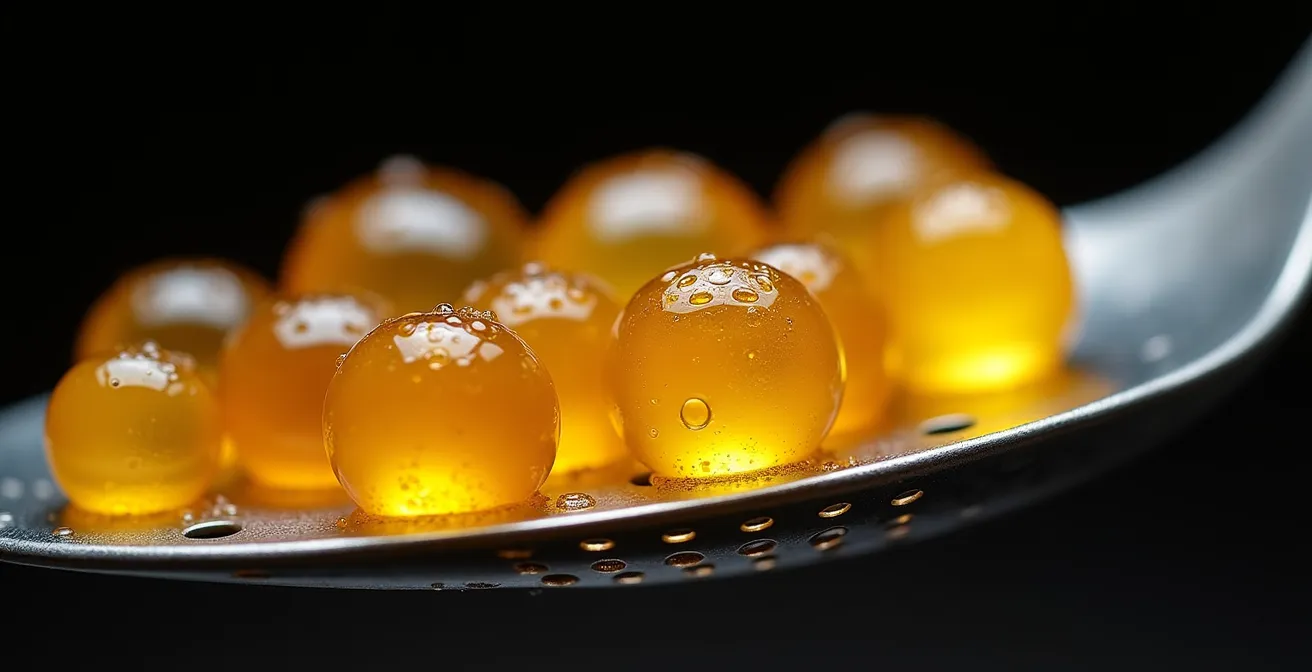
The transformation of simple ingredients into a high-value tasting menu is not a result of isolated scientific ‘tricks,’ but the application of a holistic culinary system.
- Technical precision, like controlling pH for spherification, is the non-negotiable scientific foundation.
- True value is built through sensory architecture—structuring a menu to create a narrative progression of flavors and textures.
Recommendation: Shift focus from ‘what can this technique do?’ to ‘how does this technique serve the ingredient’s story?’ This system-based thinking is the real engine of culinary innovation and value.
The question of value in fine dining is a fascinating one. How does a humble ingredient, perhaps a carrot or a scallop, undergo a metamorphosis that justifies a position on a $200 tasting menu? The common answer points to “molecular gastronomy”—a term that evokes images of liquid nitrogen smoke, edible foams, and gravity-defying spheres. Many believe the secret lies in mastering these spectacular, almost magical, scientific tricks. This leads to a focus on individual techniques, treating them as isolated tools for surprise.
However, this perspective misses the fundamental truth of modern avant-garde cuisine. If the key was simply a collection of novel textures, the novelty would quickly fade, leaving only a hollow spectacle. What if the real alchemy lies not in the tricks themselves, but in a much deeper, more integrated philosophy? The transformation from simple to sublime is rooted in a holistic system—a complete ‘culinary regimen’ where science, artistry, and ingredient philosophy work in concert. It’s about understanding the ‘why’ behind the science, structuring a sensory journey, and never forgetting that technology’s highest purpose is to reveal the soul of an ingredient, not to mask it.
This guide deconstructs that system. We will move beyond the spectacle to analyze the core principles that truly create value, exploring how chemical precision, narrative menu design, and a deep respect for the raw material converge to create an unforgettable—and valuable—dining experience.
For those who prefer a condensed format, the following video from the Harvard Science & Cooking series offers a glimpse into the reinvention of texture and flavor that underpins many of these concepts, providing a perfect visual complement to the principles discussed below.
This article will guide you through the essential pillars of this modern culinary philosophy. From the foundational science of a single sphere to the overarching narrative of an entire menu, you will gain a chef’s-eye view of how true value is architected in the world’s most innovative kitchens.
Summary: The Architecture of Value in Modern Cuisine
- Why Sodium Alginate Requires Precise pH Levels to Form Spheres?
- How to Structure a Tasting Menu to Manipulate Flavour Progression?
- Precision or Reduction: Which Method Yields the Perfect Short Rib?
- The “Instagram Trap” That Leads to Cold, Tasteless Dishes
- How to Balance Crunch and Creaminess for Palate Engagement?
- Why Retinol Alone Isn’t Enough for Skin Regeneration After 40?
- Why a Sommelier Service Increases Check Average by 30%?
- Why Terroir-Driven Ingredients Are the Backbone of Authentic Regional Cuisine?
Why Sodium Alginate Requires Precise pH Levels to Form Spheres?
Spherification, the technique of encapsulating a liquid in a delicate gel membrane, is often the poster child of molecular gastronomy. Yet, its success is not magic; it is a lesson in chemical discipline. The process relies on the reaction between sodium alginate (a salt derived from brown algae) and a calcium chloride solution. The alginate polymers cross-link in the presence of calcium ions, forming a gel. However, this reaction is incredibly sensitive to acidity. The entire structural integrity of the sphere depends on maintaining the right chemical environment, specifically the pH level.
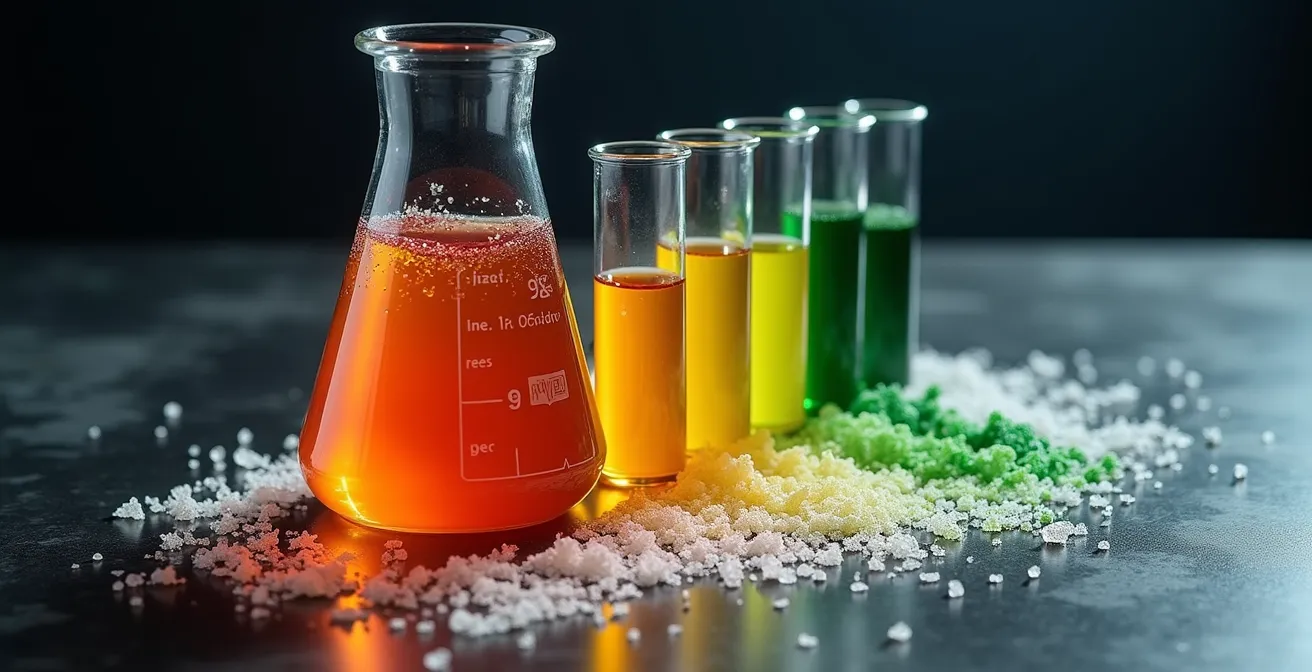
As this visualization of a professional kitchen setup implies, pH is not an afterthought; it is a primary consideration. For the gelling reaction to occur effectively, the pH of the alginate solution must be above 3.6. Below this threshold, the sodium alginate transforms into its acidic, insoluble form (alginic acid), preventing the cross-linking necessary to form a stable sphere. This presents a significant challenge when working with naturally acidic ingredients like citrus juices, vinegars, or passion fruit. As detailed in an analysis of spherification challenges, when pH levels drop, the high concentration of hydrogen ions interferes with proper gel formation. To overcome this, chefs must act as practical chemists, using a buffering agent like sodium citrate to neutralize the excess acid and raise the pH to an optimal level before spherification can even begin.
This necessity for pH control reveals the first principle of value creation: technical foundation. The “magic” is built on an unwavering respect for scientific parameters. Without this precision, the technique fails, and the ingredient’s potential is lost. It is the invisible, rigorous work that makes the spectacular possible.
How to Structure a Tasting Menu to Manipulate Flavour Progression?
Once a chef masters individual techniques, the next level of artistry involves arranging them into a cohesive narrative. A tasting menu is not just a sequence of dishes; it is a form of sensory architecture, meticulously designed to guide the diner’s palate and mind through a progression of flavors, temperatures, and textures. The goal is to create a cumulative experience where each course builds upon the last, creating a whole that is far greater than the sum of its parts. As the legendary chef Ferran Adrià articulated, “Eating isn’t just about satisfying your stomach, it needs to stimulate your brain too.” This mental stimulation is achieved through deliberate manipulation of the dining arc.
Eating isn’t just about satisfying your stomach, it needs to stimulate your brain too.
– Ferran Adrià, Harvard Science & Cooking Lecture Series
This architecture often follows a classic narrative structure. It might begin with light, acidic, and cold preparations to awaken the palate (the exposition). It then builds in intensity, introducing richer, warmer, and more complex umami flavors (the rising action), before reaching a crescendo with the main savory course (the climax). The journey then transitions through a “palate cleanser” (the falling action) before concluding with dessert (the resolution). Within this structure, a chef plays with contrasts: a creamy, rich dish might be followed by something sharp and crunchy to reset the palate; a conceptually simple dish might precede a complex, multi-component creation.
This level of curation elevates the meal from a simple service to a memorable event. It’s this experiential quality that creates significant value. In fact, a similar principle is seen in restaurant finance, where data shows that themed dining events can increase revenue by as much as 30%. A well-structured tasting menu is, in essence, a highly personal, nightly theatrical event, justifying its premium by delivering a unique and unrepeatable journey.
Precision or Reduction: Which Method Yields the Perfect Short Rib?
The conversation in modern kitchens is often framed as a battle between tradition and technology. For a classic dish like braised short rib, this translates to a choice: the time-honored method of slow reduction in a Dutch oven versus the clinical precision of sous-vide cooking. A traditional braise develops deep, complex flavors through the Maillard reaction and collagen breakdown over hours of simmering. It’s an intuitive, sensory process. Sous-vide, conversely, offers absolute control. By sealing the short rib and cooking it in a water bath at a precise, low temperature for an extended period (e.g., 48-72 hours), it achieves a perfectly uniform texture and retains moisture that can be lost in a conventional braise.
However, the most innovative chefs understand this is a false dichotomy. The goal is not to choose one method over the other, but to leverage the strengths of both in a hybrid approach. This embodies the principle of synergistic effect, where combining techniques yields a result superior to either one in isolation. A perfect short rib isn’t about precision *or* reduction; it’s about precision *and* reduction.
The Alinea Approach: A Hybrid of Precision and Tradition
At his restaurant Alinea, Chef Grant Achatz exemplifies this philosophy. For a dish like short ribs, his team often employs a dual technique. The meat is first cooked sous-vide at a precise temperature, for instance 55°C for 48 hours, to achieve a flawless, melt-in-your-mouth texture that is consistent from edge to center. However, sous-vide cooking does not produce the rich, browned flavors of traditional methods. Therefore, after the precision cooking phase, the short rib is removed, patted dry, and seared at extremely high heat to trigger the Maillard reaction, reintroducing the deep, roasted complexity that defines a classic braise. This hybrid method delivers the best of both worlds: the unparalleled consistency of sous-vide and the profound flavor of traditional searing.
This demonstrates that modern culinary arts are not about replacing old methods but about augmenting them. The question is no longer “which tool is best?” but “what is the ideal sequence of techniques to achieve the ultimate expression of the ingredient?” This intelligent integration is a hallmark of high-end cuisine and a key driver of its perceived value.
The “Instagram Trap” That Leads to Cold, Tasteless Dishes
In the age of social media, the visual appeal of a dish has become paramount, creating what can be called the “Instagram Trap.” The pressure to create visually stunning, shareable plates can lead chefs to prioritize aesthetics over the fundamental purpose of food: flavor and sensory enjoyment. This trap manifests in overly complex plating that takes too long, resulting in a dish that arrives at the table cold. It can also lead to the use of techniques for pure spectacle, without any contribution to the flavor profile. A perfectly translucent gel might look amazing, but if it tastes of nothing, it detracts from the dish.
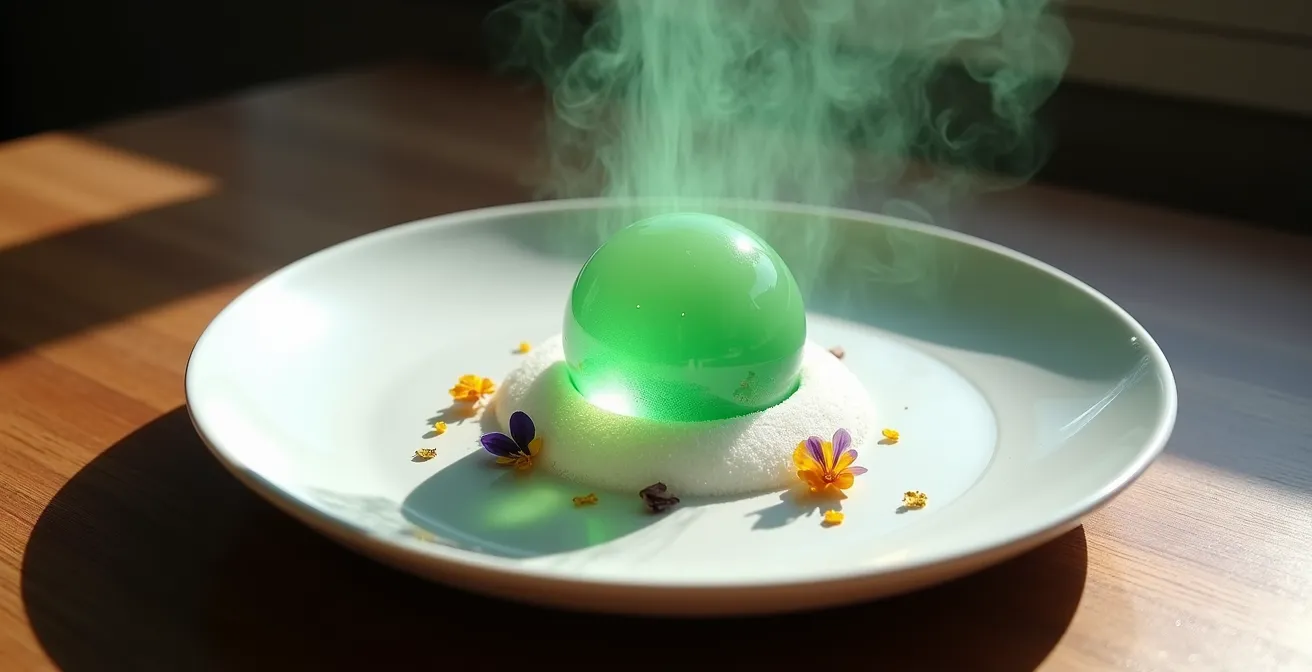
The desire for spectacle is understandable, especially when studies show that 62% of consumers are willing to pay more for unique dining experiences. However, the true masters of the craft know that spectacle must be integrated with substance. The “wow” factor should be a consequence of the cooking concept, not the goal itself. The most successful dishes are those where the visual surprise is inextricably linked to the flavor, temperature, or textural experience. The ephemeral nature of the dish pictured above—a melting sphere releasing an aromatic vapor—is only successful if it is served and consumed within seconds, delivering its payload at the perfect moment.
At Alinea we have a concept of putting a fire at the centre of the table. We hide a wagyu beef wrapped in kombu and a charred parsnip amid the burning charcoal. We light the fire in front of our guests and can leave it like this for 10 to 15 minutes.
– Grant Achatz, Food and Wine Gazette Interview
Grant Achatz’s use of a tableside fire is a perfect example of spectacle done right. It’s visually dramatic, but its primary function is to gently cook the beef and infuse it with smoke. The theatre serves the gastronomy. Escaping the Instagram Trap means binding the visual “story” to the sensory “story,” ensuring that every beautiful element on the plate also makes the dish taste better.
How to Balance Crunch and Creaminess for Palate Engagement?
Beyond flavor, texture is the most powerful tool a chef has for creating a dynamic and engaging dining experience. The interplay between contrasting textures—crispy and soft, crunchy and creamy, dense and airy—is what keeps the palate interested and prevents sensory fatigue. A dish that is uniformly soft, no matter how flavorful, quickly becomes monotonous. Molecular gastronomy has supercharged the chef’s textural toolkit, providing novel ways to introduce these crucial contrasts, turning a simple dish into a multi-dimensional journey for the senses. These techniques now see widespread use, with professional kitchen applications holding a significant 45% market share in the molecular gastronomy equipment space.
Creating these contrasts requires a command of diverse techniques. A creamy purée might be topped with a “soil” made from dehydrated olives for a savory, sandy crunch. A delicate panna cotta could be paired with an ultra-thin, shatteringly crisp “glass” made from potato starch. The goal is to build layers of texture that are discovered as the diner eats, creating moments of surprise and delight. This textural dialogue is a core component of modern plating and a key element of what makes these dishes feel so complex and satisfying.
Action Plan: Mastering Textural Contrast
- Create ultra-thin ‘glass’ from potato starch by dehydrating at 60°C for 8 hours to add a shattering crispness.
- Develop aerated ‘rocks’ using tapioca maltodextrin and high-fat liquids (like nut oils) for a light, melt-in-your-mouth crunch.
- Produce savory ‘soils’ from dehydrated olives or mushrooms ground with liquid nitrogen for a crumbly, earthy texture.
- Use transglutaminase (“meat glue”) to bind proteins into new forms, creating unique crispy-creamy combinations like a bacon-wrapped scallop roulade.
- Apply spherification to create spheres with a liquid core and a delicate skin, offering a burst of flavor that contrasts with a crunchy garnish.
Ultimately, a masterful balance of texture does more than just make a dish interesting; it enhances the perception of flavor. A crunchy element can make a creamy one seem even richer, while a smooth component can highlight the crispiness of another. It’s a carefully orchestrated dance on the palate, and mastering it is a non-negotiable skill for any chef operating at the highest level of the craft.
Why Retinol Alone Isn’t Enough for Skin Regeneration After 40?
In the world of advanced skincare, there’s a well-understood principle: no single “miracle” ingredient works in a vacuum. Retinol may be a powerhouse for skin regeneration, but its effectiveness is dramatically enhanced when used as part of a comprehensive regimen that includes hydration (hyaluronic acid), protection (sunscreen), and support (peptides). Relying on retinol alone yields limited results. This exact metaphor applies directly to the evolution of molecular gastronomy. The initial excitement in the culinary world focused on single, spectacular techniques like spherification, treating them as the “retinol” of the kitchen—a magic bullet for innovation.
However, chefs quickly learned that a single technique, used in isolation, is a gimmick. A lonely sphere on a plate is just a curiosity. Its true power is unlocked only when it’s integrated into a “culinary regimen”—a holistic system where it is supported by other elements. This represents a philosophical shift from a technique-focused approach to an ingredient- and experience-focused one. It’s the understanding that the whole must be greater than the sum of its parts.
From Single Technique to a Holistic ‘Regimen’ at Alinea
The culinary journey of a chef like Grant Achatz mirrors this evolution perfectly. Early explorations in avant-garde cuisine often highlighted a single, “magical” technique as the star of the dish. Today, the approach at a restaurant like Alinea is far more complex and synergistic. A spherified element is no longer just a sphere; its impact is amplified by precise pH control for the perfect “pop,” careful temperature manipulation to contrast with other components, and the inclusion of aromatic elements that are released with its rupture. This modern approach uses molecular techniques as part of a complex system where each element supports the others, creating an effect where the final dish is a transcendent experience, not just a technical demonstration.
Just as a dermatologist prescribes a multi-step routine, a modern chef designs a dish as a multi-layered sensory experience. The technique is a tool, not the final product. This system-based thinking is the intellectual engine that drives value, transforming a simple demonstration of science into a profound culinary statement.
Why a Sommelier Service Increases Check Average by 30%?
The role of a sommelier in a fine-dining restaurant goes far beyond simply pouring wine. A great sommelier is a storyteller and a guide, interpreting a guest’s preferences and leading them to a pairing that elevates their meal. This curated guidance not only enhances the dining experience but has a direct and significant financial impact, with reports showing that restaurants with sommelier services can see a 30% increase in check average. In the context of a molecular gastronomy tasting menu, the chef takes on a role analogous to that of the sommelier, but for flavor itself.
The chef curates the entire sensory journey, “pairing” one course with the next to build a narrative arc. They anticipate how the lingering notes of a citrus-forward first course will prime the palate for the rich, fatty fish that follows. They understand that a dish with a powerful umami profile needs to be followed by a course that “cleanses” or “resets” the senses. In this sense, the chef is the ultimate sommelier of the experience, guiding the diner through a pre-ordained progression designed for maximum impact. The high price tag of a tasting menu is, in part, a fee for this expert curation.
This curation is a key driver of the profitability seen in top-tier establishments. The financial models for molecular cuisine restaurants often project impressive figures, with some generating annual revenues from $1 million to over $5 million. This success isn’t just from high prices, but from delivering a complete, guided experience that customers perceive as a high-value, unmissable event. The chef, acting as the evening’s sensory guide, is central to creating that perception and, therefore, to the financial viability of the entire operation.
Key Takeaways
- Molecular gastronomy’s value lies in a holistic system, not isolated ‘tricks’.
- Technical mastery, like pH control, is the non-negotiable foundation for all creative expression.
- The most successful approaches are hybrid, combining modern precision with traditional flavor development.
- Spectacle must always serve the substance of the dish; otherwise, it becomes a trap that diminishes the experience.
Why Terroir-Driven Ingredients Are the Backbone of Authentic Regional Cuisine?
At first glance, the concept of “terroir”—the idea that an ingredient’s character is shaped by its specific environment—seems to belong to the world of traditional, rustic cuisine, standing in opposition to the high-tech laboratory of molecular gastronomy. Yet, this is a profound misunderstanding. The most forward-thinking chefs know that technology’s highest calling is not to erase or disguise an ingredient’s origin, but to amplify it. All the scientific precision and artistic flair are ultimately in service of a single goal: to present the purest, most intense, and most authentic expression of a perfect, terroir-driven ingredient.
This philosophy posits that a carrot from a specific, nutrient-rich soil has a unique story to tell. Technology becomes the microphone that makes its voice clearer. A technique like vacuum distillation can extract the pure essence of that carrot’s flavor, creating a concentrate that is more “carroty” than the carrot itself. Spherification can encapsulate the fresh juice of a unique local berry, delivering its sun-ripened flavor in a sudden, unadulterated burst. As the market for advanced kitchen tools continues to grow, with projections showing the molecular gastronomy equipment market is expected to grow at 9.5% CAGR through 2034, the focus remains on how this tech can better serve the ingredient.
Spherified stuff is really delightful. It really is a fantastic experience. I’ve had it in many different restaurants many different ways, and I still get a kick out of it. It is genuinely a really interesting sensory experience to eat something like that.
– Ali Bouzari, Chemical & Engineering News
As food scientist Ali Bouzari notes, the end result of these techniques is a “genuinely a really interesting sensory experience.” That experience is hollow if it is not rooted in a high-quality ingredient. The $200 price tag is not for the sodium alginate; it’s for the experience of tasting an exceptional heirloom tomato, grown in perfect soil, its essence captured and presented in a form that is both surprising and deeply, authentically itself. The backbone of avant-garde cuisine is the same as authentic regional cuisine: an obsessive, uncompromising pursuit of the best possible ingredients.
The journey from a simple ingredient to a component of a high-value tasting menu is, therefore, a complete system of thought. It begins with a scientific and technical foundation, builds into a narrative of sensory architecture, and is always grounded in a deep philosophical respect for the raw material. The next step for any aspiring culinary innovator is to stop seeing techniques as tricks and start designing their own culinary regimens. Begin by re-examining your most foundational ingredient and ask: how can science unlock its deepest potential?