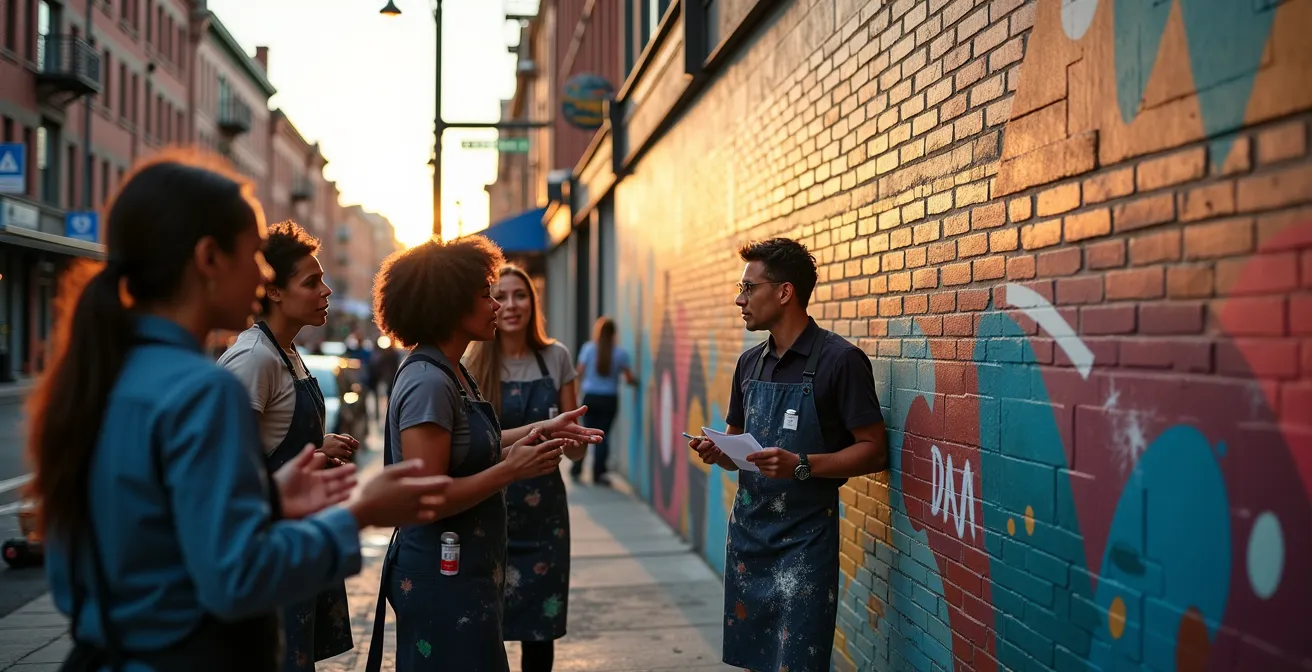
Public art is not just decoration; it’s a powerful political tool for enacting measurable, lasting change in our communities.
- Data-backed evidence shows that strategic art installations can directly impact community safety, mental well-being, and local economies.
- True influence requires moving beyond simple “consultation” to deep “civic dialogue,” making the community a co-author of the work.
Recommendation: Stop thinking about creating ‘art’ and start building ‘narrative infrastructure’—artistic interventions so powerful they make community needs impossible for policymakers to ignore.
For too long, community leaders and artists have faced the same wall of indifference. We pour our hearts into our neighborhoods, only to find our concerns dismissed as anecdotal and our pleas for change lost in the bureaucratic shuffle of city hall. The common wisdom suggests public art’s role is to beautify a neglected corner or, at best, “start a conversation.” We’re told to paint a nice mural and hope someone important notices.
But this view dramatically underestimates the power we hold. It treats art as a passive balm rather than what it truly is: a sharp, strategic instrument for political action. While others focus on the aesthetic, they miss the underlying mechanics of influence. They see a sculpture; we must see a catalyst. They see a mural; we must see a permanent piece of testimony that reframes public space.
What if the key to unlocking policy change wasn’t about having the loudest voice, but about telling the most undeniable story? This is where our work begins. The true potential of public art lies in its ability to generate what statistics and reports cannot: tangible, emotional data. It can build a new narrative infrastructure for a community, fundamentally altering how a place is perceived and, consequently, how it is governed.
This guide is designed for the strategists—the artists, the organizers, the community leaders who are ready to move beyond beautification and into mobilization. We will explore how to prove art’s impact with hard data, secure funding for projects that challenge the status quo, and choose formats and sites that transform a simple artwork into an unignorable political statement. Together, we’ll learn to wield art as the powerful tool it is, forcing the hand of policy and building communities that truly reflect our values.
To navigate this strategic approach, we will delve into the core components that transform art into action. The following sections break down everything from the foundational evidence of art’s impact to the practical steps for curating experiences that resonate long after their creation.
Summary: How Public Art Becomes a Catalyst for Policy Action
- Why Murals in High-Crime Areas Correlate With Lower Vandalism Rates?
- How to Write a Grant Proposal for Art That Challenges the Status Quo?
- Legacy or Urgency: Which Format Best Serves a Political Message?
- The Tone-Deaf Statue: Why Public Art fails Without Community Consultation
- How to Choose a Site That Amplifies the Narrative of the Artwork?
- Why Social Movements Impact Purchasing Power in G7 Nations?
- Why Access to Parks Reduces Anxiety Rates by 20% in Urban Areas?
- How Curating Exhibitions Has Shifted From Object-Focus to Experience-First?
Why Murals in High-Crime Areas Correlate With Lower Vandalism Rates?
The idea that a coat of paint can deter crime often sounds idealistic, but the data tells a compelling story. It isn’t about simple beautification; it’s about reclaiming space and building visible “narrative infrastructure.” When a community invests its identity in a public space, that space ceases to be a vacuum for neglect and becomes a defended territory. This is the core of the “Busy Streets Theory,” which posits that active, cared-for environments naturally deter illicit activity. In Philadelphia, research from the University of Pennsylvania shows the installation of a mural correlates with one less crime per month per street segment.
This effect is about more than just aesthetics. The process of creating public art often involves community members, fostering a sense of ownership and social cohesion. This engagement is a powerful deterrent. According to the Institute for Firearm Injury Prevention, neighborhoods that are well-kept and demonstrate high levels of community engagement see 40% fewer assaults and violent crimes. The mural becomes a symbol of a community’s presence and its refusal to be defined by blight or crime.
Beyond crime statistics, murals generate powerful “emotional data” by transforming the psychological landscape. A study on 3D art murals in Ipoh, Malaysia, found a significant reduction in the *fear* of crime. Residents in areas with murals felt safer, demonstrating that art creates a psychological buffer even before it impacts physical crime rates. This feeling of safety encourages more positive use of public spaces, reinforcing the “Busy Streets” effect and creating a virtuous cycle of community presence and security. This is a crucial data point for policymakers, proving that an investment in art is also an investment in public safety and well-being.
How to Write a Grant Proposal for Art That Challenges the Status Quo?
Funding is the lifeblood of public art, but grant committees are often risk-averse. They favor projects that are safe, predictable, and easily measured. So how do we, as community strategists, secure funding for art that is designed for strategic disruption? The key is to master the art of translation: framing radical concepts in the institutional language that funders understand and value.
Instead of proposing a “protest piece,” we frame it as a project for “civic dialogue facilitation.” Instead of “disruption,” we pilot “social innovation.” This isn’t about diluting the message; it’s about building a bridge between our community’s urgent needs and the funder’s mission. Success also means redefining “impact.” Traditional metrics like attendance numbers fail to capture the real value of political art. We must propose alternative Key Performance Indicators (KPIs) that measure what truly matters: the number of spin-off community actions, the artwork’s inclusion in municipal meeting agendas, or shifts in local media coverage. These metrics transform our art from a static object into a documented engine of social change.

This visualization represents the shift away from linear metrics. Instead of a simple count of viewers, we map the ripples of influence—the new connections, dialogues, and actions that radiate from the artwork. This is the kind of impact that changes policy because it demonstrates a living, evolving community response.
Action Plan: Securing Grants for Radical Art
- Frame radical concepts using institutional language: Translate ‘disruption’ into ‘social innovation pilot’ and ‘protest’ into ‘civic dialogue facilitation’.
- Develop alternative KPIs: Propose metrics like ‘number of spin-off community actions’ or ‘formal inclusion in municipal meeting agendas’ instead of traditional attendance.
- Include robust risk mitigation sections: Position deep community engagement not as a consultation, but as the primary method of risk management for the project.
- Target Challenge America grants: Use these fixed $10,000 grants from the NEA as entry points for unconventional projects that serve historically underserved communities.
- Leverage NEA priority areas: Strategically align your project with communities encouraged by White House Executive Orders to increase relevance and urgency.
Legacy or Urgency: Which Format Best Serves a Political Message?
Once funding is secured, a critical strategic choice emerges: should the artwork be a permanent “legacy” piece or a fleeting “urgency” intervention? The answer depends entirely on the political goal. There is no one-size-fits-all solution; the format must be a deliberate tool chosen to achieve a specific outcome. A monumental bronze statue and a viral flash mob are both forms of public art, but they operate on completely different timelines and impact mechanisms.
Legacy formats, like murals and sculptures, are designed for permanence. They are ideal for commemorating historical victories, embedding a counter-narrative into the physical landscape, and establishing a permanent site of conscience. They work slowly, influencing generations of residents and visitors, and becoming part of a city’s very identity. Urgency formats—such as light projections, flash mobs, or temporary installations—are built for the now. Their goal is to generate immediate media attention, mobilize a community for a specific event, and inject a political message directly into the current news cycle. Their power lies in their ephemerality and their potential for viral spread online.
Choosing the right format is a crucial part of the artistic strategy. The following matrix provides a framework for deciding which approach best aligns with a project’s political objectives.
| Format Type | Best Use Case | Duration | Impact Mechanism |
|---|---|---|---|
| Urgency Formats (Flash mobs, projections) | Rapid response, mobilization | Hours to days | Media attention, viral spread |
| Legacy Formats (Murals, sculptures) | Commemorating victories, permanent narratives | Years to decades | Physical presence, tourist engagement |
| Evolving Formats (Living murals) | Long-term campaigns | Ongoing modification | Continuous community involvement |
| Digital Formats (Viral videos) | Wide reach political messaging | Permanent online | Digital immortality, shareability |
The lines are also blurring. As the Arts & Democracy Organization points out in their work on “The Art of Policy Change,” the modern landscape of influence often favors a hybrid approach.
Ephemeral performance captured in a viral video has a more lasting and widespread political impact than a physical monument that fades into the urban landscape.
– Arts & Democracy Organization, The Art of Policy Change
The Tone-Deaf Statue: Why Public Art fails Without Community Consultation
Nothing undermines the power of public art faster than a failure to engage the community it claims to represent. A “tone-deaf” statue, mural, or installation is more than an aesthetic failure; it’s a political one. It becomes a monument to exclusion, a visible symbol of decisions made *for* a community instead of *with* them. This top-down approach is the single greatest risk to any public art project, breeding resentment and public backlash that can set back community-led efforts for years.
The solution is not simple “consultation”—a few town halls where officials present pre-approved designs. The solution is deep, authentic civic dialogue, where the community is a co-creator from the very beginning. When residents are partners in the design, creation, and placement of an artwork, it becomes their own. This co-creation process is the ultimate form of risk management. The data is clear: according to public art program evaluations, projects that involve community co-creation show 60% higher long-term acceptance and preservation rates.
The “Welcome to the Neighborhood” mural in Philadelphia’s Fishtown district is a masterclass in this process. Its success wasn’t left to chance. As detailed by the National Civic League, the design was chosen through a public contest with over 2,000 resident votes. Public paint days involved neighborhood volunteers of all ages, literally leaving their mark on the final piece. The mural itself features a collage of current and historic community leaders and locations, creating a living document of the neighborhood’s identity. This wasn’t just art placed in a community; it was art that *grew from* the community.
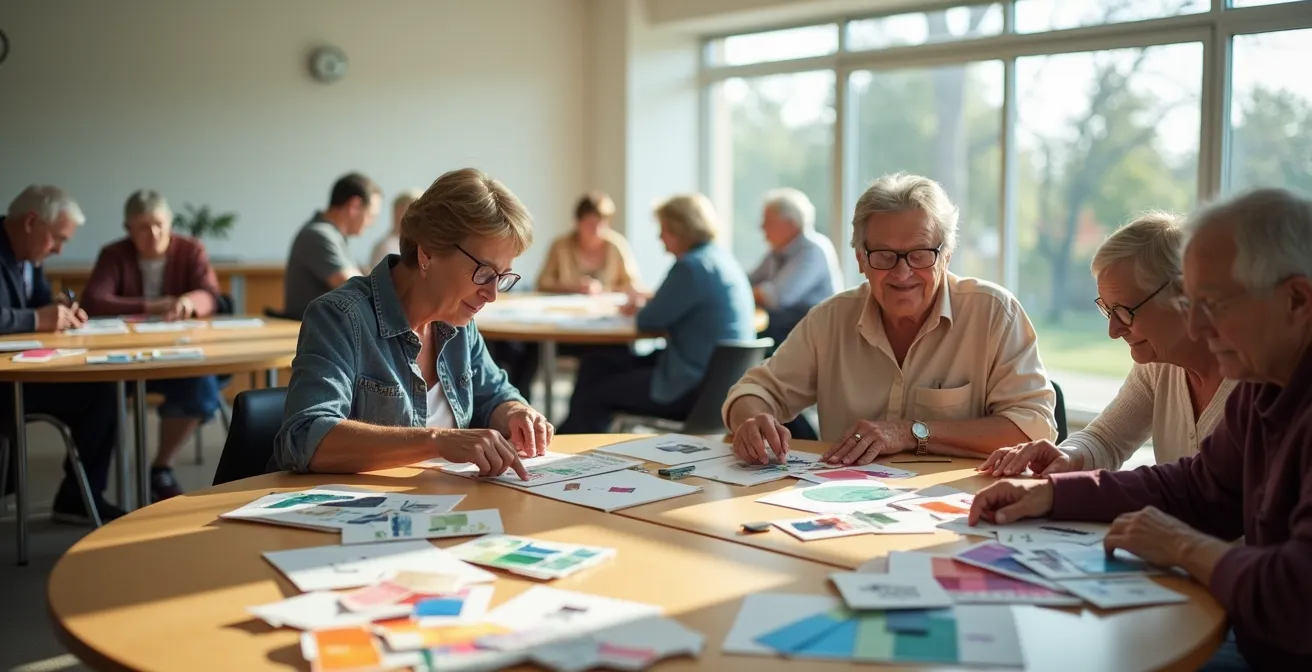
This is what authentic civic dialogue looks like in practice. It’s messy, it’s collaborative, and it ensures the final work is a true reflection of the community’s voice, not an artist’s or a donor’s imposition. It is the only way to build narrative infrastructure that is both powerful and lasting.
How to Choose a Site That Amplifies the Narrative of the Artwork?
In strategic public art, the location is never just a backdrop; the site is a protagonist. Where an artwork is placed is as important as what it depicts. A powerful message can be neutralized by a poor location, while a modest piece can become iconic when its site amplifies its meaning. The goal is to create a resonant frequency between the art and its environment, turning a simple viewing into an immersive experience.
Choosing a site requires thinking like a curator, a storyteller, and a social media strategist. The selection process goes far beyond finding an empty wall. It involves a deep analysis of the location’s context, history, and daily life. We must consider the “historical ghosts” of a place—was it a site of a forgotten protest, a displaced community, or a significant cultural event? Placing art there can reawaken these dormant narratives. We must also consider juxtaposition: an environmental piece placed near an industrial polluter creates a powerful, confrontational dialogue without a single word.
To maximize narrative impact, a site should be evaluated against several key criteria:
- Viral Potential: Assess “Instagrammability” factors like photogenic backdrops, natural lighting, and proximity to geotagged hotspots. A shareable image is a modern form of political broadcast.
- Juxtaposition Opportunities: Place social justice pieces near symbols of power or wealth, or environmental art near sites of industrial activity to create inherent tension and meaning.
- The Soundscape: Consider the ambient sounds. The peel of church bells can add a spiritual layer to a piece, while the rumble of traffic can serve as a commentary on urban life.
- Historical “Ghosts”: Research the site’s past. A location’s forgotten history—be it a former protest site or a demolished landmark—can add profound layers of meaning to the work.
- Pedestrian Flow: Map foot traffic patterns to identify zones with natural pedestrian flow. Organic, daily engagement is often more powerful than a formal unveiling event.
This strategic thinking is backed by observation. As urban design research from the University of Cincinnati highlights, successful murals are not placed randomly. They are deeply connected to the lifeblood of a neighborhood, often found near retail shops, cultural venues, and transit hubs where community life is already vibrant.
Why Social Movements Impact Purchasing Power in G7 Nations?
Social movements, often catalyzed and made visible by public art, are not just cultural phenomena; they are powerful economic engines. They fundamentally alter a community’s narrative, which in turn influences investment, consumer behavior, and ultimately, local purchasing power. When a neighborhood transforms from a place seen as “neglected” to one seen as “vibrant” and “resilient”—a story often told first through murals and community art projects—it attracts new attention and new capital.
The “Busy Streets Theory” extends beyond crime reduction into economic revitalization. In Detroit, community-led transformations of vacant lots into vibrant public art spaces and gardens did more than reduce violence; they created new centers of economic gravity. These revitalized spaces attracted investment and shifted local purchasing patterns, drawing consumers to creative economy businesses and away from areas of blight. The art didn’t just decorate the neighborhood; it helped rewrite its economic future, providing a clear signal to policymakers about where public and private investment should be directed.
This economic impact is a double-edged sword that we must navigate with care. University of Cincinnati research reveals that from 2010-2020, areas with murals saw faster increases in income, rent, and home values. While this signifies growing economic health, it also points directly to gentrification and the risk of displacing long-term residents. For us as community advocates, this economic data is a powerful tool. It allows us to go to city hall with concrete evidence of art’s impact on property taxes and local GDP, arguing for policies that manage this growth equitably—such as rent control, affordable housing provisions, and support for legacy businesses. Art makes the economic shifts visible, giving us the leverage to demand a just and inclusive policy response.
Why Access to Parks Reduces Anxiety Rates by 20% in Urban Areas?
The role of urban green spaces in promoting mental health is well-documented. Simply having access to a park can significantly reduce stress and anxiety. However, as civic art coordinators, we know that the full potential of these spaces is unlocked when they are activated with art. A park is a plot of land; a park with art is a public sanctuary. The art within these spaces acts as a powerful catalyst for mental well-being, transforming a simple walk into an experience of contemplation, joy, and connection.
The mechanism is both psychological and physiological. As Vibez Creative Arts Space notes, “Art provides a sense of joy and inspiration, offering a mental break from the stresses of daily life.” This isn’t just a feeling; it’s a neurological event. Research on community wellness indicates that interactive art installations in parks can increase dopamine release through physical engagement. When a person can touch, move, or become part of an artwork, they are no longer a passive observer. This active participation fosters a sense of agency and mindfulness that is profoundly restorative.

This is the kind of “emotional data” that can drive public health policy. We can argue that funding for public art is not a luxury but a crucial component of a preventative mental health strategy. By embedding contemplative and interactive art within our parks, we are creating accessible, no-cost resources for wellness that benefit the entire community. The art becomes a destination, drawing people into green spaces and amplifying the restorative effects of nature. It makes a powerful case for city budgets to integrate arts funding directly into public health and parks initiatives.
Key Takeaways
- Data is Your Ally: Use statistics on crime reduction, economic growth, and mental health to translate artistic value into a language policymakers understand.
- Community is Your Foundation: Move from top-down “consultation” to collaborative “civic dialogue” to ensure art is embraced, not imposed.
- Strategy is Your Method: Every choice—from format and funding to site selection—must be a deliberate tool to amplify your message and achieve a specific political goal.
How Curating Exhibitions Has Shifted From Object-Focus to Experience-First?
The most profound shift in public art today is the move away from curating static objects to designing dynamic experiences. The city itself is becoming the exhibition, and its residents are active participants, not just passive viewers. This “experience-first” approach is the ultimate expression of our work as community strategists, as it fully realizes the potential of art to create a sustained, living dialogue. It’s about designing narrative pathways that guide people through a story, a history, or a political argument using a sequence of artworks.
This approach transforms the entire community into a canvas and a stage. As the NYC Department of Cultural Affairs powerfully frames it, the goal is to create “The city as the ‘Experience-First’ Exhibition where residents and visitors follow narrative pathways.” This model shatters the walls of the museum and embeds art into the daily flow of life, creating opportunities for continuous engagement and reflection. It acknowledges that the most impactful art is that which is lived with, not just looked at.
Julia Vogl’s 2018 installation, “Pathways to Freedom,” is a landmark example of this philosophy in action. This wasn’t a single sculpture, but a city-scale experience. The project engaged 1,800 Boston residents across 27 locations, inviting them to create personal “freedom pins.” These individual acts of creation culminated in a 6,000-foot public installation around a central monument, which was visited by 25,000 people and enriched with audio stories from the participants. The project, highlighted by the National Civic League for its innovative engagement, demonstrates how a series of small, personal interactions can build a monumental collective experience. It didn’t just tell a story about freedom; it allowed thousands of people to become authors of that story.
This is the future of our work: curating not just art, but meaning, connection, and civic action. By designing these immersive experiences, we create a form of narrative infrastructure so powerful and so deeply woven into the community’s fabric that it becomes an undeniable force in shaping public life and policy.
Now is the time to move from inspiration to action. Identify a dominant, unchallenged narrative in your community that needs changing. Begin sketching the artwork, the intervention, the experience that will tell a truer story and force that new narrative onto the official agenda. This is how we build the world we want to live in, one strategic artwork at a time.