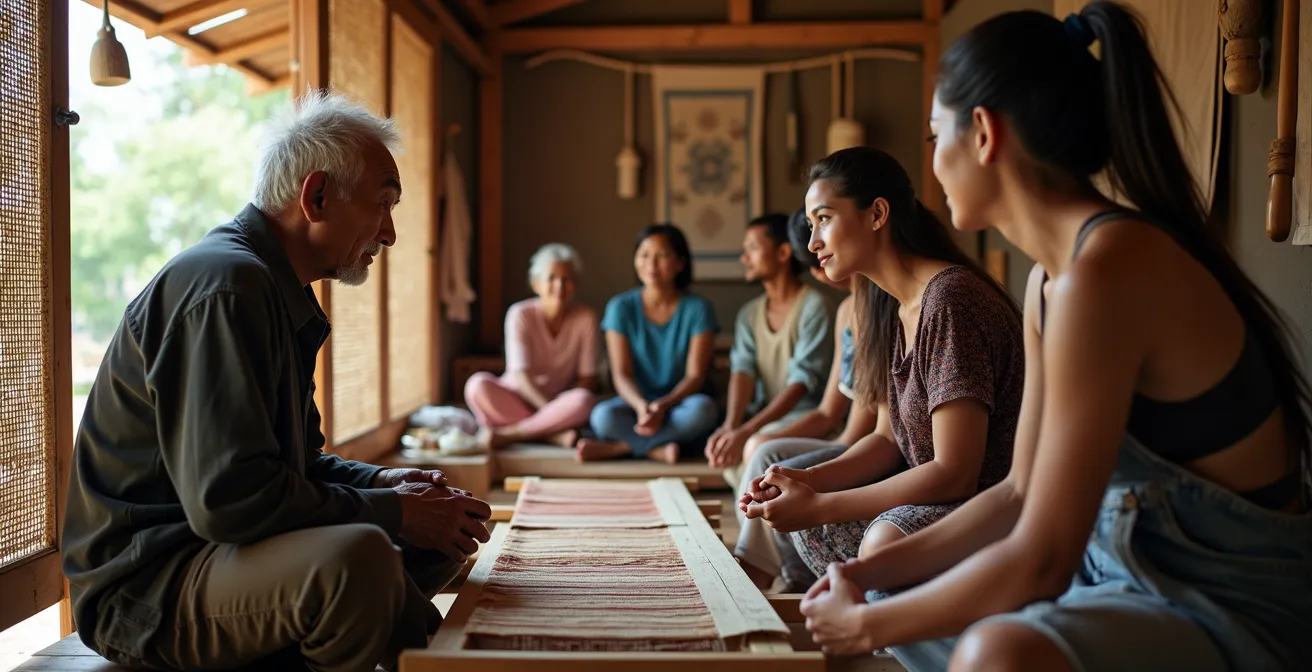
Many travelers believe respecting a culture means following a checklist of dos and don’ts. This is a respectful start, but it misses the point. True cultural immersion isn’t about avoiding mistakes; it’s about fundamentally shifting your role from a consumer of experiences to a respectful witness of living narratives. This guide explores how to engage with traditions by understanding the ‘why’ behind them, ensuring your presence supports, rather than exploits, the communities you visit.
The desire to connect with something authentic is a powerful driver for modern travel. We see a stunning photograph of a vibrant festival or an artisan’s weathered hands and feel a pull to witness it ourselves. But this desire raises a crucial, often uncomfortable question: where is the line between appreciation and appropriation? How do we participate in a living culture without turning it into a commodity for our own consumption? Too often, the advice is a simple list of prohibitions: don’t take photos without asking, don’t wear revealing clothes, don’t touch sacred objects. While well-intentioned, this approach frames cultural interaction as a minefield to be navigated, rather than a bridge to be built.
The real challenge, and the deeper opportunity, lies in understanding that much of a culture’s soul is not housed in monuments or museums. It resides in what UNESCO calls Intangible Cultural Heritage (ICH): the oral traditions, performing arts, social practices, rituals, and craftsmanship passed down through generations. It is the story behind the weaving pattern, the meaning of the festival’s dance, the knowledge in the farmer’s planting schedule. This is a living, breathing heritage.
But what if the key to respectful travel wasn’t a list of rules, but a change in mindset? What if, instead of asking “What can I see?”, we asked “How can I listen?”. This is the perspective of a cultural anthropologist, focusing not on the spectacle, but on the human context that gives it meaning. It requires shifting from a passive consumer to an active and respectful peripheral witness, recognizing that communities have sovereignty over their own narratives.
This guide will explore how to adopt this mindset. We will move beyond surface-level etiquette to understand the structures of cultural exchange, from craft workshops to sacred ceremonies. By focusing on the principles of reciprocity, community agency, and sustainability, we can learn to travel in a way that truly honors the traditions we’ve come so far to experience.
To navigate this complex and rewarding landscape, this article provides a framework for understanding and engaging with living heritage. The following sections will guide you through the key aspects of respectful cultural tourism, offering practical insights and deeper perspectives.
Summary: A Guide to Respectful Engagement with Living Heritage
- Why Storytelling Is as Important as Monuments in Cultural Preservation?
- How to Participate in a Craft Workshop Respectfully?
- Community Festival or Tourist Show: Which Experience Is Real?
- The Disrespectful Oversight When Attending Religious Ceremonies
- When to Visit: Aligning Your Trip With Local Lunar Calendars
- How to Layer Digital Storytelling Over Physical Artifacts?
- How Societal Narratives in Public Art Can Influence Local Policy Changes?
- Eco-Tourism Discovery: How to Travel Without Leaving a Carbon Footprint?
Why Storytelling Is as Important as Monuments in Cultural Preservation?
We are culturally conditioned to seek out the tangible: the ancient temple, the grand fortress, the famous statue. These physical landmarks are important, but they are silent without their stories. Intangible Cultural Heritage gives them a voice. It is the collection of oral histories, myths, and knowledge that transforms a pile of stones into a sacred site. As the Government of Newfoundland and Labrador noted in a report on oral culture, “Each member of the community possesses a piece of the shared knowledge.” Heritage is not just preserved in stone, but in people. It is a dynamic process, not a static object.
Recognizing this shifts our role as travelers. Instead of just “seeing the sights,” our goal becomes to listen to the stories. The world is catching on to this vital concept; as of early 2023, UNESCO’s Intangible Cultural Heritage List now includes 678 elements from 140 countries, ranging from musical traditions to culinary practices. These are not artifacts to be photographed, but living practices to be understood. This understanding begins with reciprocal exchange. It is not about extracting a story for a social media post, but engaging in a genuine, two-way dialogue.
This means approaching locals not as tour guides, but as experts in their own culture. It requires humility, patience, and a willingness to share a piece of yourself in return. When you ask about a local legend, be prepared to share a story from your own home. This simple act transforms a one-sided transaction into a moment of human connection. The value is not in the story you “get,” but in the shared experience of telling it. Ethical storytelling is the foundation of respectful cultural travel, creating connections that last far longer than a photograph.
Action Plan: 5 Ways to Practice Ethical Story Exchange
- Ask permission before recording or documenting any story – respect if the answer is no.
- Share a story from your own culture first to create a reciprocal exchange.
- Learn key phrases in the local language to show respect for oral traditions.
- Support local storytelling venues or cultural centers with direct donations.
- Credit the storyteller and community when sharing experiences, never claim stories as your own discovery.
How to Participate in a Craft Workshop Respectfully?
Participating in a craft workshop—whether it’s weaving, pottery, or cooking—seems like an ideal way to engage with local culture. It offers a hands-on experience and a tangible souvenir. However, the “how” of this participation matters immensely. The key is to look beyond the activity itself and understand the economic and social structure behind it. A respectful engagement supports the artisan and the preservation of their craft, while an exploitative one can cheapen it into a mere tourist trinket.
The crucial question to ask is: Who benefits from my participation? A workshop run by a private intermediary who takes a large cut is vastly different from one owned and operated by a community cooperative. In the latter, your fee directly supports the artisans and may even fund training for the next generation. The Marche Food and Wine Memories Project in Italy provides an excellent model. This private initiative preserved the culinary heritage of former sharecroppers through participatory workshops, demonstrating how travelers can support authentic craft by engaging with projects that prioritize local ownership and knowledge transfer over simple tourist consumption.
Understanding these models empowers you to make informed choices. Before booking, research the organization. Look for community-owned cooperatives, heritage centers with transparent practices, or direct invitations from artisans. Your role can be more than just a student; you can be a patron. By choosing where your money goes, you are voting for a more sustainable and equitable form of cultural tourism that honors the craftsperson as much as the craft.
This table illustrates the different economic structures you might encounter. Understanding them helps you choose a model that provides the most direct and sustainable benefit to the community, as outlined in a recent analysis of craft tourism models.
| Model Type | Community Benefit | Sustainability Score | Traveler Role |
|---|---|---|---|
| Artisan Cooperative | Direct income to craftspeople | High | Purchase directly, sponsor materials |
| Community-Owned Workshop | Profits fund skill training | Very High | Pay workshop fees, donate to education fund |
| Private Intermediary | Limited trickle-down | Low | Question supply chain transparency |
| Heritage Center Model | Preserves techniques, provides steady income | High | Support through entrance fees and purchases |
Community Festival or Tourist Show: Which Experience Is Real?
Festivals offer a dazzling window into a culture’s soul. But as tourism grows, the line between an authentic community celebration and a staged “tourist show” can become blurry. The former is a living expression of communal identity, intended for the participants themselves. The latter is a performance, packaged and sold for outsiders. Discerning the difference is a core skill for the respectful traveler. It’s not about judging authenticity, but about understanding the purpose of the event and your place within it.
The economic incentive to cater to tourists is strong. In fact, research from 2013-2022 demonstrates that 30 Chinese provinces showed an increasing link between their Intangible Cultural Heritage and tourism industries. This coupling can bring vital income, but it also risks transforming sacred rituals into repeatable spectacles. The key indicator is focus: in a community festival, the energy is directed inward, among the participants. In a tourist show, the energy is directed outward, toward the audience. Look for where the “center of gravity” lies. Are you the audience for a performance, or a witness to a community gathering?
This is where the concept of the peripheral witness becomes a powerful guide for your behavior. In a genuine community event, your role is to be on the periphery. You are a guest, observing with respect from the edges, not demanding to be in the center of the action. You are not there to be entertained; you are there to witness a moment of cultural significance for others. This requires a profound sense of self-awareness and restraint. It means putting the camera down, being quiet, and allowing the event to unfold on its own terms, not yours.
The following image captures this dynamic perfectly. The community is at the heart of the celebration, their focus on each other and the ritual. The visitors are present but unobtrusive, observing from the sidelines and allowing the event’s integrity to remain intact.
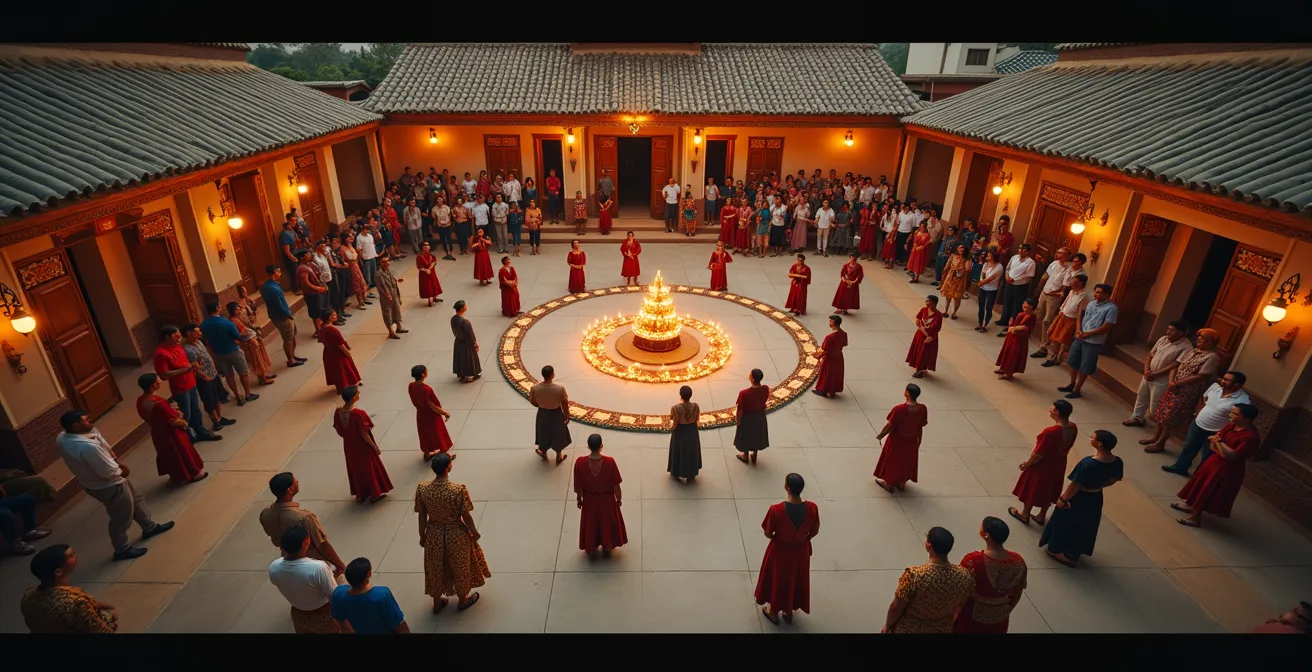
This visual distinction highlights the respectful distance that transforms a tourist into a guest. By choosing to be a peripheral witness, you honor the event’s primary purpose and ensure your presence doesn’t alter the very thing you came to see. It is the ultimate act of respect: acknowledging that this moment is not about you.
The Disrespectful Oversight When Attending Religious Ceremonies
Attending a religious ceremony can be a deeply moving experience, offering a profound glimpse into a community’s spiritual life. Travelers often focus on following explicit rules: covering their heads, removing their shoes, not taking photos. These are essential. But the most significant and often overlooked aspect of respect is not about behavior, but about acknowledging narrative sovereignty. This is the fundamental right of a community to define, control, and share its own heritage on its own terms. As the Smithsonian Center for Folklife and Cultural Heritage states, the revolutionary idea at the heart of the UNESCO Convention is that it “places communities in the central role of deciding what is and isn’t their own heritage.”
The most disrespectful oversight is to treat a sacred ceremony as a public event that you have a “right” to attend. Your presence is a privilege, not a right. The community grants you access, and this access comes with the implicit responsibility to be an unobtrusive observer. This means going beyond the written rules and attuning yourself to the unwritten ones. Observe the flow of the ceremony. Notice where community members stand or sit and find a place on the periphery. If people are in solemn prayer, your presence should be equally solemn.
This mindset also changes how you contribute. Instead of seeing a payment as an entry fee, which turns a sacred rite into a transaction, consider making a donation to the community fund or religious institution. This act reframes your contribution from a payment for service to a gesture of gratitude and support for the continuation of their traditions. It is a tangible way of acknowledging that you are a guest in their sacred space. Ultimately, true respect in this context is about making yourself as small and insignificant as possible, allowing the focus to remain where it belongs: on the community and their connection to the divine.
When to Visit: Aligning Your Trip With Local Lunar Calendars
Most travelers plan their trips around school holidays or seasonal weather. A more profound way to connect with a culture, however, is to plan your visit around its own temporal rhythms. Many societies, particularly those with deep agricultural or maritime roots, operate on lunar, solar, or other traditional calendars that dictate the timing of festivals, harvests, and spiritual practices. Aligning your travel with these calendars can unlock a much deeper understanding of a place.
Visiting during a major harvest festival or a new year celebration timed to a specific lunar phase allows you to witness the culture at its most vibrant and meaningful. It reveals the intricate web of Traditional Ecological Knowledge (TEK)—the sophisticated understanding of the natural world that is embedded within cultural practices. The Polynesian Voyaging Society’s Mālama Honua Worldwide Voyage is a powerful example. As explained at the Smithsonian, their use of traditional lunar and stellar navigation is not a relic of the past; it is a living science that connects them to their environment and ancestors. By traveling according to these ancient rhythms, they sustain both their culture and the ocean they depend on.
This approach requires more research than simply booking a flight. You may need to consult local cultural centers, community leaders, or anthropological resources to understand the year’s significant events. It is a testament to the global recognition of these practices that the UNESCO Convention for Safeguarding Intangible Cultural Heritage has been incorporated by 161 countries in just over a decade. By planning your trip to coincide with a key moment in a community’s own calendar, you move beyond being a mere tourist and become a witness to the living pulse of a culture, timed to its own heartbeat.
How to Layer Digital Storytelling Over Physical Artifacts?
In our hyper-connected world, technology can feel like a distraction from authentic experience. Yet, when used thoughtfully, digital tools can become powerful allies in the preservation and respectful sharing of intangible heritage. The goal is not to replace physical interaction but to layer digital stories over physical artifacts, enriching our understanding and empowering communities to share their narratives on their own terms. This approach counters the traditional museum model where an external curator interprets an object for the public.
Instead, community-led digital initiatives allow the creators and inheritors of a tradition to tell their own stories. This can take many forms: a QR code on a textile that links to a video of the weaver explaining the pattern’s meaning; an augmented reality app that overlays historical scenes onto a modern street; or a community-managed online archive of oral histories. The key difference between these and a commercial tourism app is community control. When the community owns the platform and the content, cultural accuracy is maintained, and the narrative is not simplified or exoticized for a foreign audience. They retain their narrative sovereignty.
The image below captures the essence of this collaborative process: the tangible craft, rich with history, is being documented by community members, ensuring the story is preserved and told by those who know it best. It is the intersection of ancestral knowledge and modern technology, used not for extraction, but for empowerment and continuation.
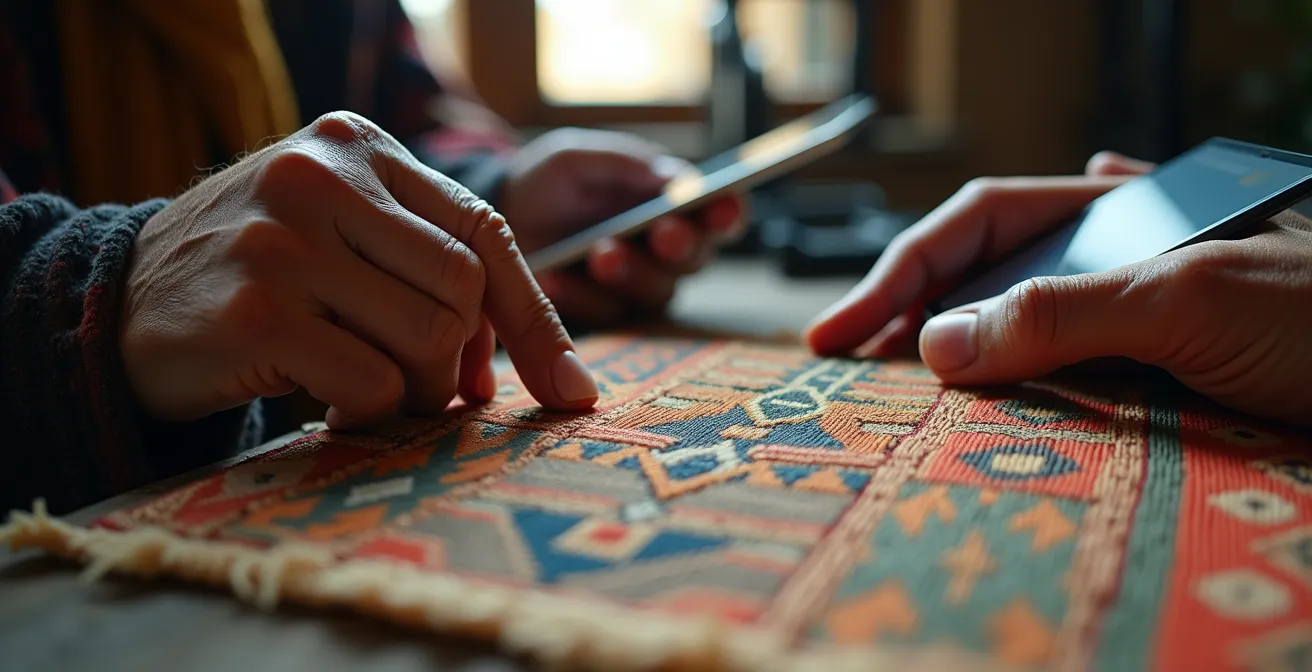
As a traveler, you can support these efforts by seeking out and using these community-generated platforms. Prioritize a museum tour that uses an app developed with local elders over one with a generic audio guide. Share links to community archives, always with proper credit. By engaging with these digital layers, you are not just learning about an artifact; you are listening directly to the voice of the community it came from, honoring their role as the primary storytellers of their own heritage.
How Societal Narratives in Public Art Can Influence Local Policy Changes?
Intangible heritage is not just about ancient rituals or crafts; it is also about the stories a society tells itself today. Public art—from murals and sculptures to street performances and commemorative festivals—is a powerful medium for these societal narratives. It can challenge dominant histories, celebrate marginalized identities, and articulate a community’s aspirations. For the observant traveler, this art is more than decoration; it is a living dialogue about identity, justice, and memory. And this dialogue can have very real political consequences.
When a community successfully asserts its narrative in the public sphere, it can galvanize support and influence policy. A powerful example is Haiti’s ‘soup joumou’. This traditional pumpkin soup, once forbidden to the enslaved, became a symbol of freedom after Haiti’s independence. Its recent recognition by UNESCO as an intangible cultural heritage in 2021 was not just a cultural accolade; it was a political act. As a former minister noted, it commemorates the fight against slavery and racism. This global recognition has spurred new cultural preservation initiatives and tourism policies in Haiti that center on this powerful story of liberation, ensuring the community retains ownership of its independence narrative.
As travelers, we can actively support this process. Instead of a generic city tour, seek out one led by local artists or community activists who can explain the context and meaning behind public art. Buy art directly from creators at community markets. Attend talks or workshops that discuss the political and social issues the art addresses. By doing so, you are not just consuming culture; you are contributing to a local economy of ideas and activism. You are validating the importance of these narratives and helping to amplify voices that are fighting to be heard. Your tourism becomes a small but meaningful act of solidarity, recognizing that culture is not just a performance, but a powerful force for social change.
Key Takeaways
- Story over Stone: True heritage lies in the living narratives and knowledge of a community, not just in its physical monuments.
- Witness over Consumer: Shift your role from someone seeking an experience to a respectful guest witnessing a community’s life.
- Community over Commodity: Support initiatives and economic models where the community retains control and direct benefit from their own cultural heritage.
Eco-Tourism Discovery: How to Travel Without Leaving a Carbon Footprint?
The conversation around sustainable travel often centers on carbon footprints: offsetting flights, using reusable water bottles, and choosing eco-lodges. These actions are vital, but a deeper form of sustainability emerges when we connect environmental stewardship with cultural preservation. Often, the most sustainable practices are those that have been part of a region’s Traditional Ecological Knowledge (TEK) for centuries. Engaging with this living heritage offers a path to a truly holistic form of eco-tourism.
Germany’s Bad Hindelang region offers a compelling case study. Their traditional system of “mobile livestock management,” where cattle are moved between valleys and high alpine pastures, is not only a cultural practice but also a sophisticated method of land use that maintains biodiversity. This practice has been recognized as a model for safeguarding heritage and sustainability. A study on high alpine agriculture notes that this type of land use is inherently sustainable. For travelers, this means agritourism in the region is not just a scenic holiday; it’s a lesson in how cultural practices create and preserve the very landscape you are enjoying. These efforts are often supported by major organizations; for instance, UNESCO and GIZ implemented a 2 million euro tourism recovery project to support similar sustainable heritage initiatives in the Alps.
This approach redefines eco-tourism. It’s not just about minimizing your negative impact, but about actively supporting systems where culture and nature are mutually reinforcing. It means seeking out experiences that are rooted in a community’s long-standing relationship with its environment. This could be learning about traditional fishing methods tied to tidal patterns, understanding regenerative farming techniques passed down through generations, or participating in a reforestation project led by an indigenous community. By doing so, you support a model of resilience where preserving culture is inseparable from preserving the planet.
Ultimately, experiencing intangible cultural heritage respectfully is an active practice of empathy. It requires us to slow down, listen more than we speak, and value connection over content. By shifting our mindset from that of a consumer to that of a respectful witness, we not only protect the integrity of the cultures we visit but also enrich our own understanding of what it means to be human. Start applying this framework to your next travel plan to transform your journey into a more meaningful exchange.