
The biggest mistake startups make in scaling is treating the offshoring vs. local decision as a simple cost-per-unit problem.
- True scalability hinges on supply chain resilience, not just the factory price, as geopolitical risks and total landed costs now outweigh labor arbitrage.
- A modern production strategy requires a diversified, risk-managed approach combined with robust digital oversight to control quality from anywhere.
Recommendation: Adopt a ‘China Plus One’ mindset and leverage digital oversight tools to build a supply chain that is robust and resilient, not just cheap.
For an operations manager holding a successful prototype, the pressure to scale from a workshop to the factory floor is immense. The question of “where to manufacture” quickly becomes the most critical decision, capable of making or breaking the company. For years, the standard playbook was simple: find the cheapest possible factory in China and manage the logistics. This approach treated manufacturing as a straightforward cost-minimization exercise.
However, the global landscape has fundamentally shifted. The once-clear advantages of a single-source offshore strategy have been clouded by trade wars, a global pandemic, and unpredictable geopolitical volatility. The old equation no longer holds. Simply chasing the lowest labor cost is a strategy fraught with hidden dangers, from catastrophic disruptions to eroding quality control as you scale.
But what if the core decision isn’t about cost, but about risk? The modern challenge for a startup isn’t just to manufacture a product cheaply, but to build a supply chain resilience that can withstand global shocks. This requires a more sophisticated framework, one that balances cost with diversification, agility, and data-driven oversight. The conversation has moved beyond “offshoring vs. local” to a dynamic risk management equation where a distributed, intelligent supply chain is the ultimate competitive advantage.
This guide provides a strategic framework for operations managers tasked with this critical decision. We will deconstruct the new rules of global manufacturing, moving from high-level geopolitical risk management and remote quality control to the granular details of packaging optimization and predictive analytics that define a truly scalable and resilient production system.
Summary: Navigating the Global Production Maze for Startups
- Why “China Plus One” Is the New Standard for Risk Management?
- How to Audit a Factory for Quality Control remotely?
- Plastic or Metal: Which Process Scales Better for Your Enclosure?
- The Yield Rate Trap: Why Ramping Up Too Fast Increases Defect Rates
- How to Redesign Packaging to Fit 20% More Units in a Container?
- Why Last-Mile Delivery Fails in Developing Urban Centers?
- How to Reduce Warehousing Costs by Trusting the Algorithm?
- How Predictive Analytics Reduces Supply Chain Disruptions by 40%?
Why “China Plus One” Is the New Standard for Risk Management?
For decades, China’s unparalleled infrastructure and mature supply chain made it the default choice for mass production. However, placing all production capacity in a single country, no matter how efficient, creates a single point of failure. The “China Plus One” strategy is a risk management framework designed to mitigate this vulnerability. It doesn’t necessarily mean abandoning China, but rather diversifying by adding a second (or third) manufacturing base in another country, such as Vietnam, India, or Mexico.
The drivers for this shift are both economic and geopolitical. Rising wages in China are eroding its cost advantage, while ongoing trade tensions introduce tariff uncertainty. A recent survey confirmed this trend, showing that about 40% of the more than 500 European firms surveyed have either shifted or are considering moving future investments out of China. This diversification creates a more resilient supply chain capable of absorbing shocks, whether they are political, economic, or logistical.
Countries like India and Vietnam are emerging as powerful alternatives. For example, India’s mobile phone exports surged over 40% in 2024, reaching $15.6 billion, a clear sign of its growing manufacturing prowess, supported by government initiatives. Vietnam has become a hub for low-tech electronics and textiles, attracting giants like Samsung. Meanwhile, Mexico’s proximity to the US market under the USMCA agreement makes it a compelling option for reducing shipping times and risks for North American startups. The goal is to build a network where production can be shifted or balanced as global conditions change, turning a potential crisis into a manageable adjustment.
How to Audit a Factory for Quality Control remotely?
One of the biggest perceived drawbacks of offshoring is the difficulty of maintaining quality control from thousands of miles away. The traditional solution—frequent, expensive flights for in-person inspections—is no longer scalable or even necessary. The rise of digital oversight technologies has revolutionized remote auditing, allowing for a level of scrutiny that can rival being physically present on the factory floor. This capability is crucial for managing a diversified “China Plus One” network effectively.
The cornerstone of modern remote auditing is real-time, high-fidelity visual access. Instead of relying on static photos or pre-recorded videos from the factory, managers can conduct virtual “Gemba walks,” interacting with employees and observing processes live. A recent study highlighted the profound impact of these tools, finding that organizations using remote audit tools reported a 40% reduction in audit times, freeing up resources and accelerating decision-making.
This is made possible by a suite of increasingly accessible technologies. 360-degree cameras, stable high-bandwidth cellular connections, and secure streaming platforms are the new essentials for the global operations manager.

Effectively implementing a remote audit system requires more than just a video call. It demands a dedicated kit and a clear protocol. Key components include:
- 360-Degree Cameras: These allow multiple experts to join a virtual tour simultaneously, with each participant able to control their own viewpoint independently, ensuring nothing is missed.
- Reliable Connectivity: A stable connection is non-negotiable. 4G LTE service is the minimum, providing a 2-6mbps uplink, while 5G is preferred for its robustness and higher bandwidth.
- Complete Audit Kits: Deploying a pre-configured kit to the factory—including the camera, an extendable stick for reach, a tripod base for stability, and high-quality Bluetooth audio—ensures consistency and professionalism.
- End-to-End Encryption: All visual and audio content must be secured with industry-standard encryption to protect sensitive intellectual property and operational details.
Plastic or Metal: Which Process Scales Better for Your Enclosure?
The choice between materials like plastic and metal for your product’s enclosure goes far beyond aesthetics; it’s a fundamental decision about manufacturing process, unit cost, and scalability. A process ideal for 1,000 units can become a financial disaster at 100,000. Understanding the break-even points of different manufacturing methods is critical for any startup planning its first major production run.
For early-stage prototypes and very small batches (under 1,000 units), processes with zero or low tooling costs like 3D Printing and CNC Machining are ideal. They offer maximum design flexibility but come with a high cost per unit that doesn’t decrease with volume. As you scale, however, the economics invert. Processes like injection molding for plastics or sheet metal forming require significant upfront investment in tooling (molds and dies), but this cost is amortized over a large volume, driving the per-unit price down dramatically. This is a core principle of designing for manufacturability (DFM).
This trade-off is further complicated by shifting global economics. For instance, the long-held assumption of China’s unbeatable cost is being challenged, as data shows that labor costs in China have risen from $2.00 per hour in 2010 to $7.10 per hour in 2024. This makes the calculation of total landed cost—which includes tooling, labor, shipping, and tariffs—more complex than ever. The following table breaks down the typical cost structures to help guide this decision.
| Process | Initial Tooling Cost | Unit Cost at 1,000 pcs | Unit Cost at 100,000 pcs | Break-even Volume |
|---|---|---|---|---|
| CNC Machining | $0 | $25-50 | $25-50 | Best for < 1,000 units |
| 3D Printing | $0 | $15-30 | $15-30 | Prototypes only |
| Injection Molding | $50,000+ | $5-10 | $1-2 | Best for > 10,000 units |
| Sheet Metal | $5,000-15,000 | $10-20 | $3-8 | Best for 1,000-50,000 units |
The Yield Rate Trap: Why Ramping Up Too Fast Increases Defect Rates
One of the most dangerous moments for a startup is the transition from low-volume to mass production. The pressure to “go fast” can lead to the “yield rate trap,” where a rapid increase in production volume causes a disproportionate spike in defect rates. Yield rate—the percentage of non-defective products coming off an assembly line—is a primary indicator of manufacturing health. A sudden drop means that for every 100 units produced, more are ending up in the scrap heap, destroying margins and delaying shipments.
This trap occurs when production processes, quality checks, and worker training haven’t been properly stabilized before the factory “floors the accelerator.” Small, manageable issues that were easily caught at low volumes can cascade into significant disruptions when multiplied by thousands of units. This isn’t just a hardware problem; the core lesson applies to any scaling operation, as demonstrated by early tech giants.
Case Study: WhatsApp’s Strategic Offshore Development
While a software company, WhatsApp’s early scaling journey offers a powerful lesson in controlled growth. Needing to develop its app efficiently with limited funding, the company hired a core team of offshore developers in Eastern Europe. This allowed the small in-house team to focus on strategy and growth rather than getting bogged down in day-to-day coding. By maintaining direct communication and clear project guidelines with their offshore team, they managed rapid growth without sacrificing stability, ultimately leading to a $19 billion acquisition. The key was strategic management of external resources, not just blind delegation to the cheapest provider. This principle of controlled, well-managed scaling is directly applicable to managing factory ramp-ups.
To avoid the yield rate trap in hardware manufacturing, a methodical approach is required. It’s crucial to establish a “golden batch” at a moderate production speed, where all processes are validated and quality is consistently high. Only then should the volume be incrementally increased, with continuous monitoring at each stage. Proactive maintenance on machinery, robust workforce management to combat turnover in repetitive tasks, and uncompromising quality control gates are essential to prevent minor issues from becoming catastrophic failures.
How to Redesign Packaging to Fit 20% More Units in a Container?
Logistics costs are a massive component of a product’s total landed cost, and no single element offers more potential for optimization than packaging. For many startups, packaging design is an afterthought focused on retail appeal. However, for an operations manager, packaging is a geometric puzzle where every millimeter saved can translate into thousands of dollars in reduced shipping fees. The goal is to maximize container density—fitting the highest possible number of units into a standard shipping container.
This optimization begins long before the factory floor, during the product development phase itself. Designing products that can nest within each other, for example, can dramatically reduce wasted space. Another effective strategy is to move away from bulky protective materials like foam and instead use form-fitting, vacuum-sealed bags. The most critical step, however, is designing the retail box and the master carton (the larger box that holds multiple retail units) to tessellate perfectly, leaving virtually no empty air within the container.
By treating packaging as an integral part of the product’s engineering, significant gains can be achieved. Shifting from a square to a rectangular box, for instance, might allow for a more efficient stacking pattern that increases container load by 20% or more. This not only cuts down on ocean freight costs but also reduces dimensional weight for more expensive air freight, providing a cost benefit across the entire logistics chain.
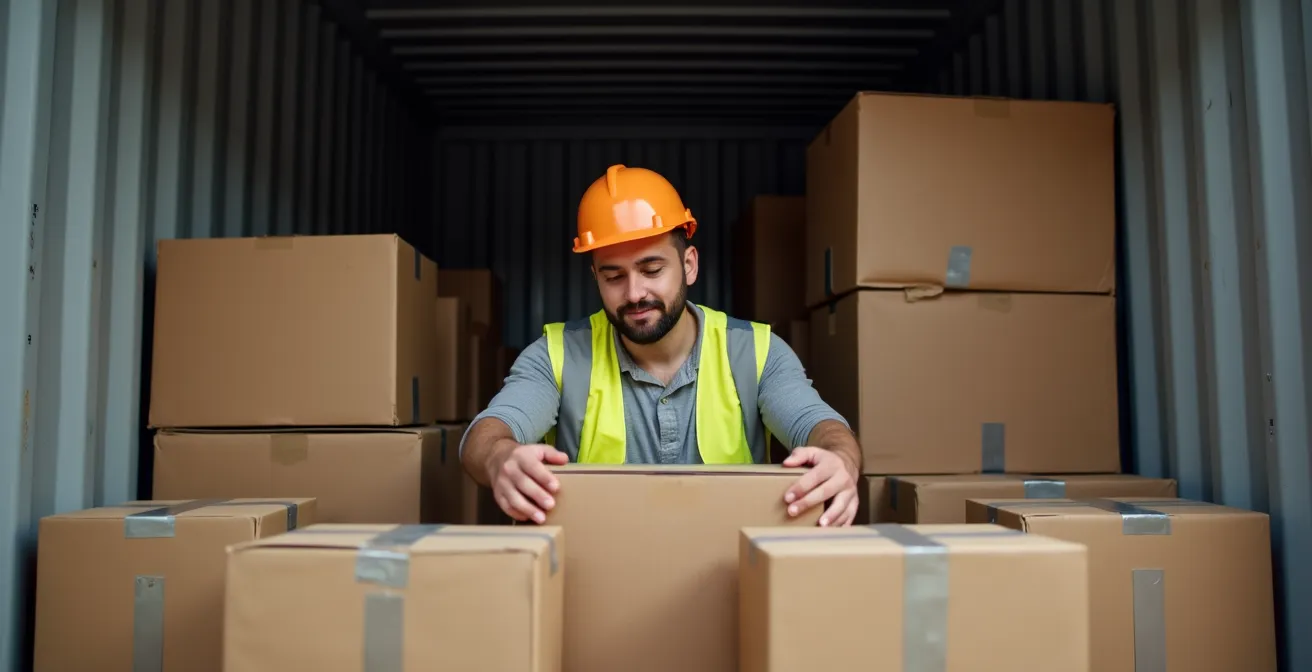
A holistic approach to packaging optimization involves several key tactics:
- Design for Nesting: Engineer products and their components to fit within one another, eliminating hollow spaces.
- Tessellate Boxes: Ensure that the dimensions of the retail box allow for perfect, gap-free arrangement within a master carton.
- Minimize Protection Bulk: Replace bulky foam inserts with vacuum-sealed bags or custom-molded pulp trays.
- Integrate Early: Involve packaging and logistics considerations in the initial product design phase, not as a final step.
- Analyze Dimensional Weight: For air freight, the volume of a package is often more important than its actual weight. Design packaging to be as compact as possible.
Why Last-Mile Delivery Fails in Developing Urban Centers?
Choosing a manufacturing location in a “Plus One” country like India or Vietnam involves more than just analyzing factory capabilities; it requires a deep understanding of the entire logistics chain, right down to the final, chaotic “last mile.” For startups targeting these fast-growing consumer markets, last-mile delivery—the final step of getting a product from a local warehouse to the customer’s doorstep—is often the point where the best-laid supply chain plans fall apart. The infrastructure and consumer habits in many developing urban centers are radically different from those in North America or Europe.
One of the most significant challenges is the lack of standardized addressing systems. In cities like Mumbai or Ho Chi Minh City, addresses can be informal, inconsistent, or based on local landmarks, making automated route planning nearly impossible. This forces a reliance on delivery drivers with deep local knowledge, which is difficult to scale and prone to error. Compounding this is the intense traffic congestion, which makes delivery time estimates highly unpredictable and can add significant fuel and labor costs.
Furthermore, consumer behavior presents its own obstacles. The preference for Cash-on-Delivery (COD) is widespread. This introduces a host of complexities, including security risks for drivers carrying cash, the need for precise change, and a higher rate of refused deliveries. Returns logistics, or reverse logistics, is another nightmare. Managing the collection, inspection, and restocking of returned items in such a fragmented environment is exceptionally difficult and costly. For a startup, a high rate of failed deliveries or returns in these markets can quickly erase any savings gained from manufacturing locally.
How to Reduce Warehousing Costs by Trusting the Algorithm?
In a modern supply chain, a warehouse is no longer a passive storage space. It is a dynamic, high-velocity data node that, when optimized correctly, can be a significant source of competitive advantage. For a scaling startup, however, warehousing can quickly become a major cost center, burdened by excess inventory, inefficient labor, and poor space utilization. The key to unlocking efficiency lies in moving away from manual, intuition-based decisions and “trusting the algorithm.”
Algorithmic warehouse optimization uses data and machine learning to make smarter decisions across every facet of operations. This starts with accurate demand forecasting, which allows for better planning of production schedules and inventory levels. By holding just enough stock to meet predicted demand (Just-in-Time), startups can dramatically reduce the capital tied up in unsold goods and minimize warehousing space requirements. This is particularly crucial when managing inventory across multiple locations in a “China Plus One” strategy.
Inside the warehouse, algorithms can orchestrate a symphony of efficiency. They can determine the optimal placement of items based on pick frequency (slotting), design the most efficient pick-and-pack routes for workers, and dynamically schedule inbound and outbound shipments to avoid bottlenecks at the loading dock. By implementing a Warehouse Management System (WMS) driven by these principles, operations managers can gain real-time visibility and control over their entire inventory.
Action Plan: Your Warehouse Algorithm Audit
- Demand Forecasting Accuracy: Audit your current forecasting methods. Are they consistently accurate, or are you frequently overstocked or understocked? Implement systems to plan schedules and inventory more precisely.
- Resource Allocation: Analyze how labor and equipment are deployed. Use algorithms for optimal resource allocation to ensure production and fulfillment targets are met without costly delays or idle time.
- Scheduling Agility: Evaluate your ability to respond to change. Deploy agile and dynamic scheduling systems that can adjust to fluctuating demand and optimize resource use in real-time.
- Shop Floor Monitoring: Inventory the digital systems used to manage workflows on the warehouse floor. Are you able to monitor activities and enhance productivity effectively?
- Workflow Integration: Map out how different systems (WMS, ERP, etc.) communicate. Ensure seamless data flow to manage workflows and enhance overall productivity without manual intervention.
To Remember
- Risk management is the new cost management: Prioritize resilience over the lowest unit price.
- The ‘China Plus One’ strategy isn’t a trend; it’s the new standard for de-risking your supply chain.
- Embrace digital oversight: Remote audits and predictive analytics are essential tools, not luxuries, for managing global production.
How Predictive Analytics Reduces Supply Chain Disruptions by 40%?
The ultimate goal of a modern supply chain strategy is not just efficiency, but invulnerability. While no chain can be completely immune to disruption, predictive analytics offers the closest thing to a crystal ball. This technology moves beyond reacting to problems to actively anticipating them. By analyzing vast datasets—including historical shipping data, weather patterns, port congestion levels, social media sentiment, and geopolitical news—predictive models can identify potential disruptions long before they occur.
Imagine a scenario where an algorithm flags a high probability of a dockworkers’ strike at a key port in two weeks. This advanced warning gives an operations manager critical lead time. Instead of scrambling when shipments are suddenly halted, they can proactively reroute cargo to an alternative port, switch to air freight for critical components, or build up a safety stock of inventory. This transforms a potential multi-week, multi-million dollar disruption into a manageable logistical adjustment. The power lies in converting unforeseen crises into predictable risks.
Predictive analytics also plays a crucial role in managing suppliers. By monitoring financial health indicators, raw material price fluctuations, and even a supplier’s own logistical challenges, a startup can get early warnings that a key partner might be facing trouble. This enables them to either work with the supplier to resolve the issue or begin qualifying a backup source before the primary one fails. It’s about creating a supply chain with a nervous system—one that can sense and react to stimuli throughout its global network.
For a scaling startup, investing in these capabilities—whether through a third-party logistics (3PL) partner or an in-house platform—is the final piece of the resilience puzzle. It represents the shift from a static, linear supply chain to a dynamic, intelligent, and self-correcting network that is built to withstand the inherent volatility of the 21st-century global marketplace.
To effectively scale your production, the next step is to map your specific product requirements against this framework of risk, resilience, and total landed cost to build a supply chain that is not just lean, but truly unbreakable.