
Contrary to popular belief, recycled polyester (rPET) is not a simple eco-friendly substitute for virgin polyester and may even worsen microfiber pollution.
- Recycled polyester can shed significantly more microfibers than its virgin counterpart, contaminating waterways with smaller, more pervasive plastic particles.
- The “recyclable” label on mixed-fiber apparel is often misleading, as the technology to separate and recycle these blends at scale is virtually non-existent.
Recommendation: Apparel designers and consumers must adopt a holistic material science approach, evaluating a fabric’s entire lifecycle—from fiber integrity and shedding to its true end-of-life—rather than relying solely on recycled content as a measure of sustainability.
The rise of recycled polyester, often marketed as rPET, has been meteoric. For apparel designers and eco-conscious athletes, it presents a compelling narrative: turn wasteful plastic bottles into high-performance athletic gear. This seems like a perfect closed-loop solution, a way to maintain the desirable properties of polyester—durability, moisture-wicking, and affordability—without the guilt of new fossil fuel extraction. Brands have enthusiastically adopted it, and consumers have embraced it as a tangible way to make a greener choice.
However, from a material science perspective, this simple story conceals a far more complex reality. The mechanical and chemical processes that transform a PET bottle into a fine textile fiber are not without consequence. But what if the pursuit of this seemingly sustainable solution has created a new set of problems? What if the key to truly eco-friendly gear isn’t just about recycling old materials, but about fundamentally rethinking the materials we use from the start? This analysis moves beyond the marketing claims to dissect the material truths.
This article will deconstruct the performance and environmental trade-offs of recycled polyester, explore superior natural and bio-based alternatives, and provide a technical framework for making genuinely sustainable material choices in sportswear. Prepare to look beyond the label.
Summary: The Technical Realities of Recycled vs. Virgin Polyester in Sportswear
- Why Your Gym Clothes Release Microfibers Into the Ocean Every Wash
- How to Source Bamboo Blends That Wick Sweat Effectively
- Merino Wool or Silver-Infused Nylon: Which Smells Less After a Hike?
- The “Recyclable” Myth: Why Mixed-Fiber Leggings End Up in Landfill
- When to Retire Running Shoes: Material Breakdown vs Visual Wear
- How Biodegradable Packaging Reduces the Carbon Footprint of Cosmetics Brands?
- How to Turn Waste Streams Into Revenue Channels (Circular Economy)?
- How Biodegradable Packaging Reduces the Carbon Footprint of Cosmetics Brands?
Why Your Gym Clothes Release Microfibers Into the Ocean Every Wash
The primary assumption that recycled polyester is inherently better for the environment faces a significant challenge when examined at the microscopic level: microfiber shedding. During every wash cycle, synthetic garments release tiny plastic fibers that are too small to be filtered by wastewater treatment plants, ultimately polluting oceans and ecosystems. The counter-intuitive truth is that the recycling process itself can exacerbate this problem. The mechanical recycling of PET bottles into yarn shortens the polymer chains, resulting in a more brittle and less stable fiber. This reduced material integrity is a critical flaw.
In fact, recent data paints a stark picture. A 2024 study by the Changing Markets Foundation revealed that recycled polyester garments release, on average, 55% more microfibers than their virgin polyester counterparts. As the foundation’s report highlights:
Recycled polyester released an average of 55 percent more microplastic particles during washing. It also showed those particles were almost 20 percent smaller, meaning they travel farther, linger longer, and penetrate more deeply into living systems.
– Changing Markets Foundation, Spinning Greenwash Report
This finding is not an isolated event. Research from Cukurova University, which analyzed garments from major brands, found recycled polyester to be the highest-shedding fabric. This means that while solving one problem (plastic bottle waste), we are actively amplifying another, more insidious one. For designers, this implies that specifying “recycled” is not enough; the stability of the fiber itself must become a key performance indicator in sustainable design.
How to Source Bamboo Blends That Wick Sweat Effectively
Given the issues with synthetics, designers are increasingly turning to bio-based fibers like bamboo. Marketed as a fast-growing, low-input crop, bamboo appears to be an ideal sustainable feedstock. However, not all bamboo fabrics are created equal, particularly concerning their processing and performance properties like moisture-wicking. The most common method, the viscose process, uses harsh chemicals like sodium hydroxide and carbon disulfide, which undermines its green credentials. A far superior alternative is the bamboo lyocell process, a closed-loop system that recycles over 99% of the non-toxic solvent used.
Beyond the production method, the construction and composition of the fabric are critical for performance. Pure bamboo fabric can lack the stretch and shape retention required for high-intensity activewear. Creating an effective blend is a technical balancing act. For optimal performance, a small percentage of spandex (elastane) is necessary, but exceeding 12% can significantly hinder the fabric’s biodegradability and recyclability. The fabric’s knit structure also plays a vital role; an interlock knit provides better stability and shape retention than a standard jersey, making it more suitable for garments like leggings and compression tops.
For designers and brands committed to genuine sustainability, sourcing high-performance bamboo requires a detailed technical specification and verification process. Simply asking for “bamboo” is insufficient and can lead to greenwashing.
Action Plan: Sourcing High-Performance Sustainable Bamboo
- Process Verification: Specify bamboo lyocell over viscose and request certifications confirming the closed-loop manufacturing process.
- Blend Optimization: Target an 8-12% spandex content for stretch, ensuring the blend remains predominantly bio-based.
- Chemical Safety: Mandate Oeko-Tex Standard 100 certification to ensure no harmful residual chemicals from finishing agents are present.
- Structural Integrity: Choose an interlock construction over jersey for applications requiring superior shape retention and durability.
- Performance Testing: Request third-party lab results or conduct in-house tests to verify moisture-wicking and drying times, which should be under 3 hours for a quality blend.
Merino Wool or Silver-Infused Nylon: Which Smells Less After a Hike?
Odor control is a non-negotiable performance attribute in sportswear, especially for multi-day activities like hiking. The battle for freshness is typically fought between natural fibers with inherent antimicrobial properties and synthetics treated with chemical agents. Merino wool stands out as the champion of natural performance. Its complex fiber structure and the presence of lanolin, a natural waxy substance, create an environment that is inhospitable to odor-causing bacteria. Unlike synthetics, which provide a smooth surface for bacteria to thrive, merino’s scaled texture disrupts their proliferation.
On the synthetic side, a common solution is silver-infused nylon. This technology leverages the oligodynamic effect, where silver ions are toxic to microbes. While effective in the short term, this approach has two major drawbacks. First is the environmental concern of nanosilver leaching into waterways during washing, where its impact on aquatic ecosystems is still not fully understood. Second is an issue of longevity; these treatments are often topical and can wash out over time, diminishing the garment’s anti-odor performance with each laundry cycle. In contrast, merino wool’s odor resistance is an inherent, permanent property of the fiber itself.
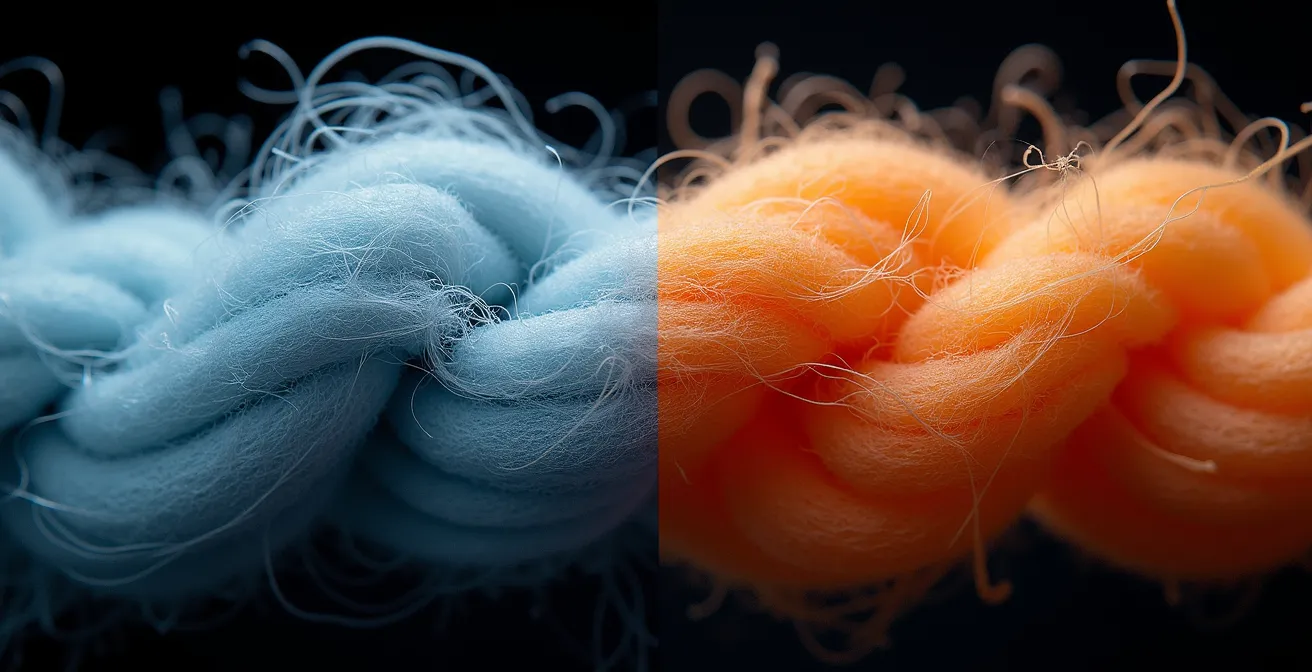
The table below provides a clear comparison of these technologies from a material engineering standpoint, highlighting the trade-offs between performance, environmental impact, and durability.
| Material | Odor Control Mechanism | Environmental Impact | Longevity |
|---|---|---|---|
| Merino Wool | Natural lanolin & fiber structure | Biodegradable, renewable | Permanent property |
| Silver-Infused Nylon | Oligodynamic effect kills microbes | Nanosilver leaching concerns | Washes out over time |
| Peppermint Oil Treatment | Natural antimicrobial properties | Bio-based, non-toxic | Requires reapplication |
The “Recyclable” Myth: Why Mixed-Fiber Leggings End Up in Landfill
One of the most pervasive myths in sustainable fashion is that a garment labeled “recyclable” will actually be recycled. This is particularly untrue for the vast majority of sportswear, which relies on mixed-fiber blends to achieve performance characteristics like stretch and durability. A typical pair of leggings, for instance, is made from a blend of polyester and elastane (spandex). While technically recyclable in a lab, the commercial infrastructure to separate these intertwined polymers at scale simply does not exist. Sorting facilities are designed to handle mono-materials, and these complex blends are treated as contaminants, destined directly for landfill or incineration.
The statistics on textile-to-textile recycling are sobering. Currently, only around 2% of recycled polyester comes from post-consumer textiles. The overwhelming majority comes from downcycled PET bottles—a completely different and less complex waste stream. This means the dream of a closed loop, where old leggings become new leggings, is still a distant reality. The “recyclable” tag on a mixed-fiber garment is, in practice, a form of greenwashing that masks the product’s linear, disposable lifecycle.
Innovations in chemical recycling are emerging, but they face significant hurdles. These technologies are crucial for unlocking the value in blended textiles, but they remain far from mainstream commercial viability.
The Challenge of Chemical Recycling: The Ambercycle Example
Companies like Ambercycle are at the forefront of developing innovative chemical recycling processes. Their technology can break down poly-cotton blends to separate the materials and regenerate virgin-quality polyester fibers. This is a massive leap forward from mechanical recycling, which cannot handle such blends. However, the process is still highly energy-intensive and requires significant capital investment to scale. Until these technologies become economically viable and widely available, the end-of-life reality for the millions of tons of mixed-fiber activewear produced each year remains the landfill.
When to Retire Running Shoes: Material Breakdown vs Visual Wear
The sustainability of a product is not just about its material composition, but also its lifespan. For running shoes, retirement is often determined by visual cues like a worn-out outsole or frayed upper. However, the true end of a shoe’s functional life is dictated by the invisible breakdown of its midsole foam. This material, typically EVA (ethylene vinyl acetate), is responsible for cushioning and shock absorption. With each footstrike, the foam compresses and rebounds. Over time, it loses this ability to rebound, a process known as compression set, leading to reduced shock absorption and an increased risk of injury for the runner.
This material fatigue occurs long before the shoe looks “worn out.” A shoe can have a pristine upper and a solid-looking outsole but a completely dead midsole. Relying on mileage alone (the common 300-500 mile rule) is also an oversimplification. Factors such as runner weight, gait mechanics (e.g., overpronation), and running surface dramatically accelerate the breakdown of the midsole. For example, trail running on uneven surfaces can reduce a midsole’s lifespan by up to 30% compared to road running. Newer, more resilient foams like PEBA (polyether block amide) offer a longer functional life but come at a higher cost.

To truly maximize a shoe’s lifespan and make an informed retirement decision, athletes and designers must look beyond aesthetics and consider the specific material science at play. A more personalized calculation is necessary to balance performance, injury prevention, and consumption.
- Baseline Calculation: Start with a baseline of 300-500 miles for standard EVA midsoles.
- Weight Adjustment: Subtract approximately 50 miles from the total lifespan for every 20 lbs of body weight over 150 lbs.
- Gait Mechanics: Overpronators or heavy heel-strikers should reduce the expected lifespan by 15-20% due to concentrated impact forces.
- Surface Impact: Predominantly trail running reduces lifespan by 30%, while treadmill running can extend it slightly.
- Foam Type Modifier: Shoes with advanced PEBA-based foams can add 100-150 miles to the baseline lifespan compared to standard EVA.
- Rotation Bonus: Actively rotating between two or more pairs of shoes allows the midsole foam to fully decompress between runs, adding up to 20% to each pair’s total lifespan.
How Biodegradable Packaging Reduces the Carbon Footprint of Cosmetics Brands?
The conversation around end-of-life solutions in sportswear is increasingly borrowing concepts from other industries, notably the push for biodegradability. While typically associated with packaging, the idea of creating materials that can safely return to the earth is being explored for textiles. One such innovation is the use of additives designed to accelerate the biodegradation of synthetic fibers in landfill environments. CiCLO, for example, is a technology that introduces “points of attack” into the plastic matrix, allowing microbes present in anaerobic landfill conditions to break down the material.
The claim is that this technology helps synthetic fabrics biodegrade at a rate comparable to natural fibers. According to one report, CiCLO technology helps synthetic fabrics biodegrade at the same rate as wool. This presents a potential solution to the landfill burden of synthetic activewear that cannot be recycled. By designing for biodegradation, the long-term environmental persistence of the material is addressed, theoretically reducing its overall footprint.
However, this approach is not without its critics and complexities. The efficacy of such additives is highly dependent on the specific conditions of the landfill—conditions that are not always met. As Sport Casuals International notes, there is a critical distinction between this type of engineered biodegradability and true compostability. The technology “only works in specific anaerobic landfill conditions, which are rare,” contrasting with materials like wool or cotton that can biodegrade in a wider range of natural environments. This highlights a crucial point for designers: “biodegradable” is not a monolithic term, and its environmental benefit is highly contextual.
How to Turn Waste Streams Into Revenue Channels (Circular Economy)?
The ultimate goal of a sustainable material strategy is to move beyond minimizing harm and toward creating a truly circular economy where waste is eliminated by design. This involves seeing waste not as a problem to be managed, but as a valuable feedstock for new products. This paradigm shift is giving rise to some of the most exciting innovations in material science, moving far beyond simply recycling plastic bottles. These companies are not just managing waste streams; they are creating entirely new, high-value revenue channels from them.
These next-generation solutions tackle waste at its source or find value in unconventional places, creating a portfolio of materials that offer both high performance and a genuinely positive environmental story. For apparel designers, this opens up a new toolbox of materials that can deliver unique performance characteristics while building a powerful brand narrative around true circularity. The focus shifts from “less bad” to “actively good,” redefining what a sustainable material can be.
Case Study: Innovations in Waste-to-Fabric Technology
Several pioneering companies exemplify this new approach. LanzaTech has developed a groundbreaking technology that captures carbon emissions from industrial sources (like steel mills) and, through a fermentation process, converts that captured carbon into ethanol, which can then be used to create polyester fibers. This is not recycling waste; it is creating virgin-quality material from air pollution. Elsewhere, BLOOM harvests harmful algae blooms from waterways, processing the algae biomass into a high-performance foam that replaces petroleum-based EVA in shoe midsoles and insoles. Finally, Piñatex transforms waste pineapple leaves from the agricultural industry into a durable, leather-like technical textile, providing extra income to farming communities and diverting agricultural waste from being burned or landfilled.
Key Takeaways
- Recycled polyester (rPET) is not an environmental panacea; it often sheds more microplastics than virgin polyester due to degraded fiber integrity.
- True sustainability requires a holistic lifecycle assessment, considering a material’s end-of-life reality, not just its recycled content.
- High-performance natural fibers like Merino wool and innovative bio-based materials offer superior and more genuinely sustainable alternatives to recycled synthetics.
How Biodegradable Packaging Reduces the Carbon Footprint of Cosmetics Brands?
As the sportswear industry grapples with its material challenges, it can draw valuable lessons from adjacent sectors, particularly the cosmetics industry’s intensive focus on biodegradable packaging. Cosmetics brands face immense pressure to reduce their packaging footprint, leading them to innovate in materials that can safely return to the biosphere. This has driven advancements in bio-polymers, compostable materials, and “design for disassembly” principles that could be directly translated to the packaging and even the trim components (like aglets or hang-tags) of athletic apparel.
The key learning is the shift in mindset: from designing for recycling to designing for decomposition. While textiles present unique challenges, the principles are transferable. For instance, the use of mono-material packaging in cosmetics to ensure compostability could inspire the design of mono-material garments that are easier to recycle or biodegrade. The rigorous certification standards for compostable packaging (like BPI or TÜV Austria) provide a roadmap for developing similar standards for textiles, moving beyond vague “biodegradable” claims to verifiable end-of-life pathways.
Ultimately, the cosmetics industry demonstrates that consumer demand for sustainability can drive rapid material innovation. By observing their successes and failures with bioplastics, water-soluble films, and refillable systems, sportswear designers can shortcut their own development cycles. The future of sustainable sportswear may lie not just in the fabric, but in adopting a holistic, cross-industrial approach to the entire product ecosystem, from the fiber to the final package it arrives in.
For designers and brands, the path forward requires a move away from simplistic solutions and toward a deep, technical understanding of material science. It’s time to demand more from our materials, looking beyond the recycled label to build a future of sportswear that performs for the athlete and the planet.