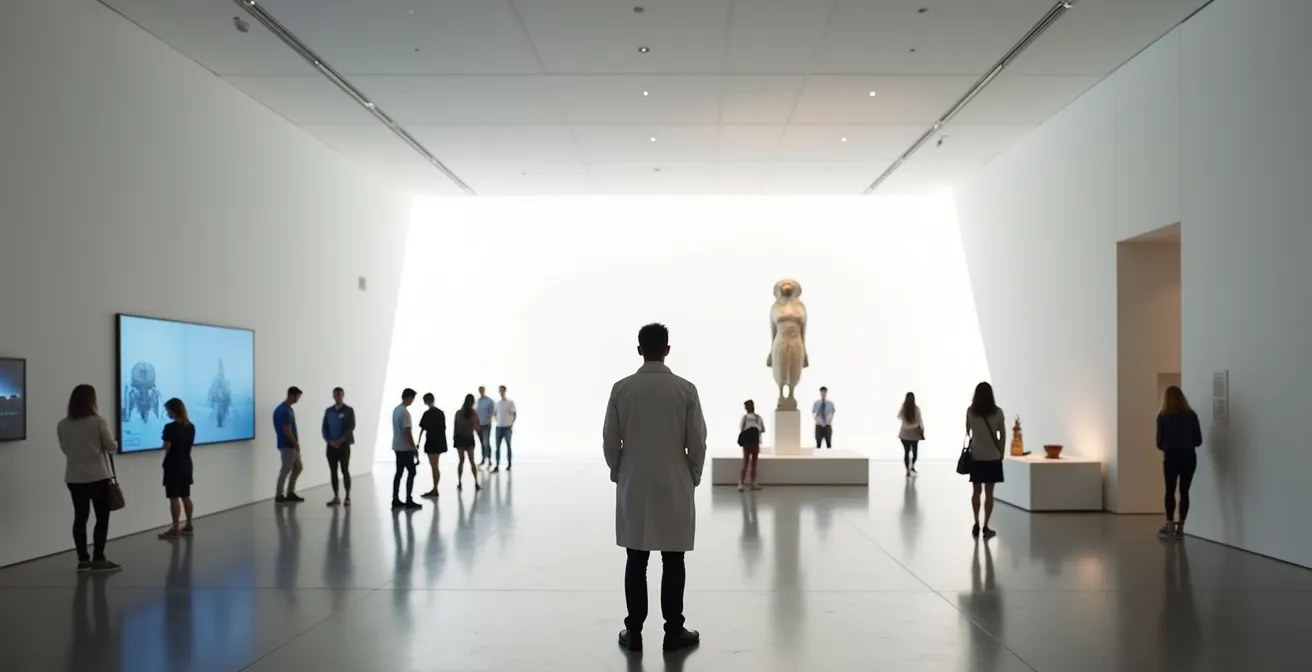
The transition to experience-first curation isn’t about adding digital gadgets; it’s about fundamentally redesigning visitor engagement around cognitive and narrative principles.
- Successful exhibits guide attention by strategically countering innate cognitive biases like the “right-turn” tendency.
- Layering digital stories over physical objects deepens meaning, with technologies like AR proving more effective due to “embodied cognition.”
Recommendation: Stop thinking about what to *show* and start designing the *journey* you want visitors to *feel* and *remember*.
The traditional museum model, built around the quiet reverence of static objects in glass cases, is facing an existential challenge. In an age saturated with digital media and interactive entertainment, the role of the curator is undergoing a profound transformation. Audiences, particularly younger demographics, no longer arrive as passive recipients of information; they come seeking engagement, participation, and a personal connection to the stories being told. This has ignited a critical shift in curatorial practice, moving the focus away from the primacy of the object and toward the primacy of the visitor’s experience.
Many institutions have responded by incorporating technology, launching blockbuster shows, or simplifying their wall texts. While these are steps in the right direction, they often treat the symptoms rather than the cause. The true evolution lies not in merely adding interactive screens or “Instagrammable” moments, but in a much deeper, more strategic re-evaluation of how we construct meaning and guide attention within the gallery space. It requires a move from being a keeper of artifacts to becoming an architect of experiences.
This article provides a strategic framework for curators and gallery directors navigating this new landscape. We will dismantle the idea that experience-first design is a departure from scholarly rigor. Instead, we will argue that it is a more effective way to achieve the museum’s core mission: to educate, inspire, and provoke. By understanding the cognitive and narrative levers that shape visitor perception, you can create immersive exhibitions that are not only more engaging but also more memorable and impactful. This is the new curatorial mandate.
This guide explores the essential strategies and principles that define modern, experience-first curation. Below is a summary of the key areas we will delve into, offering a roadmap for transforming your institution’s approach to exhibition design.
Summary: A Guide to Experience-First Exhibition Design
- Why the “Right Turn” Bias Affects How People View Exhibitions?
- How to Layer Digital Storytelling Over Physical Artifacts?
- Narrative or Timeline: Which Structure Retains Attention Longer?
- The Accessibility Trap: Simplifying Text Without Losing Academic Rigor
- When to Launch a Blockbuster Show to Capture Tourist Season?
- Why a Signature Adds 50% Value to an Otherwise Identical Print?
- Why AR Retention Rates Are 40% Higher Than Audio Guides?
- How Societal Narratives in Public Art Can Influence Local Policy Changes?
Why the “Right Turn” Bias Affects How People View Exhibitions?
The physical layout of an exhibition is not a neutral container; it is an active participant in shaping the visitor’s journey. One of the most powerful, yet often overlooked, factors is the “right-turn bias,” a well-documented human tendency to turn right upon entering a new space. This cognitive shortcut means that, without intervention, a significant portion of your audience will unconsciously follow a predictable path, potentially missing key introductory elements or entire sections placed to the left of the entrance. This isn’t a conscious choice but a function of our brain’s desire for efficiency; indeed, research on visitor attention patterns shows that people gravitate towards experiences that are satisfying with minimal effort.
Understanding this bias is the first step in designing a true cognitive architecture for your exhibition. Instead of fighting against this natural tendency, the savvy curator works with or around it. The goal is to interrupt this “cognitive autopilot” and intentionally guide the visitor’s gaze and movement. This can be achieved through a series of “pattern interrupts”—strategic design choices that make the desired path the path of least resistance. By creating a strong focal point on the left wall, using targeted lighting to draw the eye, or employing textures on the floor to direct foot traffic, you can craft a more balanced and deliberate visitor flow. This ensures your narrative unfolds as intended, rather than being dictated by an unconscious bias.
Action Plan: Implementing Pattern Interrupt Design
- Place a striking focal point or “hero” artifact on the left wall to immediately counter the natural right-turn tendency.
- Use specific, high-contrast lighting to illuminate the intended starting point and guide visitors against their cognitive autopilot.
- Employ changes in floor textures or subtle graphic patterns on the floor to subconsciously direct traffic flow towards the left.
- Create prominent visual landmarks, such as large-scale graphics or sculptures, that are visible from the entrance to establish alternative paths.
- Design “attract modes” for digital screens or kinetic pieces that communicate primary messages from multiple viewpoints, catching attention regardless of approach.
How to Layer Digital Storytelling Over Physical Artifacts?
The presence of a physical artifact offers an unparalleled sense of authenticity, but its story is often silent and incomplete. Layering digital content over these objects presents a powerful opportunity to enrich their narrative without compromising their integrity. The most elegant approach to this is the concept of the “narrative palimpsest,” where new layers of information are added, but the original object remains the central, revered text. This model avoids the pitfall of digital screens competing with artifacts for attention. Instead, technology becomes a lens that reveals hidden histories, lost contexts, or microscopic details.

As seen in the image above, the goal is not to replace the physical experience but to augment it with ethereal layers of meaning. A successful digital palimpsest makes the artifact *more* interesting, not less. For example, using Augmented Reality (AR) on a visitor’s phone, you could restore the original vibrant colors to a faded Roman statue or animate the intricate workings of a clockwork mechanism. This symbiotic relationship transforms a static viewing into an active process of discovery. The key is to ensure every digital interaction drives attention back to the physical object, using technology as a bridge to deeper appreciation rather than a distraction from it.
Implementing this requires a structured approach. A useful framework involves designing multiple layers of engagement:
- Layer 1: Visual Augmentation. Use AR to show an object’s original state, such as reconstructing a fragmented pot or showing the original paint on a sculpture.
- Layer 2: Process Demonstration. Use interactive animations to illustrate how an artifact was created, used, or discovered.
- Layer 3: Human Stories. Add audio clips accessible via NFC tags that share stories from the object’s creators, owners, or those impacted by it.
This tiered approach respects different levels of visitor interest while consistently reinforcing the centrality of the artifact itself.
Narrative or Timeline: Which Structure Retains Attention Longer?
Once you have the visitor’s attention, the next challenge is to hold it. The structure of your exhibition is the primary tool for this, and the choice between a chronological timeline and a thematic narrative is a critical one. A timeline offers clarity and is excellent for explaining historical processes, but it can often feel like a forced march through dates and facts. A narrative structure, by contrast, taps into a more fundamental human impulse. As the foundational museum theorist Freeman Tilden stated, the visitor’s primary interest lies in what connects to them personally. In his seminal guide, he notes:
The visitor’s main interest is in whatever touches his or her personality, experiences, and values. Every visitor seeks to be engaged and connect to a story.
– Freeman Tilden, Interpreting Our Heritage
This insight suggests that narrative-driven exhibitions generally achieve higher engagement and retention. A story, with its inherent structure of characters, conflict, and resolution, creates emotional investment and a cognitive roadmap that makes information more memorable. It transforms a collection of objects into a cohesive, compelling journey. However, the choice is not simply binary; several structural models can be employed to balance narrative depth with visitor freedom.
| Structure Type | Visitor Experience | Engagement Pattern | Best For |
|---|---|---|---|
| Linear Pathway | Single physical pathway through exhibit | Controlled narrative progression | Historical chronologies, process explanations |
| Multiple Pathways | Several story paths available | Explorer-friendly, non-linear discovery | Thematic exhibitions, diverse audiences |
| Constellation Model | Central theme with interconnected stories | Any-order exploration with core narrative anchor | Complex topics, repeat visitors |
As this framework for exhibition storytelling shows, the most effective approach often depends on the subject matter and target audience. The “Constellation Model” is particularly powerful for experience-first design, as it provides a strong central narrative (the main star) while allowing visitors the autonomy to explore interconnected sub-themes (surrounding stars) in any order they choose, creating a personalized yet cohesive experience.
The Accessibility Trap: Simplifying Text Without Losing Academic Rigor
In the quest to be more accessible, many museums fall into the “accessibility trap”: dumbing down exhibition text to the point where it loses all nuance and academic integrity. This approach patronizes the general audience while alienating specialists. The challenge is not to simplify, but to clarify. The reality is that curators are competing in a fierce attention economy, and a wall of dense academic text is a losing proposition when studies show the average person spends less than 8 seconds looking at a work of art. The text must therefore work much harder to be engaging.
A far more effective strategy is the “Progressive Disclosure” model. This approach layers information, offering multiple entry points for different levels of interest, all without sacrificing rigor. It acknowledges that not every visitor wants or needs the same depth of information. The implementation is straightforward and respects both the casual browser and the dedicated scholar.
The model works in tiers:
- Layer 1 (The Hook): A short, evocative physical label of 20-30 words. It poses a question or presents a striking fact, designed to capture initial interest. It uses active language and avoids jargon.
- Layer 2 (The Context): A QR code or NFC tag next to the primary label links to a second layer of text. This is a clear, concise paragraph (100-150 words) that provides essential context, background, and interpretation.
- Layer 3 (The Deep Dive): Within the second layer, a link provides access to the full academic paper, primary source documents, artist interviews, or conservation reports for the specialist audience.
This method gracefully solves the dilemma. It keeps physical gallery spaces clean and uncluttered, provides a meaningful experience for the time-poor majority, and still offers a path to deep academic content for those who seek it. It’s about providing intellectual generosity, not forced simplification.
When to Launch a Blockbuster Show to Capture Tourist Season?
The timing of a blockbuster exhibition launch is one of the highest-stakes decisions a museum director can make. Conventional wisdom dictates launching at the beginning of the peak tourist season to maximize immediate foot traffic. However, this strategy often leads to overcrowded galleries, overwhelmed staff, and a diluted visitor experience. A more sophisticated, experience-first approach favors a counter-intuitive strategy: the “shoulder season” launch. This involves opening a major show in a period like May (before the summer rush) or September (just after).
This strategy carries several distinct advantages. First, it allows the exhibition to build critical word-of-mouth momentum. The initial visitors are often engaged locals and discerning early-adopter tourists who are more likely to share their positive experiences on social media and with their networks. They become evangelists for the show. By the time peak season arrives, the exhibition is not a cold open but a validated “must-see” event, driving even greater demand. Second, it provides a crucial period for staff to iron out any operational kinks in visitor flow, ticketing, and interactive elements before the full-scale onslaught of peak crowds.

This approach prioritizes the quality of the initial experience, recognizing that a positive, uncrowded first impression is a powerful marketing tool. It transforms the launch from a logistical gamble into a strategic build-up, ensuring that by the time the largest crowds arrive, both the exhibition and the institution are fully prepared to deliver a world-class experience. It’s a shift from chasing volume to cultivating value.
Why a Signature Adds 50% Value to an Otherwise Identical Print?
On the surface, an artist’s signature is merely a few strokes of ink. Yet, in the art market, that small mark can dramatically increase the value of a print. The phenomenon isn’t about the aesthetic quality of the signature itself; it’s a powerful lesson in the value of narrative. The signature is the ultimate narrative layer, a physical trace that tells a profound story of authenticity, provenance, and direct connection to the creator. It transforms an object from a mechanical reproduction into a piece that has been personally touched, acknowledged, and validated by the artist.
This act of signing imbues the print with a story that a machine-made object lacks. It’s the story of the artist’s hand, a moment in time, and an affirmation of the work’s legitimacy within their oeuvre. For a collector or a museum-goer, this signature acts as a bridge, closing the psychological distance between the viewer and the creator. It offers a tangible link to the “aura” of the original, even in a reproduced format. It signifies that this is not just *a* copy, but *the artist’s* copy.
For curators designing experiences, this principle holds a vital lesson. The value—whether monetary or experiential—is often found not in the object alone, but in the stories that are attached to it. Just as a signature validates a print, the stories we layer onto artifacts in an exhibition give them meaning and resonance. An anonymous Roman coin is a piece of metal; a Roman coin presented with the story of the emperor who minted it, the soldier who carried it, and the marketplace where it was spent becomes a vessel of history. The signature proves that the most powerful element we can add to an object is a compelling and authentic story.
Why AR Retention Rates Are 40% Higher Than Audio Guides?
For decades, audio guides have been the default technology for enriching the museum experience. However, emerging evidence suggests that Augmented Reality (AR) applications can lead to significantly higher information retention. The reason for this 40% boost isn’t simply novelty; it’s rooted in a powerful psychological principle known as “embodied cognition.” This theory posits that our cognitive processes are deeply intertwined with our body’s interactions with the world. We don’t just think with our brains; we think with and through our bodies.
An audio guide is a passive, disembodied experience. A visitor stands still, listening to a narrator describe an object. The learning is auditory and abstract. AR, in contrast, demands active, physical participation. To use an AR app, a visitor must physically hold up their device, point it at an object, move around it to see different angles, and interact with digital overlays that appear integrated with the physical space. This physical action—pointing, moving, framing—creates a much stronger memory trace.
A prime example is New Zealand’s Otago Museum, which used AR for its ‘Sea Monsters’ exhibit. As detailed in an analysis of their ‘Plunge’ experience, visitors used their phones to see virtual 3D sea creatures swimming around them in the real gallery space. They weren’t just told about the creature’s scale; they physically moved their bodies to look up at a massive virtual mosasaur floating above them. This act of embodied interaction—looking, moving, reacting—connects the abstract information to a physical, spatial memory, making it far more durable than information received passively. AR works because it forces the body to become a partner in the act of learning.
Key Takeaways
- Curatorial success is no longer measured by the collection, but by the quality of visitor engagement and participation.
- Effective exhibition design is a form of cognitive architecture, intentionally guiding visitor attention and movement.
- Technology should serve as a lens to deepen appreciation for physical artifacts, not as a distraction from them.
How Societal Narratives in Public Art Can Influence Local Policy Changes?
The role of the museum in the 21st century extends beyond its own walls. Exhibitions, particularly those dealing with public art or pressing societal issues, have the potential to function as powerful catalysts for civic discourse and even influence local policy. When a museum successfully creates an immersive, emotionally resonant narrative around a topic like environmental justice, urban development, or historical memory, it does more than just educate; it creates an intense public forum for debate. It can galvanize a community and place an issue squarely on the agenda of local policymakers.
This influence is not accidental; it is the result of designing an exhibition as a “civic action funnel.” This concept reframes the end of the visitor journey. Instead of exiting through a gift shop, visitors are guided towards a space for reflection, response, and action. For instance, the Museum of Science and Industry in Chicago created an immersive exhibit on ocean pollution that used powerful visuals to demonstrate environmental challenges. Such an experience can evoke a strong emotional response, which can then be channeled. An effective civic action funnel might include stations where visitors can record their own video testimonies, sign petitions for local initiatives, or receive information from partner advocacy groups.
By creating this bridge between the emotional experience of the exhibition and concrete, real-world actions, the museum transforms from a passive cultural repository into an active agent of social change. It provides the narrative and emotional context that data-heavy policy reports often lack, making complex issues relatable and urgent to both the public and the officials who serve them. The museum becomes a space where a community can collectively understand a problem and begin to imagine solutions, directly influencing the local narrative and, subsequently, the political will for change.