
True income stability for artists comes from acting like the CEO of your own creative enterprise, not just a gig worker.
- Shift focus from chasing one-off projects to building a portfolio of strategic income assets.
- Implement a “value ladder” pricing model to escape the “starving artist” trap of hourly rates.
Recommendation: Start by identifying one piece of your existing artwork that could be repurposed for a passive income stream, like a licensing agreement or print-on-demand product.
If you’re a freelance illustrator, painter, or digital artist, you’ve likely felt the precariousness of the gig economy. The cycle of feast or famine—landing a big commission one month and chasing invoices the next—is exhausting. The common advice is to simply “diversify your income” by posting more on social media or selling a few prints. But this often feels like running on a treadmill, a constant hustle for diminishing returns that can lead to burnout.
This approach mistakes activity for strategy. It keeps you in the mindset of a “gig artist,” perpetually reacting to the market instead of shaping it. But what if the path to a stable income wasn’t about working harder, but about thinking differently? What if the solution was to stop being just an artist and start being the CEO of your own creative enterprise?
Building a sustainable career is less about finding the next gig and more about strategically constructing a business around your art. This involves turning your creations into assets, protecting your intellectual property, pricing for value instead of time, and curating your brand to attract the clients you deserve. This guide will walk you through the practical, business-savvy steps to move beyond surviving and start thriving as a creative professional.
This article provides a roadmap to transform your artistic practice into a stable and profitable business. We will explore how to adapt to changing platforms, create powerful legal protections, and build multiple, complementary revenue streams.
Summary: Visual Artists and the Gig Economy: How to Stabilize Income Streams?
- Why Instagram Engagement Is Dropping for Static Visual Art?
- How to Draft a Licensing Agreement That Protects Your Copyright?
- Crypto Art or Merch: Which Passive Income Stream Is More Stable?
- The Pricing Mistake That Keeps You trapped in “Starving Artist” Mode
- How to Curate Your Portfolio to Attract High-Paying Art Directors?
- Old Masters or Young Contemporaries: Where is Your Capital Safer?
- How to Write a Grant Proposal for Art That Challenges the Status Quo?
- Fine Arts Investment: How to Spot Undervalued Masterpieces Before Auction?
Why Instagram Engagement Is Dropping for Static Visual Art?
You’ve noticed it, haven’t you? The beautifully rendered static image you spent hours on gets a fraction of the engagement it would have a few years ago. You’re not imagining things. The digital landscape has shifted beneath our feet, and for visual artists, this change is seismic. Platforms like Instagram are no longer just digital galleries; they are entertainment hubs prioritizing video content to compete with rivals like TikTok. As a result, the algorithm now heavily favors motion, sound, and interaction.
The data confirms this trend. While overall engagement has slightly decreased, the disparity between content types has widened dramatically. The key insight is that Reels receive 22% more interaction on Instagram than standard video posts, and far more than static images. This doesn’t mean your visual art has lost its value; it means the way you package and present it must evolve. The platform is rewarding content that holds a viewer’s attention for longer.
The strategic pivot for a creative CEO is not to abandon the platform, but to adapt your presentation. Think about how you can incorporate your static art into a dynamic format. This could involve creating short videos showing your creative process, animating layers of a digital painting, or using a “Ken Burns” effect to pan across a high-resolution piece. The goal is to translate the storytelling inherent in your art into a format the algorithm understands and rewards, turning a passive viewing experience into an active one.
How to Draft a Licensing Agreement That Protects Your Copyright?
One of the most powerful shifts from “artist” to “creative enterprise” is realizing that you’re not just selling a single painting or illustration; you are creating an intellectual property (IP) asset that can generate revenue for years. Licensing is the mechanism that makes this possible. It allows you to grant a company the right to use your artwork on their products—from greeting cards and textiles to phone cases and advertisements—in exchange for a fee or royalties, while you retain full ownership of your copyright.
A well-drafted licensing agreement is your shield. It must clearly define the scope of use: which products, for how long (term), and in which geographic territories. Vague agreements are a recipe for exploitation. The financial terms are equally critical. While there’s a wide range, industry data shows that most artists earn between 3-10% royalty rates on the wholesale price of products sold. Your agreement must also specify payment schedules and your right to audit sales records to ensure you’re being paid accurately.
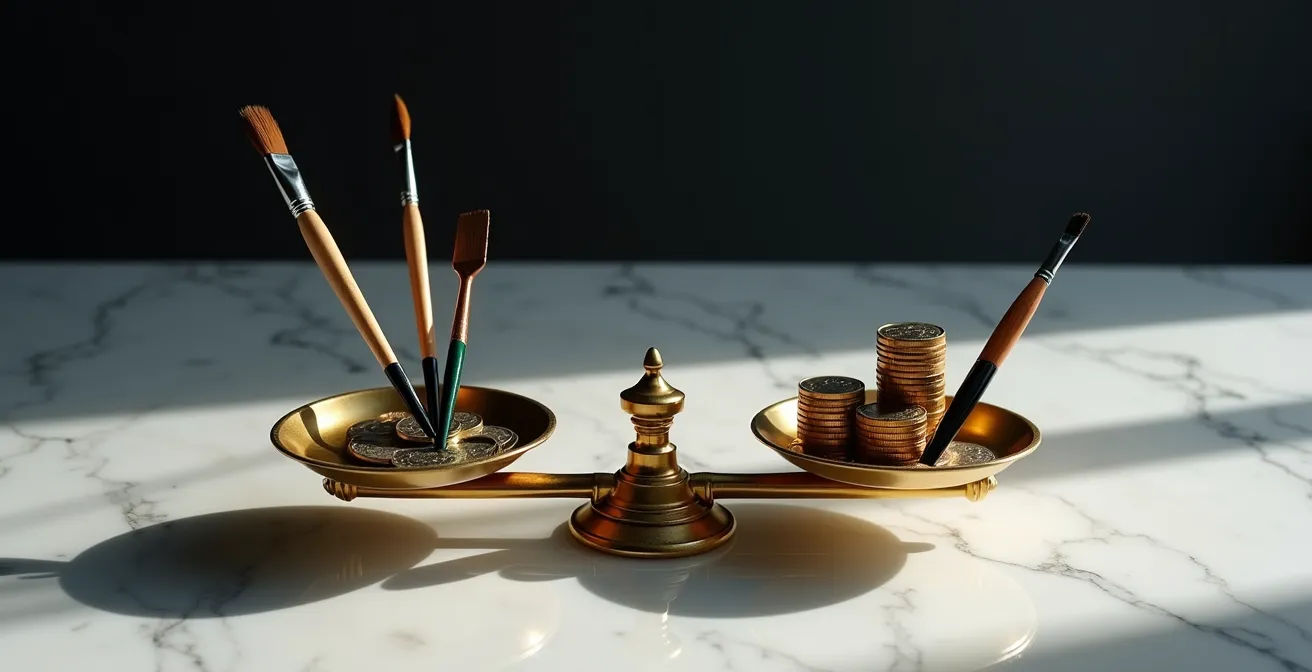
The power of a single piece of art, when licensed effectively, can be profound. It transforms a one-time sale into a source of long-term, passive income. This strategy is a cornerstone of building a stable financial foundation for your art business.
The Long-Term Value of Strategic Licensing
Consider the power of a single piece of IP. In one documented instance, a single Christmas design painted in gouache was licensed for various paper products. Over a nine-year period, this one piece of art earned its creator over $55,000 in 5% royalties. This wasn’t a one-time payment; it was a steady stream of income from a strategic agreement, demonstrating how licensing can turn your creative work into a durable financial asset.
Crypto Art or Merch: Which Passive Income Stream Is More Stable?
Once you embrace the CEO mindset, you’ll start evaluating income streams not just on their creative appeal, but on their business characteristics: risk, accessibility, and stability. Two popular “passive” income avenues for artists are Crypto Art (NFTs) and Print-on-Demand (POD) merchandise. On the surface, both allow you to monetize a single piece of art multiple times, but they represent fundamentally different business strategies.
NFTs offer the potential for high rewards, with smart contracts that can provide perpetual royalties on secondary sales. However, this comes with extreme market volatility, high upfront technical and financial costs (gas fees), and an audience that is often more interested in speculative investment than the art itself. It’s a high-risk, high-reward game. In contrast, POD merchandise (t-shirts, mugs, prints) operates on a low-risk, steady-return model. There are virtually no upfront costs, and you tap into a broad consumer base that wants to own a beautiful, accessible piece of your creative world.
The following table breaks down the core differences, helping you decide where to allocate your time and energy.
| Factor | NFT/Crypto Art | POD Merchandise |
|---|---|---|
| Upfront Investment | High (gas fees, platform costs) | Low to zero |
| Market Volatility | Very high | Low |
| Audience Accessibility | Tech-savvy collectors | Broad consumer base |
| Passive Income Potential | Perpetual smart contract royalties | Zero-inventory model |
| Risk Level | High risk, high reward | Low risk, steady returns |
The “Core and Explore” Strategy
A smart approach recommended by successful artists is the “Core and Explore” model. This strategy uses POD merchandise as the stable, foundational “core” of your passive income. Once this system is set up, it requires minimal ongoing effort. You then “explore” with a small, curated selection of your work in higher-risk, higher-reward areas like NFTs. This balanced approach, highlighted in an analysis of artist income streams, allows you to build a stable financial base while still experimenting with emerging technologies without betting the entire farm.
The Pricing Mistake That Keeps You trapped in “Starving Artist” Mode
The most common and damaging mistake artists make is pricing their work based solely on time and materials. This “hourly wage” mindset immediately puts a cap on your earning potential and anchors your value to manual labor, not creative output. While the US Department of Labor lists the average hourly wage for a fine artist at around $24.58, tying your income to this metric keeps you in the “starving artist” cycle. You can only work so many hours in a day, and this model doesn’t account for your unique vision, your years of skill development, or the value your art brings to a client.
Escaping this trap requires a fundamental shift to a value-based pricing model. Instead of asking, “How long did this take me?” ask, “What is this worth to my client?” and “How does this piece fit into my overall business strategy?” This leads to the creation of a “Product Ladder” or “Value Ladder,” a tiered pricing structure that offers multiple entry points for different types of buyers. It allows someone to become a fan with a small purchase and gradually move up to more significant investments.
A value ladder not only increases your total revenue but also stabilizes it. Low-cost passive items provide a consistent income floor, while high-ticket commissions create significant financial peaks. It’s a strategic system designed for growth, not just survival.
Action Plan: Build Your Product Ladder Pricing Strategy
- Tier 1 (Low-Cost/Passive): List your entry-level offerings. Offer prints, digital downloads, and small merchandise starting at accessible price points to capture new fans and impulse buyers.
- Tier 2 (Mid-Cost/Active): Define your standard commission structure. Price these projects based on your established hourly rate plus materials, but also factor in complexity and usage rights. This tier targets serious individual collectors and small businesses.
- Tier 3 (High-Ticket/Premium): Create your premium packages. Command top prices for large-scale projects, corporate commissions, art direction services, or exclusive licensing deals that require your highest level of expertise.
- Factor and Review: For every tier, ensure you factor in all costs—materials, time, and overhead (studio rent, software subscriptions)—and then add a minimum 30% profit margin. Review and adjust your entire ladder annually based on demand, experience, and career milestones.
- Communicate Value: Clearly articulate what a client receives at each tier. Your pricing page shouldn’t just be a list of numbers; it should tell a story of escalating value and exclusivity.
How to Curate Your Portfolio to Attract High-Paying Art Directors?
Your portfolio is not a scrapbook of your greatest hits; it is your single most important sales tool. Many artists make the mistake of filling it with everything they’ve ever created, resulting in a confusing and unfocused presentation. A high-paying art director or serious collector doesn’t have time to decipher your potential. They need to see, in an instant, that you are the solution to their specific problem. This requires a ruthless and strategic curation of your work.
First, define your ideal client. Are you targeting editorial illustration, book covers, brand collaborations, or fine art collectors? Each audience is looking for something different. Once you know who you’re talking to, curate your portfolio to speak directly to them. This means showing not just your best work, but your most relevant work. If you want to illustrate children’s books, your portfolio should be filled with character designs and narrative scenes, not abstract paintings, no matter how beautiful they are.
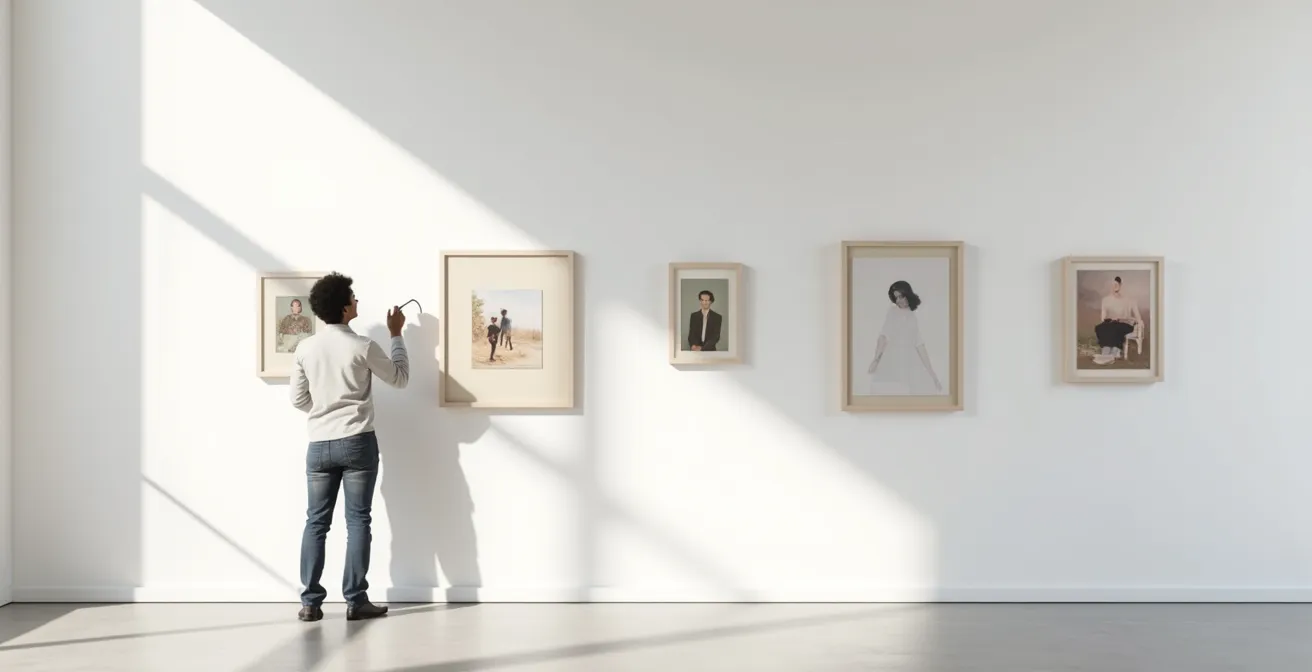
Furthermore, frame your work with context. Instead of just displaying an image, present it as a mini-case study. Briefly explain the client’s problem, your creative solution, and the successful outcome. This shows art directors that you are not just an image-maker, but a professional problem-solver who understands commercial goals. A curated portfolio demonstrates confidence and business acumen, signaling that you are ready for high-stakes projects.
Collectors often assess a piece based on its intrinsic value rather than the artist’s reputation.
– Jason Horejs, RedDotBlog
Old Masters or Young Contemporaries: Where is Your Capital Safer?
In the fine art world, investors constantly debate where to place their capital for the best returns. But for you, the creative entrepreneur, this question has a different, more personal meaning. The “Old Masters” are the established, safe bets, while the “Young Contemporaries” are the high-risk, high-growth opportunities. When it comes to your own business, the most crucial investment you can make is not in another artist’s work, but in yourself as the ultimate “Young Contemporary.”
Your time and money are your investment capital. It’s tempting to chase quick wins or get distracted by what other successful artists are doing. However, the highest and safest return on investment (ROI) comes from strategically investing in your own creative enterprise. This means allocating resources to areas that directly build your primary income stream and long-term brand value. While industry analysis reveals that beginner artists typically earn $200-$4,000 per artwork, this number grows exponentially as an artist invests in their own business infrastructure.
What does this self-investment look like? It’s not just buying better paint. It’s taking a course on contract law, purchasing professional project management software, hiring a photographer for your portfolio, or dedicating a budget to targeted marketing. These aren’t expenses; they are capital investments in the machinery of your business. You are the asset with the most growth potential.
The ROI of Self-Investment
When you analyze the careers of financially successful artists, a clear pattern emerges. Many report that their breakthrough moments came not from a single sale, but from a strategic decision to invest in their own business. As one analysis points out, artists who invest in skills development, quality materials, a professional website, and robust marketing systems see the highest ROI compared to speculating on external assets. This approach directly builds their primary income stream and creates a flywheel effect, where better business systems lead to better clients, which in turn provides more capital for further investment.
How to Write a Grant Proposal for Art That Challenges the Status Quo?
Grants are often viewed as a form of artistic validation or charity, but for the creative CEO, they are a strategic business development tool. A grant is non-dilutive funding—it’s capital you don’t have to pay back, which can be used to fund projects, purchase equipment, or simply provide you with the financial runway to create your most ambitious work. For artists whose work challenges the status quo, grants are particularly vital, as foundations are often specifically looking to fund innovative and boundary-pushing projects that the commercial market might initially overlook.
Writing a successful grant proposal is an art in itself. It requires you to translate your artistic vision into the language of a business case. Grantors are investors, and they want to see a return on their investment—not necessarily a financial one, but a social, cultural, or community one. Your proposal must clearly articulate the problem your art addresses, the uniqueness of your approach, and the impact your project will have. It needs a clear budget, a realistic timeline, and measurable outcomes.

To make this a stable income source, move beyond one-off applications and build a “Grant Funnel System.” This involves creating a master proposal that can be customized, using tools to track deadlines, and building relationships with foundation program officers. By treating grant writing as a consistent business activity rather than a desperate, last-minute effort, you can integrate it as a reliable pillar of your financial structure.
Here are key steps to systematize your grant-seeking efforts:
- Build a master proposal template that outlines your mission, methods, and impact, which you can then customize for different foundations.
- Use tracking tools (like a spreadsheet or a CRM) to monitor grant deadlines across local, national, and corporate foundations.
- Thoroughly research each foundation’s priorities and explicitly align your project description to fulfill their specific mission.
- Build relationships with program officers through informational interviews *before* applying to gain insights and visibility.
Key takeaways
- Adopt a “Creative CEO” mindset to move from reactive gig work to proactive business building.
- Diversify your income streams strategically with a mix of active work (commissions) and passive assets (licensing, POD).
- Price your work based on a “value ladder” to maximize revenue and escape the trap of hourly billing.
Fine Arts Investment: How to Spot Undervalued Masterpieces Before Auction?
In the art market, fortunes are made by those who can spot an undervalued masterpiece before the rest of the world catches on. They see the potential, the story, and the intrinsic value that others miss. As a creative entrepreneur, your final and most important task is to apply this same skill to your own work. The most valuable, undervalued asset in your possession is your own potential and the portfolio of work you have yet to fully monetize.
This is not an empty platitude; it’s a statistical reality. National Endowment for the Arts data shows that more than 50% of all visual artists are self-employed. You are already a business owner. The question is whether you are running your business by accident or by design. Spotting the masterpiece in your own studio means looking at your back catalog and asking: “Which of these pieces could be a greeting card line? Which character could anchor a children’s book? Which pattern could be licensed for textiles?”
Stabilizing your income stream is the cumulative result of the strategies we’ve discussed: adapting your marketing, protecting your IP through licensing, building a balanced portfolio of passive income streams, pricing with a value ladder, and treating grants as a business tool. Each action is a step toward recognizing and unlocking the full commercial value of your creative output. You are the artist, the curator, and the investor, all in one.
Having multiple income streams is one of the best ways to set yourself up for success so that you’re never relying on just one source of revenue.
– Goodtype Team, How to Make Money with Visual Art
Your journey from a freelance artist to a thriving creative CEO begins now. Start by taking a single, concrete step: evaluate your existing portfolio not just for its artistic merit, but for its business potential. Choose one piece and brainstorm three different ways it could be monetized beyond a one-time sale. This is the first step in building a resilient, profitable, and creatively fulfilling career on your own terms.