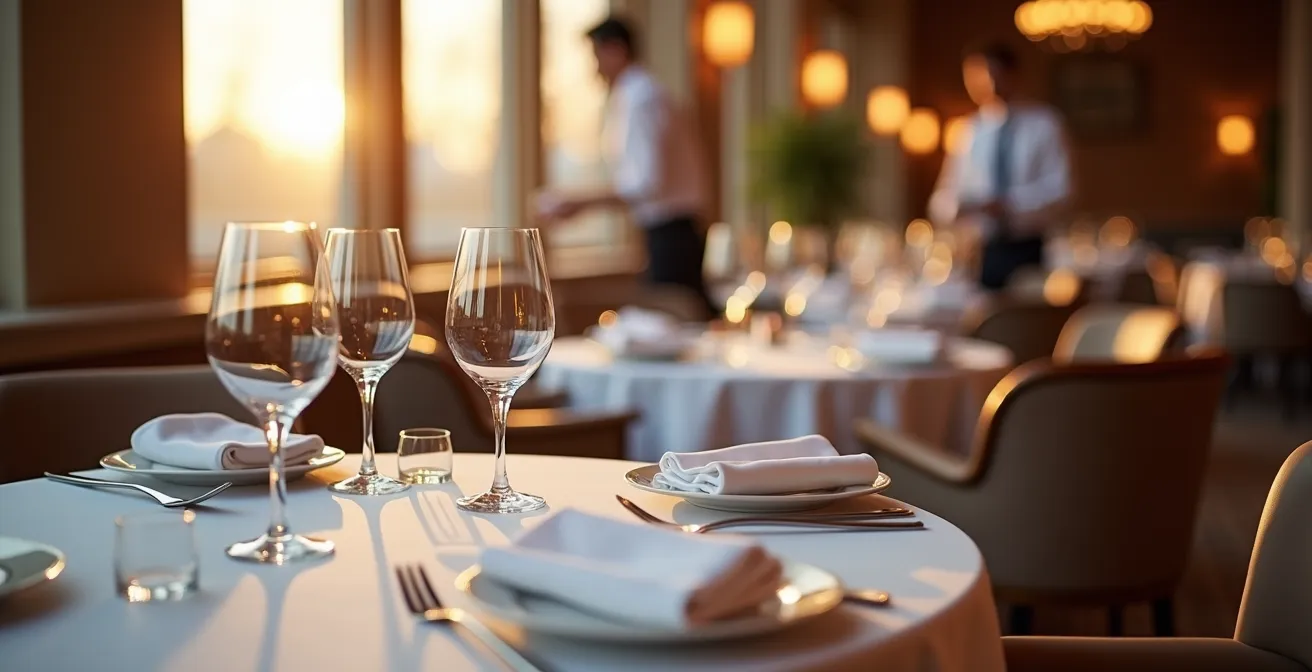
The critical difference between good and Michelin-level service is not superior politeness, but the execution of a meticulously engineered operational science.
- Exceptional service is a silent, choreographed performance designed to manage the guest’s perception of time, space, and comfort.
- Every element, from acoustic design to the narrative framing of a wine choice, is a deliberate component of an immersive sensory story.
Recommendation: Begin applying principles of ‘Controlled Urgency’ and ‘Sensory Storytelling’ to transform routine service interactions into memorable, high-value experiences.
Every hospitality professional knows the satisfying feeling of a guest leaving with a smile after a good dinner. The food was delicious, the service was prompt and polite. But a select few establishments operate on a different plane entirely—one where dinner is not just consumed, but experienced. This is the realm of Michelin-star service, a level of hospitality so seamless it can feel like magic. Yet, the common belief that it’s merely about anticipating needs or having an encyclopedic menu knowledge only scratches the surface. These are table stakes in fine dining.
The real differentiator is far more profound and systematic. It lies beyond simple attentiveness and enters the domain of applied psychology, environmental engineering, and performance art. While good service reacts, exceptional service directs. It architects the guest’s entire sensory journey from the moment they arrive to the final, lasting impression they take with them. This isn’t about simply preventing problems; it’s about curating a flawless narrative where every detail, seen and unseen, serves the story.
This article moves past the platitudes to deconstruct the operational science behind world-class service. We will explore how elite teams read unspoken cues, control the very sound of the room, masterfully turn tables without rushing guests, and transform a simple meal into an indelible memory. This is the blueprint for transitioning from good hospitality to unforgettable excellence.
To fully grasp these advanced concepts, this guide breaks down the core pillars that constitute the science of Michelin-level service. The following sections will provide a detailed roadmap for any professional aiming to elevate their craft.
Summary: The Blueprint for Michelin-Level Hospitality
- Why Reading Body Language Is the Server’s Most Valuable Skill?
- How to Dampen Noise Levels to Encourage Intimate Conversation?
- White Glove or Conversational: Which Service Style Fits Modern Diners?
- The Departure Oversight That Ruins a Perfect 3-Hour Meal
- How to Turn a Table in 2 Hours Without Making Guests Feel Rushed?
- Applying Lean Methodologies to Eliminate Service ‘Waste’
- How Sensory Storytelling Elevates a Meal Into a Memory
- From Wine Steward to Choice Architect: The Financial Impact of Expertise
Why Reading Body Language Is the Server’s Most Valuable Skill?
In the theater of fine dining, the script is often unspoken. While food quality is paramount, research from hospitality experts reveals that for 75% of diners, service quality is equally important. The foundation of this elite service is not just serving plates, but reading people. The ability to interpret non-verbal cues is the single most valuable skill a front-of-house professional can possess, as it transforms reactive service into proactive, almost precognitive, hospitality. It’s the difference between a server and a guest advocate.
This isn’t about grand gestures, but about mastering micro-expressions. As Michelin Guide Inspectors emphasize, the most memorable moments are often the most basic: a genuine smile and direct eye contact upon entry. These small, non-verbal signals communicate recognition and welcome, setting the stage for the entire experience. An inspector noted that these details are not just pleasantries; they are foundational data points in their overall assessment. A leaning-in posture may signal engagement with the menu, while crossed arms might indicate indecision or even discomfort. Averting eyes could mean a guest is ready to order or, conversely, wishes not to be disturbed. Responding to the wrong cue is a service failure.
Mastering this silent language requires dedicated training and observation. Elite teams practice a set of specific skills to decode and respond to guest needs with seamless precision. These skills include:
- Mastering the ‘glide’ movement: Differentiating between rushed, chaotic energy and efficient, controlled motion that projects calmness.
- Reading natural conversation lulls: Identifying auditory and visual pauses to approach tables at the perfect moment, without interrupting the guests’ flow.
- Practicing ‘Situational Code-Switching’: Dynamically adapting the service approach—from formal to conversational—based on real-time cues from the diners.
- Recognizing cultural nuances: Understanding that gestures, eye contact, and personal space have vastly different meanings across cultures, and adjusting accordingly.
Ultimately, reading body language allows the service team to become invisible architects of the guest’s comfort, addressing needs before they are ever voiced and making the entire service feel effortless and intuitive.
How to Dampen Noise Levels to Encourage Intimate Conversation?
In the modern luxury landscape, true opulence is often measured in tranquility. For a fine dining restaurant, where intimate conversations are as much a part of the experience as the cuisine, controlling the auditory environment is not a secondary concern—it is a core component of the product. An acoustically chaotic room, filled with clattering plates and echoing conversations, can undermine the most exquisite meal. Therefore, Michelin-star establishments engineer their spaces with the precision of a recording studio, using both passive and active measures to sculpt the soundscape.
The first layer of acoustic management is passive, built into the very fabric of the restaurant’s design. This involves a strategic selection of materials that absorb, rather than reflect, sound waves. Hard, reflective surfaces like bare glass, polished stone, and unadorned walls create harsh, cacophonous environments. Elite restaurants counter this by incorporating soft, porous materials. Think plush velvet banquettes, heavy draperies, textured wall coverings, and even custom-designed acoustic panels disguised as art. These elements work silently to dampen ambient noise, creating pockets of conversational clarity.
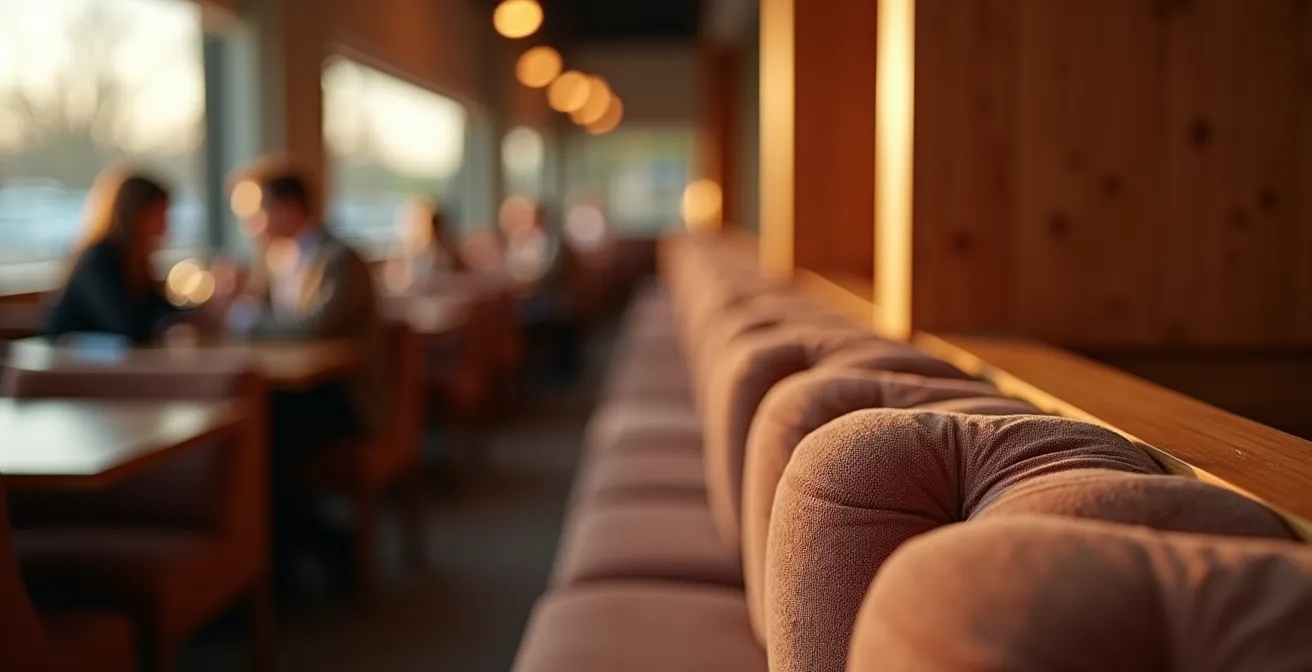
However, materials alone are not enough. The second, and more dynamic, layer is the practice of ‘silent service’. This is an active noise reduction strategy implemented through what is known as service choreography. Staff are trained to move with purpose and grace, wearing soft-soled shoes to minimize footfalls. Crockery and cutlery are chosen not just for their beauty, but for their acoustic properties, designed to reduce clatter when set down. Most importantly, teams use sophisticated non-verbal communication systems—subtle hand signals or digital cues—to coordinate actions without shouting across the room. This disciplined, silent ballet is a critical part of maintaining an atmosphere of serene intimacy.
By combining thoughtful material choices with highly disciplined service protocols, a restaurant can effectively protect the sanctity of guest conversations, transforming a simple meal into a private, luxurious experience.
White Glove or Conversational: Which Service Style Fits Modern Diners?
The traditional image of fine dining service is one of rigid formality: the ‘white glove’ approach, characterized by silent precision and reverential distance. Yet, the modern diner’s expectations have evolved. The central question for today’s top-tier restaurants is no longer about choosing one style, but about mastering many. With 42% of restaurants having raised their prices, guests expect a service experience that is not just flawless, but also deeply personalized to their mood and context.
The idea that a single service style fits all occasions is now obsolete. As celebrity chef Michael Mina observes, even in the most formal settings, some guests need to be out in 45 minutes for a business dinner, while others are settling in for a three-hour celebration. The pinnacle of modern service, therefore, is not adherence to a rigid script, but the mastery of ‘Situational Code-Switching’. This is the bilingual ability of a service professional to pivot seamlessly between a formal, unobtrusive presence and a warm, conversational guide, based on the subtle cues a table provides.
An exceptional server becomes a social chameleon. For a couple on an anniversary, the style might be warm, engaging, and story-driven, creating a memorable connection. For a corporate group negotiating a deal, the service must be almost invisible—discreet, efficient, and anticipating needs without ever interrupting the flow of business. This requires a deep-seated emotional intelligence, an ability to quickly assess the table’s “mission” for the evening and calibrate every interaction to support it. The goal is to make the guests feel that the service was designed uniquely for them, on that specific night.
Ultimately, the debate between ‘white glove’ and ‘conversational’ is a false choice. True Michelin-star service is a fluid spectrum, and the most valuable professionals are those who can navigate it with effortless grace, ensuring every guest receives not just the service they expect, but the one they truly need.
The Departure Oversight That Ruins a Perfect 3-Hour Meal
A fundamental principle of human psychology is the “peak-end rule”: people judge an experience largely based on how they felt at its most intense point and at its very end. A three-hour symphony of culinary perfection can be instantly soured by a clumsy or indifferent conclusion. Michelin-star establishments understand this intimately and thus obsess over what can be called ‘The Last 100 Yards’ of the guest journey. This final phase, from the bill presentation to the farewell at the door, is not an afterthought; it is the moment that cements the entire memory of the evening.
As MICHELIN Guide Inspectors have pointed out, there is nothing more dispiriting than paying a significant bill and walking the length of the restaurant to exit without a single staff member acknowledging your departure. This silent, anonymous exit erases the feeling of being a valued guest and reduces the experience to a mere transaction. It communicates that once the payment is settled, your importance has vanished. This is the single greatest—and most common—unforced error in hospitality. A perfect meal can be ruined by a feeling of being invisible at the very end.
To prevent this, elite establishments choreograph the departure with the same precision as the main course. The process is designed to be seamless, respectful, and personalized, ensuring the final impression is as powerful as the first. This requires a coordinated effort and a clear set of protocols that every team member understands and executes flawlessly. The goal is to make the guest feel cherished until they are physically out of the establishment’s care.
Action Plan: Mastering the ‘Last 100 Yards’
- Seamless Payment: Implement discreet, efficient payment processing. Bring the terminal to the table and handle the transaction swiftly to avoid awkward waiting periods.
- Anticipatory Service: Have coats, bags, or other checked items ready before guests stand up, demonstrating a proactive attention to their needs.
- Proactive Coordination: If valet, taxi, or ride-share services were used, coordinate their arrival proactively so transportation is waiting for the guest, not the other way around.
- Personalized Farewell: Ensure a host or manager is at the door to offer a personalized farewell, ideally referencing a detail from the evening (“I hope you enjoyed the Burgundy,” or “Happy anniversary again”).
- Post-Visit Communication: For special occasions or high-value guests, follow up with a non-automated thank you email or note within 24-48 hours to extend the feeling of hospitality beyond the physical restaurant.
By meticulously scripting these final interactions, a restaurant ensures that the feeling of warmth and recognition is the lasting takeaway, transforming a great meal into a cherished memory worth sharing.
How to Turn a Table in 2 Hours Without Making Guests Feel Rushed?
For any successful restaurant, turning tables is an economic necessity. The challenge in a fine dining context is executing this with such finesse that the guest feels completely unhurried, as if they have all the time in the world. This is perhaps the most delicate ballet in hospitality, resolving the inherent conflict between operational efficiency and luxurious leisure. The secret does not lie in moving faster, but in mastering what elite service professionals call ‘Controlled Urgency’.
This concept is fundamentally about perception. It’s the critical difference between being rushed and being efficient. Rushed service is characterized by frantic, jerky movements—a ‘scramble’ that transfers anxiety to the guest. Controlled urgency, on the other hand, is a ‘glide’. It’s a state of high efficiency executed with smooth, calm, and purposeful movements. This perceived calm is psychologically transferred to guests, who feel attended to and cared for, rather than processed. When a server glides, the guest relaxes; when a server scrambles, the guest tenses up.
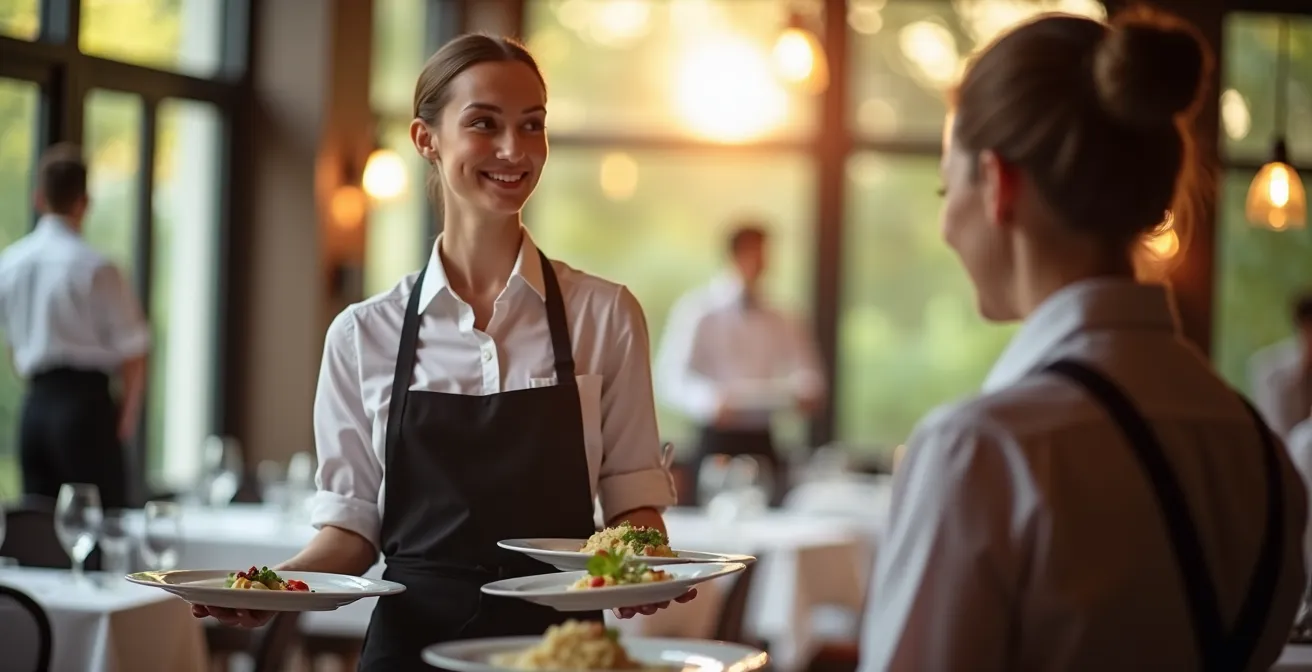
Achieving this state of controlled urgency requires rigorous training and systemic support. It is a choreography built on several pillars. Firstly, there’s economy of motion, where every trip from the kitchen to the dining room is maximized—never returning empty-handed. Secondly, there is impeccable timing, where courses are fired based on the guests’ rhythm, not a rigid clock. A team that has mastered reading body language knows precisely when a table is ready for the next course. Finally, a system of silent communication between servers, bussers, and the kitchen ensures that the entire team moves as a single, fluid organism, eliminating verbal chaos and wasted steps.
In essence, turning a table efficiently without making guests feel rushed is a masterful illusion. It’s a performance where the immense effort of the service team is rendered invisible, leaving only a feeling of seamless, effortless, and perfectly paced hospitality.
Applying Lean Methodologies to Eliminate Service ‘Waste’
The operational backbone of a Michelin-star restaurant often has more in common with a high-tech manufacturing plant than a traditional eatery. To achieve their signature consistency and efficiency, many elite establishments unknowingly or explicitly apply principles of Lean Methodology, a management philosophy born in the factories of Toyota. The core idea is the relentless elimination of ‘Muda’, the Japanese term for waste. In a restaurant context, waste isn’t just about leftover food; it’s any activity that consumes resources without adding value to the guest experience.
Identifying and eliminating these forms of service waste is key to creating a frictionless and profitable operation. This requires a paradigm shift: viewing the dining room as a production floor where the ‘product’ is a flawless guest experience. Applying the seven forms of ‘Muda’ to a service context reveals countless opportunities for improvement. For instance, the ‘Waste of Motion’ is not just about a server’s tired feet; it’s about an inefficient station layout that adds seconds to every task, which multiply into minutes over a service. The ‘Waste of Waiting’ is the guest staring at an empty water glass or waiting too long for the bill—moments that directly detract from perceived value.
To systematically attack this waste, top restaurants use Lean tools like ‘Kaizen’ (continuous improvement) and ‘Poka-Yoke’ (mistake-proofing). A pre-service briefing becomes a micro-Kaizen event, analyzing the previous night’s failures and implementing immediate countermeasures. A Poka-Yoke could be as simple as designing a service tray that can only be held in a stable position, preventing spills, or as complex as a CRM system that automatically flags a guest’s allergy in bright red on every order ticket, making it impossible for the kitchen or server to miss.
| Waste Type | Manufacturing Context | Restaurant Service Application |
|---|---|---|
| Waste of Waiting | Idle time in production | Guests waiting for menus or bills |
| Waste of Motion | Unnecessary movement | Inefficient server walking paths |
| Waste of Over-processing | Excessive production steps | Taking reservations by phone then re-entering into system |
| Waste of Defects | Product quality issues | Incorrect orders or service errors |
| Waste of Inventory | Excess materials | Over-stocked perishables |
| Waste of Transport | Unnecessary material movement | Multiple trips for items that could be carried together |
| Waste of Overproduction | Making more than needed | Preparing excessive mise en place |
This rigorous, analytical approach to service design is what separates the merely good from the truly great. It builds a resilient system that delivers exceptional quality not by chance, but by design, night after night.
How Sensory Storytelling Elevates a Meal Into a Memory
Once the operational mechanics of service are perfected, the highest-level establishments ascend to another plane: that of narrative. Here, the meal is no longer a sequence of dishes but an immersive story, and every element of the service is a tool for sensory storytelling. The staff are not just servers; they are narrators and guides, and their role is to give context, emotion, and meaning to the chef’s creations. This is where hospitality transcends into art.
The famed Eleven Madison Park under Chef Daniel Humm is a masterclass in this approach. Here, the philosophy is that “the story isn’t just told, it’s experienced.” The tasting menu is structured with a clear narrative arc: the amuse-bouche acts as the inciting incident, the main courses build the rising action and climax, and the dessert provides the resolution. But the story is told through more than just food. The minimalist design of the room, the texture of the menu paper, the weight of the cutlery, and the design of the staff uniforms are all “chapters” in the restaurant’s overarching narrative. Every sensory input is deliberate.
The service team is trained to be the bridge between the chef’s vision and the guest’s experience. When they present a dish, they don’t just list ingredients. They might share a brief, evocative story about the farmer who grew the vegetables or the inspiration behind the dish’s creation. This narrative framing transforms a simple carrot into a protagonist with a backstory. It engages the guest’s imagination and emotion, making the flavors more resonant and the experience more memorable. The passion and dedication of the creator, as expressed through the words of the server, become a palpable ingredient.
By weaving a consistent and compelling narrative through every sensory touchpoint, a restaurant elevates itself from a place to eat into a world to be discovered. The meal becomes a personal journey, and the memory of that story is the ultimate luxury that guests take with them.
Key takeaways
- Service Is a Science: Excellence is not random; it’s built on observable cues, choreographed processes, and psychological principles.
- Ambiance Is an Active Creation: The sound, flow, and feel of a room are actively managed through design and disciplined service, not just left to chance.
- The Experience Is the Product: Every step, from the initial greeting to the final farewell, is a deliberate part of a curated narrative designed to create a lasting memory.
From Wine Steward to Choice Architect: The Financial Impact of Expertise
The sommelier is often seen as the pinnacle of service expertise, but their role in a Michelin-star establishment goes far beyond simply recommending wine. They are the ultimate embodiment of all the principles discussed: they are masters of psychology, narrative, and efficiency. More than that, they are ‘Choice Architects’, skillfully guiding guests through a potentially overwhelming wine list to a decision that enhances both their meal and the restaurant’s bottom line. The often-cited 30% increase in check average from sommelier service is not an accident; it’s the result of applied behavioral economics.
An expert sommelier never asks an open-ended question like, “What would you like to drink?” This induces the ‘paradox of choice’, overwhelming the guest. Instead, they act as a trusted guide. They begin by building rapport and understanding the guest’s preferences and price sensitivity through subtle, conversational questions. Then, leveraging this trust, they deploy several psychological techniques. They might use ‘anchoring’ by mentioning a spectacular, high-priced wine first to make other premium options seem more reasonable. Most effectively, they reduce the choice set, presenting just two or three perfectly tailored suggestions.
This curated selection does more than simplify the decision; it transforms a purchase into a guided discovery. By using narrative framing to tell the story behind each bottle—the passionate winemaker, the unique terroir, the difficult harvest—the sommelier reframes the price as an investment in a unique experience. This ‘transfer of trust’ from the expert to the guest reduces risk aversion and makes the guest feel confident and excited about their choice, rather than intimidated or uncertain. Their expertise extends beyond wine to include water, tea, coffee, and non-alcoholic pairings, ensuring every guest feels catered to. Key techniques include:
- Acting as a ‘Choice Architect’ using behavioral science.
- Presenting 2-3 curated options to avoid overwhelming the guest.
- Using narrative framing to tell the story behind each selection.
- Extending expertise to all beverage pairings, not just wine.
- Building trust through a demonstration of knowledge without a hint of condescension.
Start by observing your own service not as a series of tasks, but as a system. Identify one form of ‘Muda’ to eliminate this week, or meticulously script the ‘Last 100 Yards’ for your guests. Excellence is not a destination; it is the outcome of a continuous, detail-obsessed operational process.