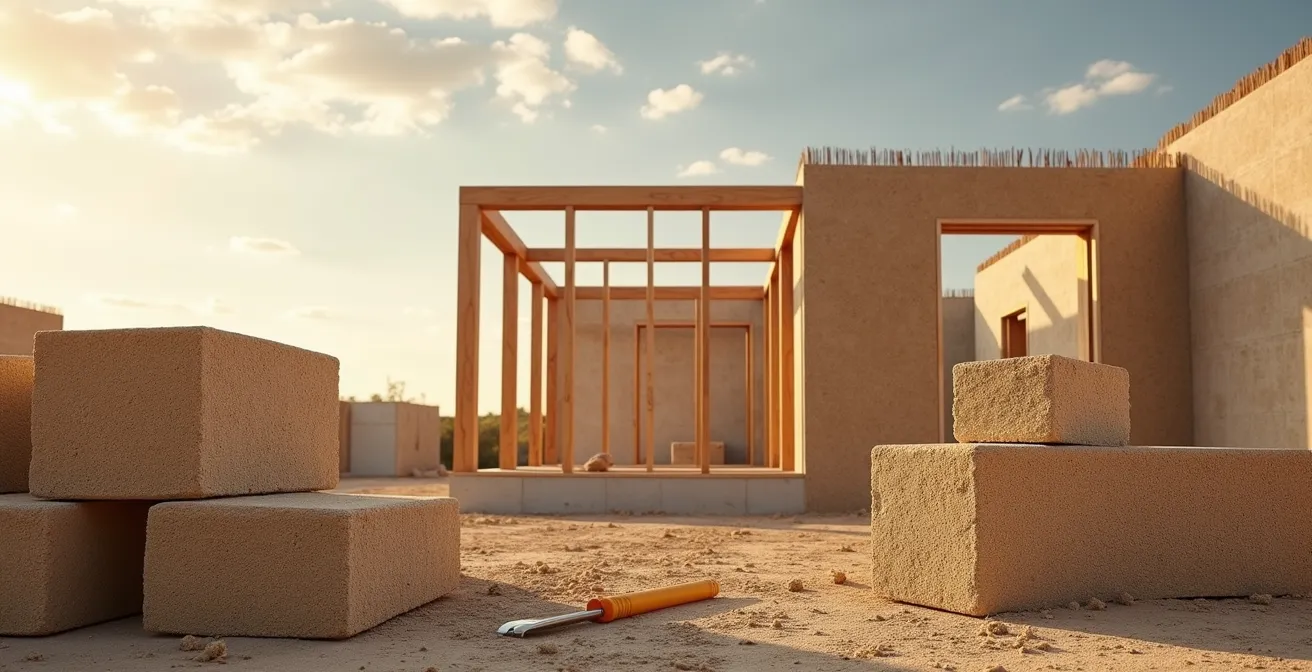
Carbon-neutral construction is achieved not by simply swapping materials, but by leveraging the superior physical properties of bio-sourced alternatives.
- Bio-composites like hempcrete offer better hygrothermal performance and moisture regulation than conventional concrete.
- Materials like mycelium actively improve indoor air quality by avoiding the VOCs found in traditional insulation.
Recommendation: Shift your design focus from a material’s “green” label to its performance data on vapor permeability, thermal mass, and life-cycle impact.
For decades, the architectural response to the climate crisis has been dominated by a narrative of reduction: reducing energy consumption, reducing waste, and reducing our reliance on concrete and steel. While essential, this focus often overlooks a more profound opportunity. The conversation is shifting from simply using “less bad” materials to embracing materials that are fundamentally better, actively contributing to both the building’s performance and the occupants’ health.
Many discussions about bio-sourced materials stop at their ability to sequester carbon. We hear about bamboo, cork, and straw as generic green substitutes. But for architects and builders, the true revolution lies not in the “what,” but in the “how.” It’s in understanding and mastering the specific physical properties that make these materials technically superior. The future of carbon-neutral construction isn’t just about eco-friendliness; it’s about high-performance engineering derived from nature.
This is where our perspective must evolve. We need to move beyond the surface-level benefit of embodied carbon and dive deep into the technical advantages: superior hygrothermal performance, inherent vapor permeability, and significant thermal mass. This article will deconstruct why bio-sourced materials are not just a sustainable choice, but a strategic one for creating resilient, energy-efficient, and healthy buildings that outperform their conventional counterparts. We will explore the specific metrics and design considerations that unlock their true potential, from moisture management in walls to ensuring the authenticity of your supply chain.
To navigate this complex but crucial topic, this guide breaks down the key performance aspects, verification methods, and innovative applications of bio-sourced materials. Explore the sections below to understand how these natural alternatives are setting a new standard for building performance.
Summary: Unlocking the Technical Future of Bio-Sourced Building Materials
- Why Hempcrete Provides Better Insulation Than Traditional Concrete?
- How to Verify FSC Certification for Tropical Hardwoods?
- Fungi or Glass: Which Insulation is Safer for Indoor Air Quality?
- The Moisture Oversight That Rots Straw Bale Walls
- How to Calculate the Ideal Rammed Earth Wall Thickness for Your Climate?
- How Biodegradable Packaging Reduces the Carbon Footprint of Cosmetics Brands?
- Air Filters or Traffic Bans: Which Best Protects School Children?
- Innovations in Property Development: Reducing Construction Timelines by 30%?
Why Hempcrete Provides Better Insulation Than Traditional Concrete?
Traditional concrete is a fantastic structural material, but a poor insulator. Its density leads to high thermal conductivity, allowing heat to pass through it easily. Hempcrete operates on a completely different principle. It’s a bio-composite material, made by mixing hemp hurds (the woody inner part of the plant stalk) with a lime-based binder. It is not used as a structural element like concrete, but as an insulating infill within a structural frame, and this is where its superiority lies.
The secret to hempcrete’s performance is its unique porous structure. The trapped air within the hemp-lime matrix provides excellent thermal resistance. Unlike the solid mass of concrete, hempcrete’s network of fibers and voids creates a powerful insulating barrier. Recent thermal performance measurements show that hempcrete achieves an R-value of 0.67/cm to 1.2/cm (1.7/in to 3.0/in), a range significantly better than concrete. This hygrothermal performance means buildings require less energy for heating and cooling, directly reducing their operational carbon footprint over their entire lifespan.
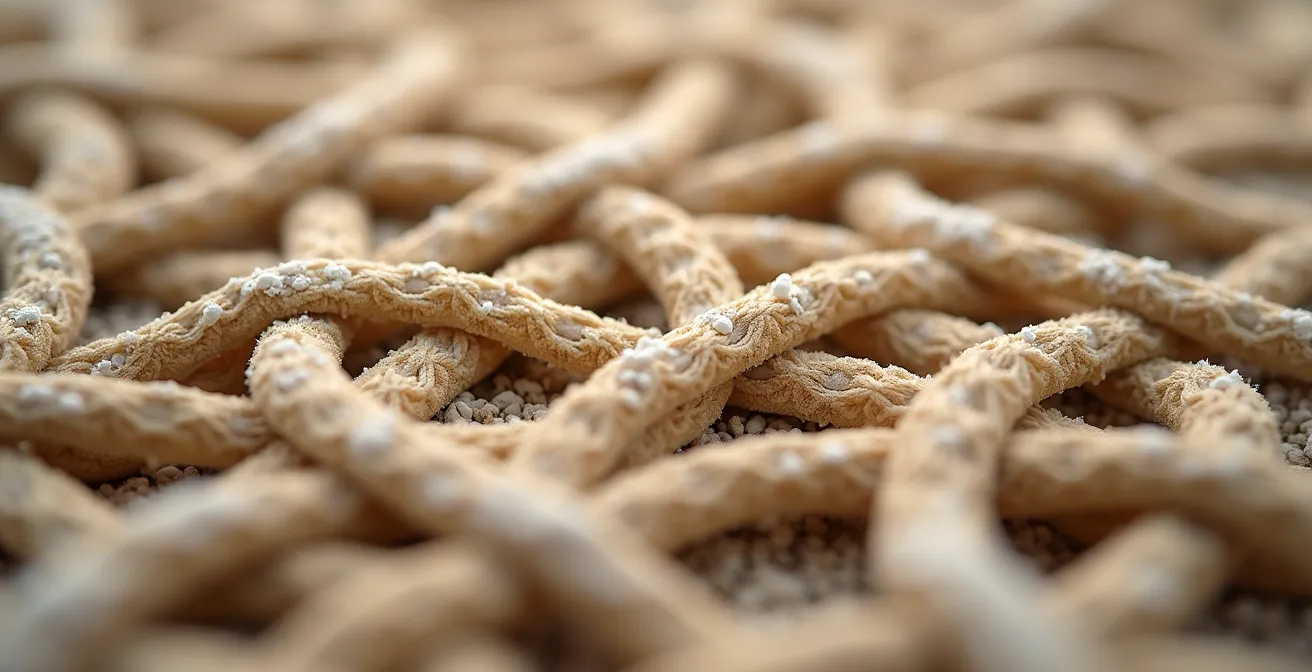
This microscopic view reveals everything. The intricate web of hemp fibers and lime binder creates countless tiny air pockets, which are the key to its insulating power. Furthermore, this structure allows the wall to “breathe,” a critical factor in moisture management that we will explore later. It’s a perfect example of how a bio-sourced material’s physical makeup delivers performance that dense, synthetic materials cannot match.
Ultimately, comparing hempcrete and concrete for insulation is about understanding their roles. Concrete provides strength; hempcrete provides a high-performance thermal and moisture-regulating envelope. For a carbon-neutral building, using a dedicated, high-performance bio-insulator is far more effective than relying on the minimal thermal properties of a structural material.
How to Verify FSC Certification for Tropical Hardwoods?
Tropical hardwoods are prized for their beauty and durability, but their use is fraught with ethical and environmental risks, including deforestation and illegal logging. For architects committed to sustainability, simply specifying a “certified” wood is not enough. True due diligence requires a robust verification process. The Forest Stewardship Council (FSC) provides the most recognized framework for this, but its effectiveness depends on understanding and verifying the Chain of Custody (CoC).
The scale of the issue is significant; for context, a 2021 report noted that the French construction industry alone used 134,700 m³ of imported tropical wood. Ensuring this vast supply chain is legitimate is a major challenge. The CoC is the documented path that products take from the forest to the final user, including all stages of processing, transformation, manufacturing, and distribution. Without verifying every link in this chain, a certificate can be meaningless.
As a specifier, the responsibility falls on you to actively check the claims of your suppliers. This isn’t a passive task of accepting a logo on an invoice; it’s an active investigation to protect your project’s integrity and ensure you are not inadvertently contributing to environmental degradation. The following checklist provides a concrete methodology for this essential task.
Action Plan: Verifying FSC Chain of Custody for Timber
- Locate the Chain of Custody (CoC) number on all invoices and material documentation from your supplier.
- Access the FSC Certificate Database at info.fsc.org to verify the CoC number’s validity and scope.
- Check that the certificate explicitly covers the specific wood species you are purchasing.
- Verify the certificate’s expiration date and ensure it is current for your project’s timeline.
- Request transaction verification documents that trace the wood from the forest to your project site.
While advanced methods like isotope analysis exist for high-value timber, mastering this fundamental CoC verification process is the most powerful tool an architect has to guarantee the use of legally and sustainably harvested wood, transforming a potential liability into a verified asset for any green building project.
Fungi or Glass: Which Insulation is Safer for Indoor Air Quality?
The choice of insulation has a profound and often underestimated impact on the health of a building’s occupants. For years, the standard has been mineral wools like glass wool or rock wool. While effective insulators, their production and installation raise health concerns, primarily due to the formaldehyde-based binders used and the risk of inhaling microscopic fibers. As we focus more on Indoor Air Quality (IAQ), bio-sourced alternatives like mycelium are emerging as a fundamentally safer option.
Mycelium, the root structure of fungi, can be grown into custom-shaped insulation panels using agricultural waste as a substrate. This natural process creates a material that is not only an effective insulator but is also inherently biocompatible. As the Tunley Environmental Research Team highlights in their analysis of sustainable construction:
Bio-based materials, on the other hand, are non-toxic and emit fewer VOCs, creating a healthier environment for building occupants
– Tunley Environmental Research Team, Bio-Based Materials Changing the Outlook for Sustainable Construction
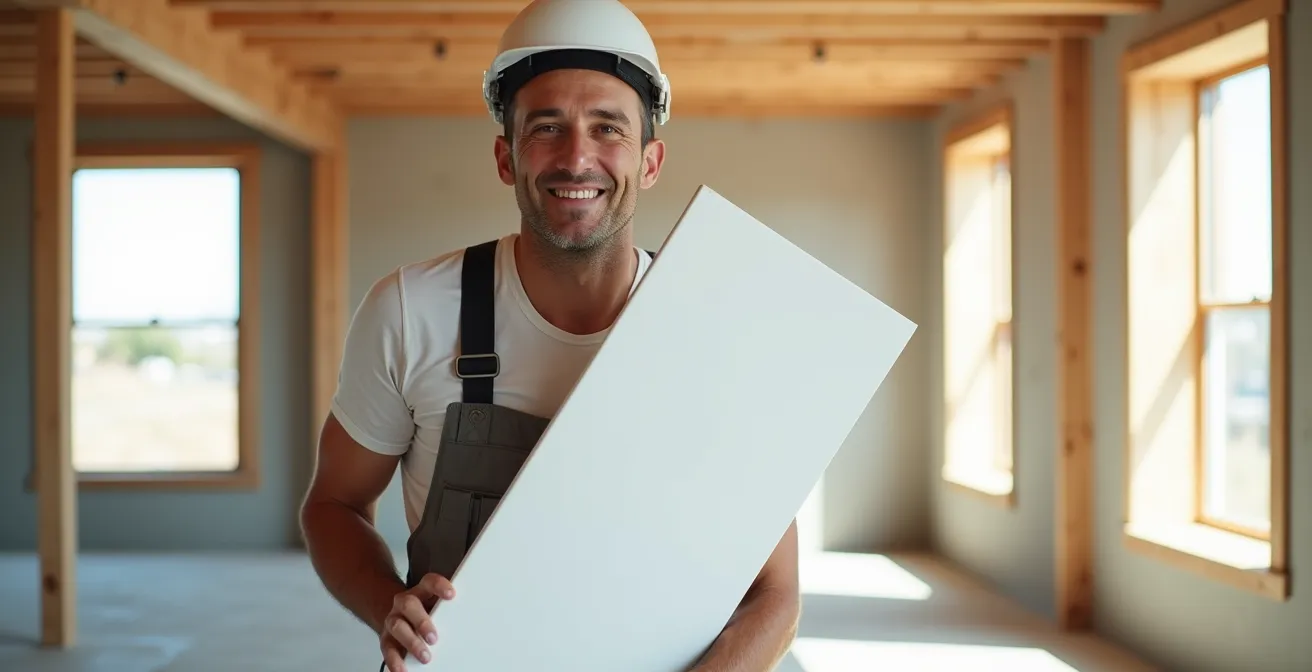
The difference is clear during installation. Handling glass wool requires extensive personal protective equipment (PPE) to prevent skin irritation and respiratory issues. In contrast, mycelium panels are safe to handle with bare hands, reflecting their non-toxic nature. The primary health consideration for mycelium is preventing spore release, which is managed by ensuring the material is properly dried and sealed post-growth. This stands in stark contrast to the persistent off-gassing of Volatile Organic Compounds (VOCs) from synthetic binders in conventional insulation.
The following table provides a direct comparison of the IAQ impact, clarifying the key differences for architects and builders concerned with occupant health.
| Criteria | Mycelium Insulation | Glass Wool Insulation |
|---|---|---|
| VOC Emissions | Minimal to none | Formaldehyde-based binders present |
| Airborne Particles | Potential spore release (mitigatable) | Micro-fiber release risk |
| Biocompatibility | Bioactive, supports healthy microbiome | Inert, sterile environment |
| End-of-life Impact | Fully compostable | Permanent landfill pollutant |
| Installation Safety | No protective equipment required | Requires masks and protective gear |
Ultimately, choosing mycelium over glass wool is a proactive step towards creating a healthy building. It shifts the paradigm from mitigating harm (with PPE and ventilation) to preventing it at the source by selecting materials that are inherently safe and biocompatible, a core principle of truly sustainable architecture.
The Moisture Oversight That Rots Straw Bale Walls
Straw bale construction is one of the oldest forms of bio-based building, celebrated for its superb insulation and low embodied carbon. However, it has a well-known vulnerability: moisture. A catastrophic—and entirely avoidable—oversight is to pair this naturally absorbent material with a non-breathable exterior render, such as cement-based stucco. This common mistake turns the wall into a sealed container, trapping any moisture that gets in and leading inevitably to rot and structural failure.
The core of the problem lies in a misunderstanding of vapor permeability. Natural materials like straw need to “breathe.” This means they must be able to absorb ambient moisture from the interior (during high humidity) and release it to the exterior. A cement render acts like a plastic bag, preventing this natural diffusion. Once moisture penetrates through a small crack or from an internal leak, it has no way to escape. The trapped water, combined with organic material, creates the perfect conditions for mold, decay, and the complete decomposition of the wall.
This highlights a critical lesson in bio-based design: material compatibility is paramount. The solution is not to abandon straw, but to pair it with a vapor-permeable plaster, like a lime or clay render. A material like hempcrete, which is inherently mixed with lime, has this property built-in. Studies show that hemp concrete demonstrates water vapour diffusion resistance ranging from a factor of 5 to 25, which is extremely low and indicates high breathability. Its ability to absorb and release humidity is excellent, making it a model for how to correctly manage moisture in a bio-based wall system.
Therefore, the failure of a straw bale wall is rarely a failure of the straw itself. It is a design failure stemming from the misapplication of a modern, impermeable material onto a traditional, breathable system. By prioritizing vapor permeability and selecting compatible plasters, architects can design straw bale buildings that are not only sustainable but also resilient and durable for centuries.
How to Calculate the Ideal Rammed Earth Wall Thickness for Your Climate?
Rammed earth is a construction technique that leverages the immense thermal mass of compacted soil to create highly energy-efficient buildings. Unlike insulation, which resists heat transfer, thermal mass absorbs and stores heat energy. A thick rammed earth wall will absorb the sun’s heat during the day and slowly release it into the interior at night, stabilizing indoor temperatures. Conversely, in hot climates, it can absorb interior heat during the day and radiate it outwards at night. The key to unlocking this potential is calculating the correct wall thickness for your specific climate.
There isn’t a single universal thickness. The calculation is a balance of several factors:
- Diurnal Temperature Swing: The most important factor. This is the difference between the highest daytime temperature and the lowest nighttime temperature. A large swing (typical of desert climates) allows the wall to fully “charge” and “discharge” its stored energy, making rammed earth highly effective. A thickness of 30-45 cm is common here.
- Solar Radiation (Insolation): The amount and angle of sunlight hitting the wall. In colder climates, walls are designed to maximize winter sun exposure to store heat.
- Desired Time Lag: This is the time it takes for heat to travel from the outside of the wall to the inside. A 12-hour time lag is often ideal, meaning the peak afternoon heat reaches the interior in the middle of the night. This is directly proportional to thickness.
- Material Composition: The specific density and conductivity of the soil mix used will influence how quickly it absorbs and releases heat.
Modern energy modeling software (like WUFI or EnergyPlus) is the most accurate way to determine the optimal thickness. These tools allow you to simulate a wall’s performance using local climate data and material properties. The goal is to find the sweet spot where the wall’s thermal storage capacity is maximized for the local conditions. For example, recent research into advanced bio-based phase change materials shows that high-performance wall systems can achieve up to 5.54 MJ/m² of stored energy over 24 hours, quantifying the significant potential of thermal mass design.
By moving beyond a generic “thicker is better” approach and performing a climate-specific analysis, architects can tune the building’s envelope to act as a passive battery. This reduces or even eliminates the need for mechanical heating and cooling systems, representing a cornerstone of carbon-neutral design.
How Biodegradable Packaging Reduces the Carbon Footprint of Cosmetics Brands?
While seemingly distant from the world of construction, the shift towards bio-based materials in industries like cosmetics offers a powerful parallel for architects. The core principle is the same: reducing environmental impact by considering the material’s entire life-cycle assessment (LCA), from sourcing to disposal. The innovations in biodegradable packaging directly inform the mindset required for a circular economy in the built environment.
Cosmetics brands have historically relied on single-use plastics, which have a high carbon footprint in production and persist for centuries in landfills or oceans. By switching to biodegradable alternatives—such as materials derived from cornstarch (PLA), mushrooms (mycelium), or seaweed—these brands are tackling their environmental impact on two fronts. First, the production of these bio-polymers is often less energy-intensive than petroleum-based plastics. Second, and more importantly, they are designed for decomposition, returning to the soil as nutrients instead of becoming permanent pollutants.
This focus on a material’s end-of-life is a critical lesson for the construction industry, which generates a colossal amount of demolition waste. When we specify materials for a building, we are also deciding what will happen to them in 50 or 100 years. Choosing a bio-based, compostable insulation like mycelium over a non-recyclable foam board is the architectural equivalent of a cosmetics brand choosing a seaweed-based sachet over a plastic one. Both decisions prioritize a circular material flow over a linear “take-make-waste” model.
The lesson for architects is clear: a material’s performance cannot be judged solely on its function within the building. Its origin and its ultimate fate are equally important components of its carbon footprint. The strategies being pioneered in packaging design are a blueprint for how the construction industry can and must evolve towards a truly circular and carbon-neutral future.
Air Filters or Traffic Bans: Which Best Protects School Children?
The debate over how to protect vulnerable populations, like school children, from air pollution often centers on two distinct approaches: mechanical intervention (air filters) versus source control (traffic bans). This conversation is highly relevant to architects, as it mirrors the internal debate within building design: do we rely on HVAC systems to clean up polluted indoor air, or do we build with materials that don’t pollute the air in the first place?
High-efficiency particulate air (HEPA) filters are effective at removing pollutants like PM2.5 from indoor air. They are a reactive solution, cleaning the air once it is already contaminated. Similarly, traffic bans around schools aim to reduce the external source of pollutants. Both have demonstrated benefits, but they also have limitations. Filters require energy to run and regular maintenance, while traffic bans can be difficult to implement and may only displace the pollution problem.
This brings the focus back to the building itself as a protective, and proactive, system. A significant portion of indoor air pollution comes not from the outside, but from the building materials themselves. Adhesives, paints, carpets, and synthetic insulation can off-gas VOCs for years, contributing to a toxic indoor environment. This is where the principles of bio-based construction offer a more fundamental solution. By specifying materials that are inherently non-toxic—such as solid wood, lime plasters, and mycelium insulation—we eliminate the source of pollution from the outset. This strategy of source control at the material level is a proactive, passive, and permanent solution to improving IAQ.
While air filters and traffic bans are valuable tools, they are ultimately treating the symptoms of a larger problem. The most robust and sustainable approach to protecting children’s health is to design buildings that are inherently healthy. This means prioritizing bio-sourced, non-toxic materials, ensuring the building envelope itself becomes the first and most effective line of defense for clean air.
Key takeaways
- Hygrothermal Champions: Bio-composites like hempcrete consistently outperform traditional materials in both thermal insulation and moisture management.
- IAQ is a Design Choice: Materials like mycelium prove that insulation can actively contribute to healthier indoor air by eliminating the VOCs found in synthetic alternatives.
- Breathability is Non-Negotiable: The success of bio-based walls (like straw bale) depends entirely on pairing them with vapor-permeable finishes to prevent trapped moisture and decay.
Innovations in Property Development: Reducing Construction Timelines by 30%?
The pressure to reduce construction timelines and costs is immense in property development. Traditionally, innovation in this area has focused on project management software, logistics, or off-site manufacturing with conventional materials like steel frames and concrete panels. However, a significant and emerging source of innovation lies in the integration of modern manufacturing techniques with bio-sourced materials.
The notion that building with natural materials is inherently slow and artisanal is outdated. Today, innovations are accelerating the use of bio-based components, making them competitive with, and in some cases faster than, traditional methods. Key examples include:
- Prefabricated Hempcrete Panels: Instead of casting hempcrete on-site, which requires drying time, prefabricated panels can be manufactured in a controlled factory environment and shipped to the site for rapid assembly. This dramatically cuts down on-site labor and weather-related delays.
- Cross-Laminated Timber (CLT): Large, solid wood panels are precision-cut in a factory and assembled on-site like a giant kit of parts. CLT construction is famously fast, quiet, and produces minimal on-site waste.
- 3D Printing with Earthen Mixes: While still in development, 3D printing technology is being adapted to use clay and earth-based materials, offering the potential to rapidly construct complex forms with local, natural resources.
These methods combine the carbon-sequestering and high-performance benefits of bio-sourced materials with the speed and precision of industrial manufacturing. This synthesis addresses the developer’s need for efficiency while meeting the architect’s goal of sustainability. The result is a building that is not only better for the planet and its occupants but is also delivered faster and more predictably.
To truly pioneer the future of carbon-neutral building, the next step for architects and developers is to integrate these material performance metrics and innovative construction methods into their earliest design phases. Moving beyond a simple material substitution to a holistic, performance-driven approach is how we will build the resilient and healthy structures of tomorrow.