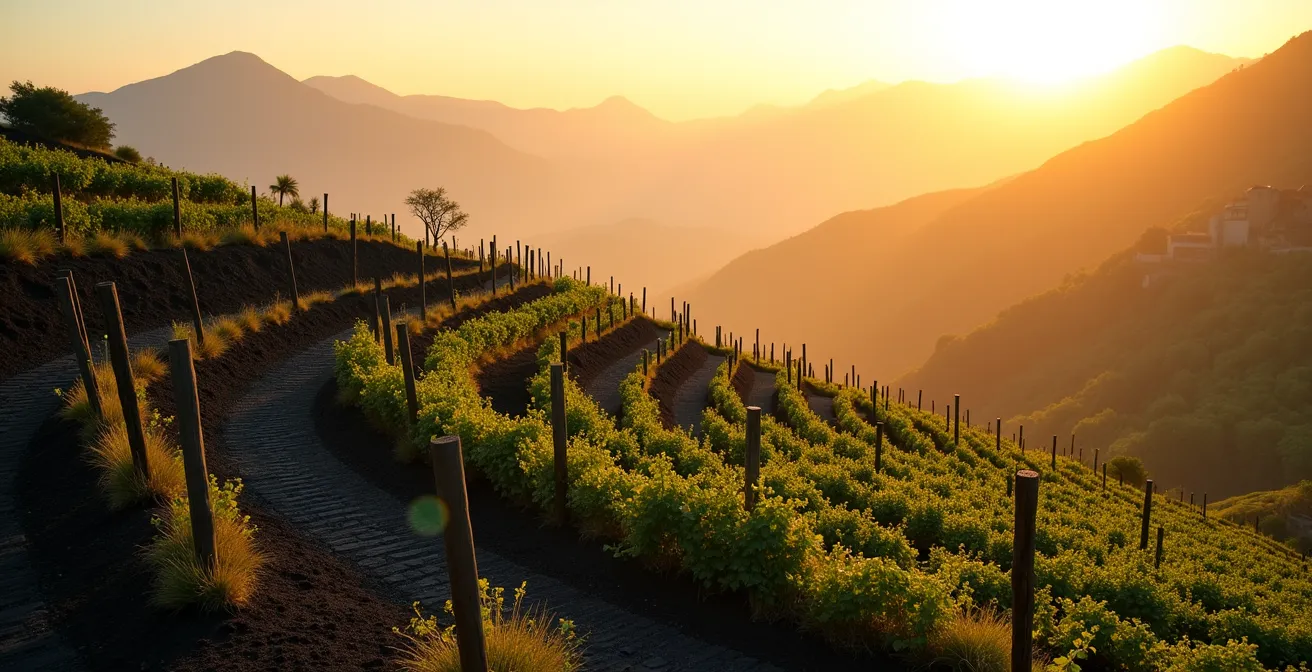
Contrary to the romantic notion of a “taste of place,” the power of terroir lies in measurable science, not magic.
- An ingredient’s unique flavor is a direct biochemical signature of its specific geography, from soil mineralogy to microbial life.
- Factors like nutrient stress and harvest timing are not accidental; they are precise levers that concentrate flavor compounds.
Recommendation: Shift from simply sourcing ‘local’ ingredients to understanding their geological and biological origins to unlock their true culinary potential.
For any chef or gourmet, the term “terroir” evokes a near-mythical connection between a food and its home. We speak of the briny essence of a coastal oyster or the sun-baked sweetness of a Mediterranean tomato. But too often, this conversation remains in the realm of poetry, missing the rigorous science that underpins authentic flavor. The common advice is to “buy local,” but this advice is incomplete. It’s not just about proximity; it’s about the profound, intricate dialogue between the land and what it yields.
The real backbone of regional cuisine isn’t just a location, but a specific, and often challenging, environment. It’s the story of a plant’s struggle and adaptation, written in its very chemistry. This understanding moves us beyond generic labels and toward a deeper appreciation of why, for instance, a tomato grown in volcanic soil is fundamentally different from one grown in a commercial greenhouse, or why a wild mushroom possesses a complexity that its cultivated cousin can never replicate.
What if the secret to transcendent flavor wasn’t just about the ingredient itself, but about mastering the environmental code that created it? This guide moves past the platitudes to dissect the tangible forces—geology, biology, and human intervention—that forge a terroir-driven ingredient. We will explore the scientific mechanisms that translate soil into acidity, the fight for biodiversity that defines flavor, and how this deep understanding of origin is the true differentiator in both humble kitchens and world-class restaurants.
To truly grasp how geography shapes every bite, this article breaks down the essential pillars of terroir. We’ll journey from the mineral-rich soils of volcanoes to the complex ecosystems of the forest floor, uncovering the science that separates a good ingredient from an unforgettable one.
Summary: The Science and Soul of Regional Flavors
- Why Volcanic Soil Produces Higher Acidity in Tomatoes and Grapes?
- How to Verify the Authenticity of San Marzano Tomatoes?
- Foraged Mushrooms or Cultivated: Is the Flavor Difference Worth the Cost?
- The Biodiversity Loss That Makes All Bananas Taste the Same
- When to Pick Strawberries: The 4-Hour Window for Maximum Sweetness
- Why a Sommelier Service Increases Check Average by 30%?
- How Farm-to-Table Sourcing Fixes the Broken Restaurant Supply Chain?
- How Molecular Gastronomy Transforms Simple Ingredients Into $200 Tasting Menus?
Why Volcanic Soil Produces Higher Acidity in Tomatoes and Grapes?
The intense, bright acidity that defines some of the world’s most coveted tomatoes and wines is not a happy accident; it is a direct geological inheritance. Volcanic soils are a prime example of terroir’s power. Unlike typical agricultural loam, this soil is born from fire, composed of ash, pumice, and pulverized rock. This composition results in a soil that is low in organic matter but exceptionally rich in specific minerals like iron, magnesium, potassium, and phosphorus. It is also porous and well-draining, which forces plant roots to dig deeper in search of water.
This “nutrient stress” is key. Instead of growing large, watery fruit, the plant focuses its energy on producing smaller, more concentrated berries or fruits. The minerals in the soil are directly absorbed by the roots and become part of the fruit’s biochemical makeup. The high potassium levels, for instance, help maintain acidity during the ripening process, preventing the flat, overly sweet taste found in less-stressed plants. This creates a distinct “saline” or “mineral” finish on the palate—a direct taste of the geology. For example, the region around Mount Vesuvius in Naples, blanketed in thick tephra deposits from ancient eruptions, is now a massive tomato-growing area renowned for this very quality.
This phenomenon is even more pronounced in viticulture. Research shows that volcanic soils in cooler climates produce wines with an unrivaled concentration of acidic compounds, giving them incredible structure and aging potential. The vine is in a constant dialogue with the earth, translating its mineral story into the glass.
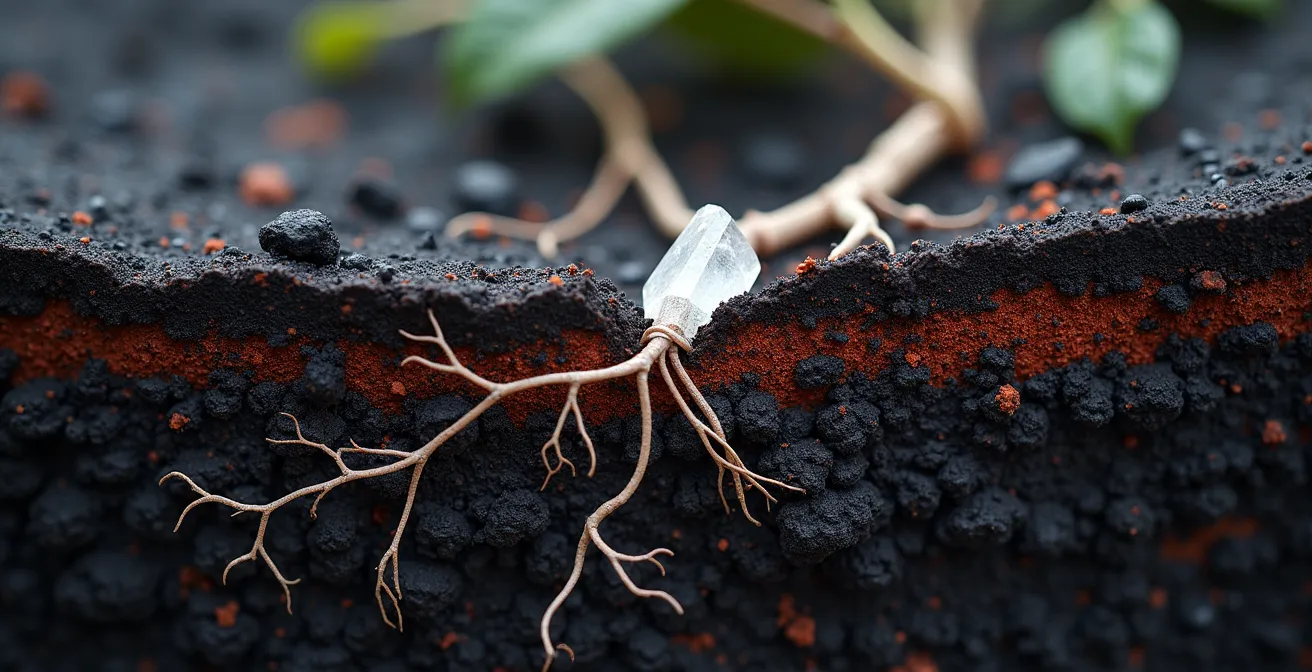
As this image reveals, the interaction is intimate. Vine roots intertwine with mineral deposits, drawing up the unique chemical signature of the soil. It’s a clear visual representation of how geology becomes biology, and ultimately, flavor. This process is the foundation of why ingredients from volcanic regions possess an unmistakable vibrancy and complexity.
How to Verify the Authenticity of San Marzano Tomatoes?
When an ingredient’s identity is so deeply tied to its unique terroir, protecting its authenticity becomes paramount. The San Marzano tomato, a product of the volcanic plains around Mount Vesuvius, is a perfect case study. Its singular profile—low acidity, firm pulp, and minimal seeds—is a direct result of that specific soil and climate. This distinctiveness has made it a target for counterfeiting, with many cans on the market containing different plum tomato varieties. For a chef or discerning consumer, verifying authenticity is crucial to capturing the intended flavor.
The European Union has established a Denominazione d’Origine Protetta (DOP), or Protected Designation of Origin, to safeguard this culinary heritage. This legal framework provides a clear set of criteria for verification. As the Wine-Searcher Editorial Team notes, volcanic soils often create unique growing conditions that contribute to this authentic expression, making such protections necessary. The process of verification, however, goes beyond simply looking for a logo; it involves a sensory and physical audit.
Volcanic soils are naturally hostile to pests and often boast ungrafted and very old vines, contributing to authentic terroir expression.
– Wine-Searcher Editorial Team, The Wild World of Volcanic Wines
This natural resilience is part of the terroir’s signature, and it’s what the DOP seal is designed to protect. To ensure you are getting the real product, a systematic check is required. The following plan outlines the key steps to distinguish a genuine San Marzano from an imitation, ensuring the unique flavor profile of its volcanic home makes it to the plate.
Action Plan: Verifying San Marzano Authenticity
- Inspect the Label and Seal: Look for the official “Pomodoro San Marzano dell’Agro Sarnese-Nocerino DOP” certification logo and an individual serial number on the can. Any can simply labeled “San Marzano” without the DOP seal is likely not authentic.
- Conduct the Can Test: Authentic San Marzano tomatoes are packed with less water and a higher pulp density. A genuine can should feel surprisingly light for its size compared to a generic brand of peeled tomatoes.
- Examine the Physical Tomato: Upon opening, the tomatoes should be elongated, firm, and maintain their shape. They should have a thick pulp, very few seeds, and be so tender they can be easily crushed by hand, releasing a rich, sweet aroma.
- Check the Ingredient List: A can of true San Marzano DOP tomatoes should contain only two ingredients: San Marzano whole peeled tomatoes and San Marzano tomato puree. Some may contain basil, but there should be no added water, salt, or citric acid.
- Trust the Source: Purchase from reputable importers or specialty food stores that understand the importance of origin. They are more likely to have a direct and verifiable supply chain from the protected region in Italy.
Foraged Mushrooms or Cultivated: Is the Flavor Difference Worth the Cost?
The debate between foraged and cultivated mushrooms extends far beyond simple availability; it cuts to the very heart of what terroir means. A cultivated mushroom, like a button or cremini, grows in a controlled environment on a uniform substrate like compost or sawdust. Its flavor is predictable and consistent. A foraged mushroom, however, is a wild expression of a forest ecosystem. Its flavor is a complex tapestry woven from the soil, the trees it associates with, and the microbial life around it.
This profound difference comes from mycorrhizal relationships. Wild mushrooms like porcini, chanterelles, and truffles form a symbiotic network with the roots of specific trees. The fungus provides the tree with water and minerals scavenged from the soil, and in return, the tree provides the fungus with sugars. This exchange infuses the mushroom with complex compounds and volatile aromatics derived directly from its living partner and the surrounding soil, creating a depth of flavor that cannot be replicated. Cultivated mushrooms lack this intricate dialogue.
The higher cost of foraged mushrooms is not just a matter of scarcity but also a “risk premium” for the forager and an acknowledgment of its untamable nature. The flavor difference is a direct measure of the ingredient’s connection to a complex, living terroir. For a chef, this means a cultivated mushroom is a reliable bass note, while a foraged one is an unpredictable, but potentially transcendent, melody.
This table, based on an analysis of terroir’s role in flavor, breaks down the key distinctions that justify the difference in both price and culinary impact.
| Aspect | Foraged Mushrooms | Cultivated Mushrooms |
|---|---|---|
| Flavor Complexity | Complex and variable, influenced by mycorrhizal relationships with trees and soil microbes. | Simpler, more uniform flavor profile determined by the substrate (e.g., compost, wood). |
| Umami (Glutamate) | Higher concentration and wider variety of glutamate compounds, leading to deeper savoriness. | Lower and less diverse glutamate content, resulting in a more one-dimensional flavor. |
| Price & Availability | High cost due to foraging risk, seasonality, and unpredictable yields. | Lower cost due to predictable, controlled, and year-round production methods. |
| Terroir Expression | Strong expression of the forest ecosystem, including tree species, soil type, and climate. | Limited terroir expression, primarily influenced by the artificial substrate. |
The Biodiversity Loss That Makes All Bananas Taste the Same
Nowhere is the consequence of ignoring terroir and embracing monoculture more apparent than on the breakfast table. The modern banana, the Cavendish, is a story of logistical efficiency triumphing over flavor diversity. Before the 1950s, the world’s most popular banana was the Gros Michel, a variety celebrated for its creamy texture and rich, complex flavor. However, it was nearly wiped out by a fungal outbreak known as Panama disease. The industry’s solution was not to cultivate a diversity of resistant bananas, but to find a single, new replacement: the Cavendish.
Case Study: The Cavendish Monoculture Decision
The Cavendish banana was not chosen for its taste. It was selected for its resistance to the then-prevalent strain of Panama disease, its ability to ripen uniformly after being shipped green, and its thick skin that withstands long-distance transport. These are a shipper’s priorities, not a gourmet’s. In standardizing the global supply with a single variety, the industry sacrificed the vast spectrum of flavors offered by other heirloom bananas, such as the vanilla-ice-cream notes of the Blue Java or the sweet, apple-like tang of the Manzano. This decision prioritized a resilient supply chain over a rich flavor landscape, effectively erasing the expression of different terroirs from the commercial banana market.
This industrial approach is the antithesis of a terroir-driven philosophy. By relying on a single genetic clone, the global banana industry is not only vulnerable to new diseases but has also conditioned consumers to accept a singular, monotonous flavor as the standard. It serves as a stark warning: when we disconnect an ingredient from its potential for diverse expression, we lose more than just a product; we lose an entire library of tastes, textures, and aromas that biodiversity provides.
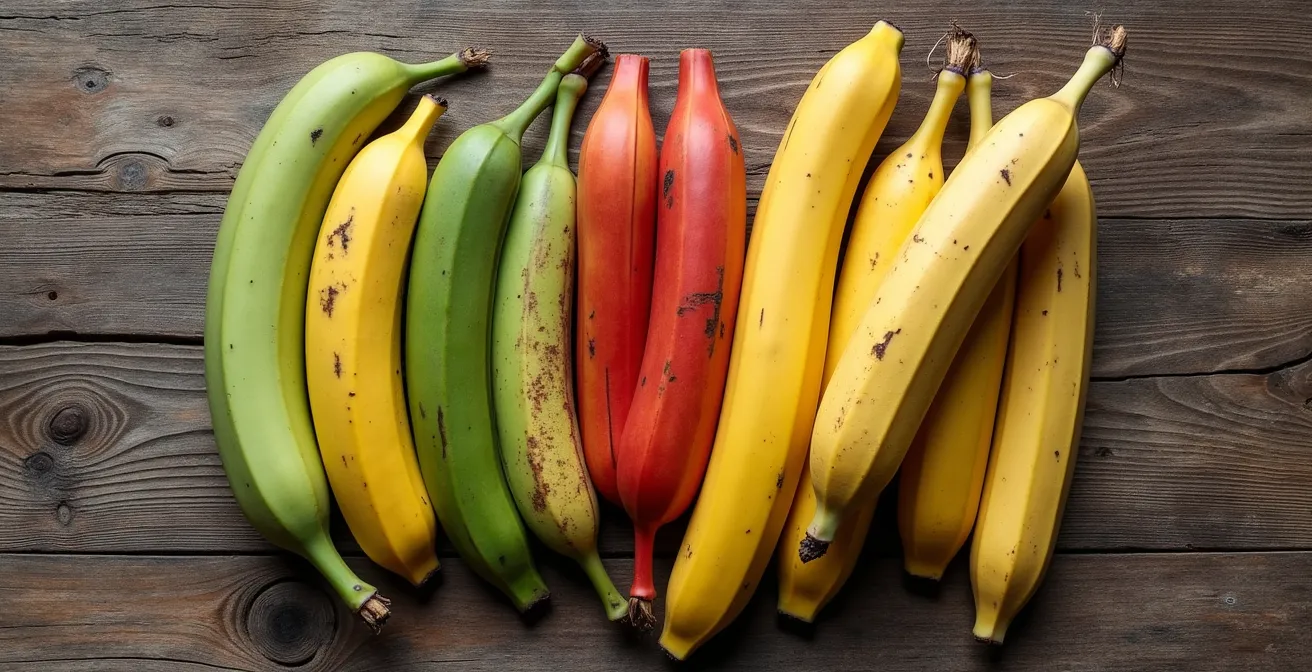
The visual difference between these varieties is a powerful symbol of the flavor diversity we have lost in the name of convenience. Each color, shape, and size represents a different potential flavor profile, a different story of a place, all but silenced by the dominance of one logistical champion. This highlights the critical importance of preserving agricultural biodiversity as a cornerstone of authentic regional cuisine.
When to Pick Strawberries: The 4-Hour Window for Maximum Sweetness
Capturing the peak expression of terroir is not just about where an ingredient is grown, but precisely *when* it is harvested. For delicate fruits like strawberries, the moment of picking is a race against time and biology. A strawberry, unlike a banana, is a non-climacteric fruit, meaning it does not continue to ripen or develop sugars after being separated from the plant. Its sweetness is at its absolute maximum at the moment it is picked, and that level is heavily influenced by immediate environmental factors.
The ideal time to harvest strawberries is in the cool of the early morning, typically within the first four hours after sunrise. During the night, the plant’s metabolic rate slows, and it converts starches produced during the previous day into sugars, which are then stored in the fruit. As the day heats up, the plant’s respiration increases, and it begins to consume these sugars for energy, causing the sweetness in the fruit to decline. Harvesting in the morning locks in that peak sugar content.
Terroir adds another layer of complexity. For instance, soil type affects water retention and plant stress. Research on viticulture confirms that sandy soils create stress that prompts vines to produce smaller, more concentrated fruit with intense aromatics. This same principle of nutrient stress applies to strawberries, where well-drained soils can lead to higher sugar concentrations. Other terroir factors also play a role:
- Altitude: Higher elevations mean cooler mornings, which can extend the optimal harvesting window.
- Coastal Influence: Morning fog common in coastal regions acts as a natural coolant, preserving the fruit’s sugar content for longer.
- Industrial Harvesting: In contrast, industrial operations often pick strawberries with greenish-white tops. These underripe fruits are sturdier for shipping but will never develop the full, complex sweetness of a plant-ripened berry.
This meticulous timing is the final step in honoring the ingredient’s terroir. It ensures that the story written by the soil, climate, and plant biology is captured at its most eloquent and flavorful moment.
Why a Sommelier Service Increases Check Average by 30%?
The value of a sommelier, and the resulting increase in a restaurant’s check average, is often misunderstood as simple upselling. In reality, a great sommelier’s primary role is that of a storyteller, and their most compelling story is that of terroir. When a guest is deciding between a $50 bottle and a $150 bottle of wine, the price difference is rarely justified by production cost alone. It is justified by the uniqueness, rarity, and narrative of the wine’s origin.
A skilled sommelier does not just describe a wine’s tasting notes; they transport the guest to its place of origin. They articulate the geological and biological signature of the ingredient. They can explain how the volcanic cliffs of an island create a wine of searing acidity and salinity, or how the old, ungrafted vines of a particular plot yield a wine of profound concentration. This is where the economic power of terroir is unlocked.
The Story of Santorini: Selling Volcanic Terroir
Consider the Assyrtiko wines from Santorini, Greece. A sommelier can explain that these ancient vines are trained into basket-like wreaths to protect them from the harsh island winds. They can describe how the porous volcanic soil, devoid of clay, made the island immune to the phylloxera pest that wiped out most of Europe’s vineyards. They then connect this story of survival and unique geology to the wine’s flavor: an intense minerality and high acidity that is a direct taste of its dramatic, sun-scorched, volcanic home. Suddenly, the wine is not just a beverage; it is a piece of agricultural history. The guest is no longer just buying fermented grape juice; they are investing in an experience and a story that cannot be replicated anywhere else.
This act of “terroir translation” transforms the wine list from a price sheet into a curated collection of places and stories. The 30% increase in check average is not a sales trick; it is the tangible economic value of a well-told story of origin. The sommelier gives the terroir a voice, and guests are willing to pay a premium to listen.
How Farm-to-Table Sourcing Fixes the Broken Restaurant Supply Chain?
The conventional restaurant supply chain is a model of distance and standardization. Ingredients travel hundreds, sometimes thousands, of miles, passing through numerous intermediaries. This system prioritizes shelf life and transportability over flavor and nutritional value. The farm-to-table movement is not merely a trend; it is a fundamental restructuring of this broken system, re-centering the supply chain around the principles of terroir, freshness, and community.
By sourcing directly from local farms, a restaurant dramatically shortens the time and distance between harvest and plate. As farm-to-table research confirms, local products can arrive in the kitchen mere hours after being picked, whereas imported goods may spend days or even weeks in transit. This immediacy preserves the volatile aromatic compounds and delicate textures that are the first casualties of long-distance shipping. The flavor is brighter, the nutrients are denser, and the ingredient is a truer representation of its origin.
More profoundly, this model re-establishes the relationship between the chef and the grower. The chef is no longer a passive recipient of standardized products but an active participant in the agricultural process. This dialogue allows for the cultivation of unique, heirloom varieties perfectly suited to the local terroir—ingredients that would never survive the rigors of the industrial supply chain. It fosters a system built on trust and mutual respect rather than anonymous transactions.
Case Study: The Terroir-Driven Approach of a Sète Restaurant
In the coastal French town of Sète, one local restaurant embodies this philosophy. By preparing every dish from scratch using ingredients sourced directly from neighboring farmers and fishers, the menu becomes a living narrative of the region’s terroir. The chef knows the farmer who grew the tomatoes and the specific conditions that gave them their sweetness. This connection is palpable on the plate. Each bite tells a story, linking the restaurant not only to its immediate environment but also to its local community and deep-seated culinary heritage, creating a dining experience that is both authentic and sustainable.
Key Takeaways
- Flavor is not arbitrary; it is a biochemical signature directly influenced by an ingredient’s specific geological and biological environment.
- Protecting biodiversity and understanding micro-terroirs are essential for preventing flavor standardization and preserving culinary heritage.
- The value of a premium ingredient is intrinsically linked to its story of origin, a narrative that can be a powerful economic driver.
How Molecular Gastronomy Transforms Simple Ingredients Into $200 Tasting Menus?
At first glance, molecular gastronomy, with its foams, gels, and spherifications, might seem like the polar opposite of rustic, terroir-driven cuisine. However, at its highest level, it is the ultimate expression of respect for an ingredient’s origin. The ability to deconstruct a carrot into a fluid gel or a tomato into a delicate sphere requires an almost fanatical understanding of its fundamental properties: its sugar content, acidity, pectin levels, and volatile compounds. And all of these properties are dictated by its terroir.
A chef practicing molecular gastronomy is not trying to mask the ingredient, but to isolate and amplify its purest essence. To do this successfully, they must start with an ingredient that has a distinct and powerful story to tell. A watery, mass-produced vegetable lacks the chemical complexity needed for these transformations. A chef needs the intense sweetness of a strawberry harvested at its peak or the profound umami of a mushroom nurtured by a forest ecosystem. They are, in effect, scientific storytellers, using technology to highlight a single, perfect chapter of the terroir’s narrative.
This is why ingredients with extreme terroir expressions are so prized in these kitchens. A perfect example is the micro-terroirs of Mount Etna in Sicily. This massive active volcano creates such distinct environmental conditions that each quadrant of the mountain produces completely different grape varietals with unique flavor profiles. An ingredient from such a place is not a blank canvas; it is a complex chemical equation. Molecular gastronomy provides the tools to solve that equation and present the answer in a new and startling form.
The $200 price tag on a tasting menu is not for the technology in the kitchen. It is a valuation of the chef’s profound understanding of the ingredient’s origin and their ability to present its terroir in a way that is both intellectually stimulating and sensorially breathtaking. It is the final frontier of honoring the land: not just serving its bounty, but revealing its very soul.
Ultimately, understanding an ingredient’s terroir is the key that unlocks its highest potential. By moving beyond a surface-level appreciation for “local” food and embracing the deep, scientific dialogue between the earth and the plate, we can elevate every aspect of how we cook and eat. The next step is to begin applying this lens to your own sourcing and cooking, questioning the origin of every ingredient and seeking out those with the most compelling stories to tell.